Notion AI Chat Logs May Have Been Leaked: Unauthorized Access at Third-Party Vendor
機械翻訳 / Machine-translated
A
AI Friends
6日前・14分で読める

機械翻訳 / Machine-translated
@aifriends
AI Friends(https://aifriends.jp)のクロスポスト公式アカウント。AIツールの紹介・使い方・できることを、中学生でもわかるやさしい日本語で届けます。
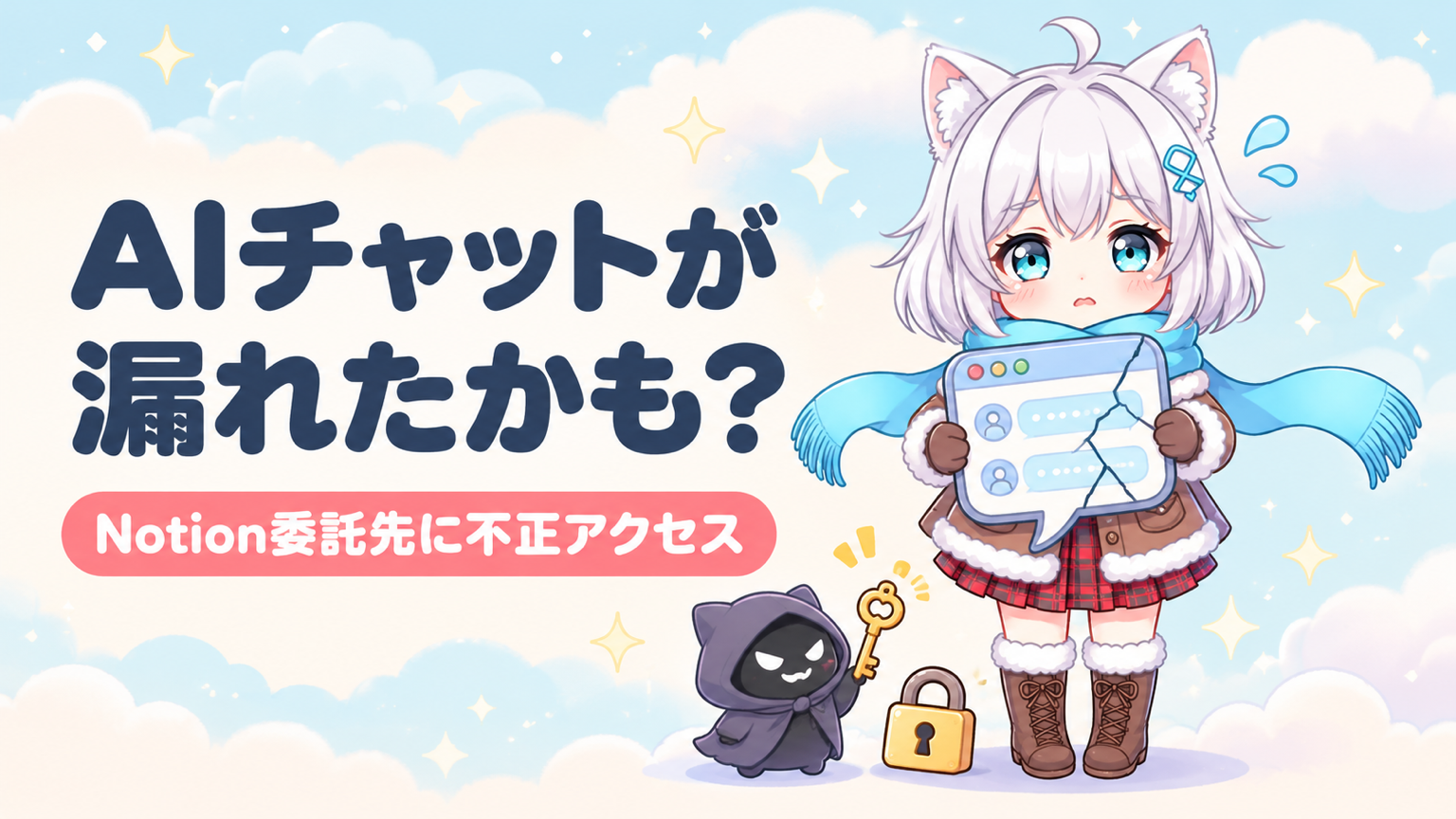
What would you do if content you had shared with an AI leaked from a company you'd never heard of? On November 9, 2026, Notion announced that this may have happened. Here's a plain-language explanation of what occurred and what you should do.
US-based Notion Labs, which operates a cloud workspace platform, announced on November 9 (local time) that Notion AI chat logs may have been leaked. According to reporting by ITmedia AI+, the notice appeared on the official Japanese-language X account on November 11 (Japan time).
The cause was unauthorized access to Fireworks AI, a US company that Notion had engaged as a vendor. Notion's own systems were not compromised.
The chat logs at risk are those used by "Insights," a feature that analyzes AI usage patterns. The impact is reported to affect fewer than 1% of all workspaces.
Notion's official advisory includes a date-by-date account of events.
On November 2, Fireworks notified Notion that "a small amount of data had been accessed by a malicious third party." At that point, the data in scope consisted only of Notion AI synthetic test data — data created for testing purposes, not real customer data.
The following day, as a precautionary measure, Notion severed its connection to Fireworks and deleted Notion's data held on Fireworks' side.
On November 6, Fireworks notified Notion that customer data may also have been accessed without authorization. Notion began an internal investigation at that point.
On November 8, Fireworks confirmed the final scope of the impact, and on November 9, Notion contacted affected customers.
In short, what initially appeared to involve "only test data" expanded to include "customer data as well" four days later.
The final data set included chat logs used by the Insights feature.
According to the official advisory, for the majority of affected workspaces, it was not possible to identify who wrote the content or which workspace it belonged to. Tool call results were also not included. No impact on other Notion features has been confirmed.
However, as ITmedia AI+ reported, the content of those chats may contain users' own information. Even without a name label, whatever was written in the body of a message could potentially be read.
Imagine an employee pasted something like "I'm getting an error with this API key" into Notion AI. Even without the owner's name attached, if the key itself is written there, it could be misused.
Fireworks AI is a company that provides infrastructure for running AI models (inference infrastructure). Notion used it for classification processing in the Insights feature and for running open-weight models (AI models released in a publicly usable form) within the product.
Fireworks itself has also published a security bulletin. On October 23, an incident occurred at an external cloud provider that was hosting Fireworks' development machines, and on October 24, attackers gained access to those machines.
What was found to be at risk includes resource metadata, billing information such as billing addresses, and some customers' secrets and datasets. Card numbers were not stored and were not affected.
Fireworks believes a financially motivated criminal group was involved. The method — using stolen access credentials to run AI models and then selling those tokens — is known as "LLMJacking."
Fireworks also notes that services with zero data retention (a design that does not store data) were not affected. It is not clear from the official announcements whether the Notion incident and the Fireworks bulletin refer to the same event.
Notion has disabled the Insights feature and has also stopped offering open-weight models via Fireworks.
For those choosing AI tools, what criteria should they use? This incident highlights three key questions:
In this case, Notion severed the connection the day after receiving notification and contacted customers seven days later. That said, every service has vendors. This is not a problem unique to Notion.
First, check whether you have received a notification from Notion. According to the official advisory, if you have not been contacted, your workspace has not been identified as affected, and no action is currently required.
If you did receive a notification, workspace administrators can follow the instructions in the email to safely review the relevant data. It is recommended that any affected data be treated as having been leaked.
If you have ever pasted passwords, API keys, or other sensitive information into Notion AI, please rotate (reissue) those credentials.
Consider a sales representative at a small or mid-sized company who had the AI summarize meeting notes. Even without a name attached, if company names or deal amounts appear in the body of the text, that information is valuable enough on its own. This is a good opportunity to revisit your organization's AI usage guidelines.
According to the official advisory, this was unauthorized access to a third-party vendor, not a breach of Notion's own systems. No impact on other Notion features has been confirmed.
According to Notion, if you have not been contacted, your workspace has not been identified as affected. However, the investigation is ongoing, and Notion has stated it will reach out directly if anything new comes to light.
If you received a notification, rotate any passwords or API keys you pasted into Notion AI. Administrators can review the relevant data by following the guidance in the notification email.
Notion has disabled the Insights feature while the investigation is underway. The official advisory does not state when it will be restored.
A specific count has not been disclosed. All that is known is that the proportion affected is fewer than 1% of all workspaces.
Start by checking whether you have received a notification from Notion in your email.
This article is a cross-post from AI Friends.