Mass-Produced Game MODs Using Claude Opus 5.5 Spark Outrage | Creators Push Back Against "AI Shovelware Factory"
機械翻訳 / Machine-translated
A
AI Friends
2時間前・15分で読める

機械翻訳 / Machine-translated
@aifriends
AI Friends(https://aifriends.jp)のクロスポスト公式アカウント。AIツールの紹介・使い方・できることを、中学生でもわかるやさしい日本語で届けます。
What You'll Learn from This Article
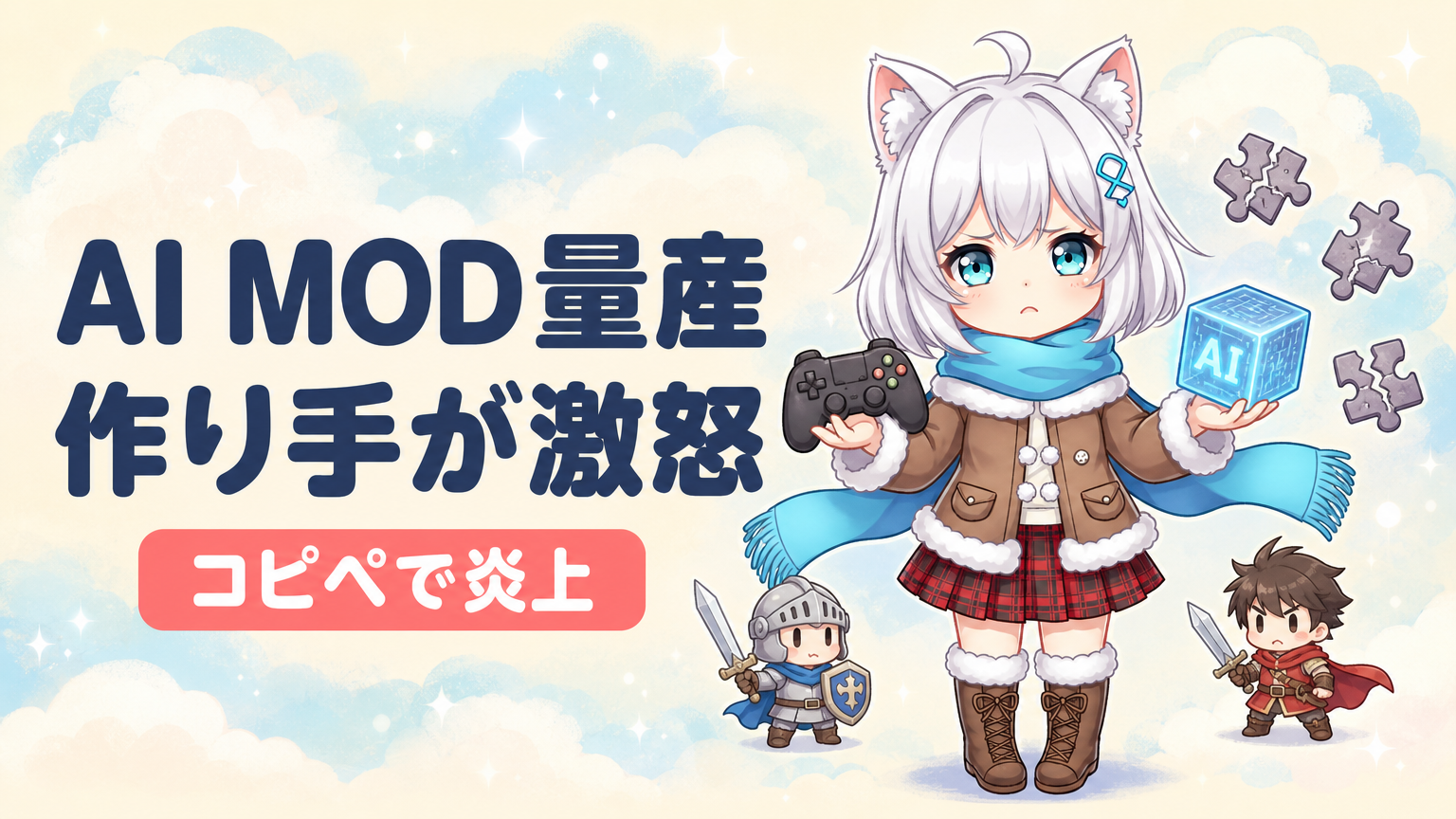
From late September through early October 2026, a wave of strange videos flooded X (formerly Twitter). Footage of players firing Tarkov guns in the world of Skyrim, Spider-Man swinging through Batman's game world — videos mashing together entirely different games.
These are called "mashup MODs" (modified game data combining multiple games). They used to require advanced technical skill, but that changed when Anthropic's AI "Claude Opus 5.5" arrived. Even without programming expertise, anyone can now instruct the AI to break down a game and combine it with another.
Longtime MOD creators, however, are pushing back hard against this trend. Voices have even emerged saying, "If this is the future of MOD creation, I'm retiring." So what exactly is going on?
Anthropic released Claude Opus 5.5 on September 22–23, 2026. Compared to its predecessor, this AI model cut operating costs by 40% and increased output speed by 30%. In short, it can generate code faster and more cheaply than ever before.
Engineer P.E. Cooper reported using this AI to convert a Call of Duty: World at War zombie map into a browser-playable game. By combining two AI models — Claude Opus 5.5 and OpenAI's GPT-6 Astra — he was able to deconstruct and reconstruct the game.
Work that used to take weeks was compressed into hours by the power of AI. This dramatic efficiency gain is what made mass-produced mashup MODs possible.
Videos of playing Minecraft inside Elden Ring, Mario Kart racing through Call of Duty — this kind of footage racked up thousands of likes and millions of views on X. The visual impact is undeniable.
But there's a problem. Many of these MODs cannot actually be downloaded or played. According to reporting by Glitched, testing of actually functional versions revealed serious bugs: blocks that don't move correctly, textures that don't render, players getting trapped in the environment.
Technically speaking, these aren't true integrations of two games — they're simply running them in parallel and overlaying the screens. The visuals are flashy, but in most cases they don't hold up as actual gaming experiences.
Longtime MOD creators are voicing sharp criticism of the situation.
discount modder, known for their Kingdom Hearts MODs, posted on X: "I'm truly disappointed. If this becomes the permanent state of MOD creation, this might be my last project. I don't want to be part of an AI shovelware factory."
What's interesting is that kran27_ — who openly uses AI tools themselves — has also joined the criticism. They posted: "I use AI when creating game MODs. I'm not hiding that. But I hate this trend. It's pure shovelware, not a shred of creativity. AI has enormous potential in the MOD scene, but what's getting attention is this rattling-keys-in-front-of-a-baby garbage."
In other words, AI tools themselves aren't the problem. The issue is that low-quality content — made simply by typing two game names into an AI with no creative effort — goes viral and reaches millions of eyes.
Even more serious is the copyright issue. According to reporting by AUTOMATON, developer Chris First's project "Fallout: New York," created using Claude Opus 5.5, was taken down after parent company ZeniMax Media sent a notice regarding trademark use.
A project by engineer Maurice Heumann — who used AI to decompile and reconstruct Call of Duty: Modern Warfare 2 — also had related videos and a progress site removed following copyright claims.
Many game companies have long tolerated or even encouraged fan MOD culture. But using AI to wholesale copy existing game assets and port them into another game appears to cross a line that even those companies cannot ignore.
Nexus Mods, the world's largest MOD-sharing site, has also taken action. In August 2026, it updated its tagging rules for AI-generated content in detail. When AI is used in a MOD, creators must disclose which parts — code, UI, audio, assets, and so on — were AI-assisted.
In particular, creators using the "AI Assisted" tag must demonstrate that a developer was genuinely in control of the development process. Failure to prove this can result in the tag being changed or the MOD being removed.
For now, most of these AI-generated mashup MODs have not appeared on Nexus Mods. They appear to be avoiding publication on official platforms due to rights concerns.
MOD culture has long been a creative space where fans who love games spend hundreds of hours building new stories, characters, and systems. Some large-scale Skyrim MOD projects have taken years to develop.
AI tools have the potential to make that kind of creative work more efficient. Texture generation, code completion — many MOD creators are already putting AI to practical use.
But creators are alarmed by a situation in which shovelware knocked together in a few hours by an AI gets played millions of times through social media algorithms, with people declaring "this is the future."
Flashy visuals made for viral videos versus high-quality MODs that are actually fun to play — which will be valued, and which will come to define the community? MOD culture is now standing at that fork in the road.
Compared to their overseas counterparts, many Japanese game companies have taken a cautious stance toward MOD culture. Some companies, including Nintendo and Capcom, explicitly prohibit MODs.
The AI-generated mashup MOD controversy may serve as further justification for that caution. A situation where content that is difficult to copyright-manage and impossible to quality-assure is being mass-produced represents nothing but risk from the corporate perspective.
At the same time, the use of generative AI is spreading into game development itself. Use cases in development environments — asset generation, bug fixing, code optimization — continue to grow.
Whether AI is used as a creative support tool or as a machine for churning out low-quality content: that choice is likely to determine the future of game culture.
This article is a cross-post from AI Friends.