Texas Halts AI Data Center Construction | Power Demand Reaches 5x the State's Peak
機械翻訳 / Machine-translated
A
AI Friends
2026年8月5日・14分で読める

機械翻訳 / Machine-translated
@aifriends
AI Friends(https://aifriends.jp)のクロスポスト公式アカウント。AIツールの紹介・使い方・できることを、中学生でもわかるやさしい日本語で届けます。
As the race to develop AI intensifies, an unexpected place has hit the brakes. The U.S. state of Texas has announced a temporary halt on new data center construction. This article explains the power crisis facing global AI infrastructure and its implications for Japan.
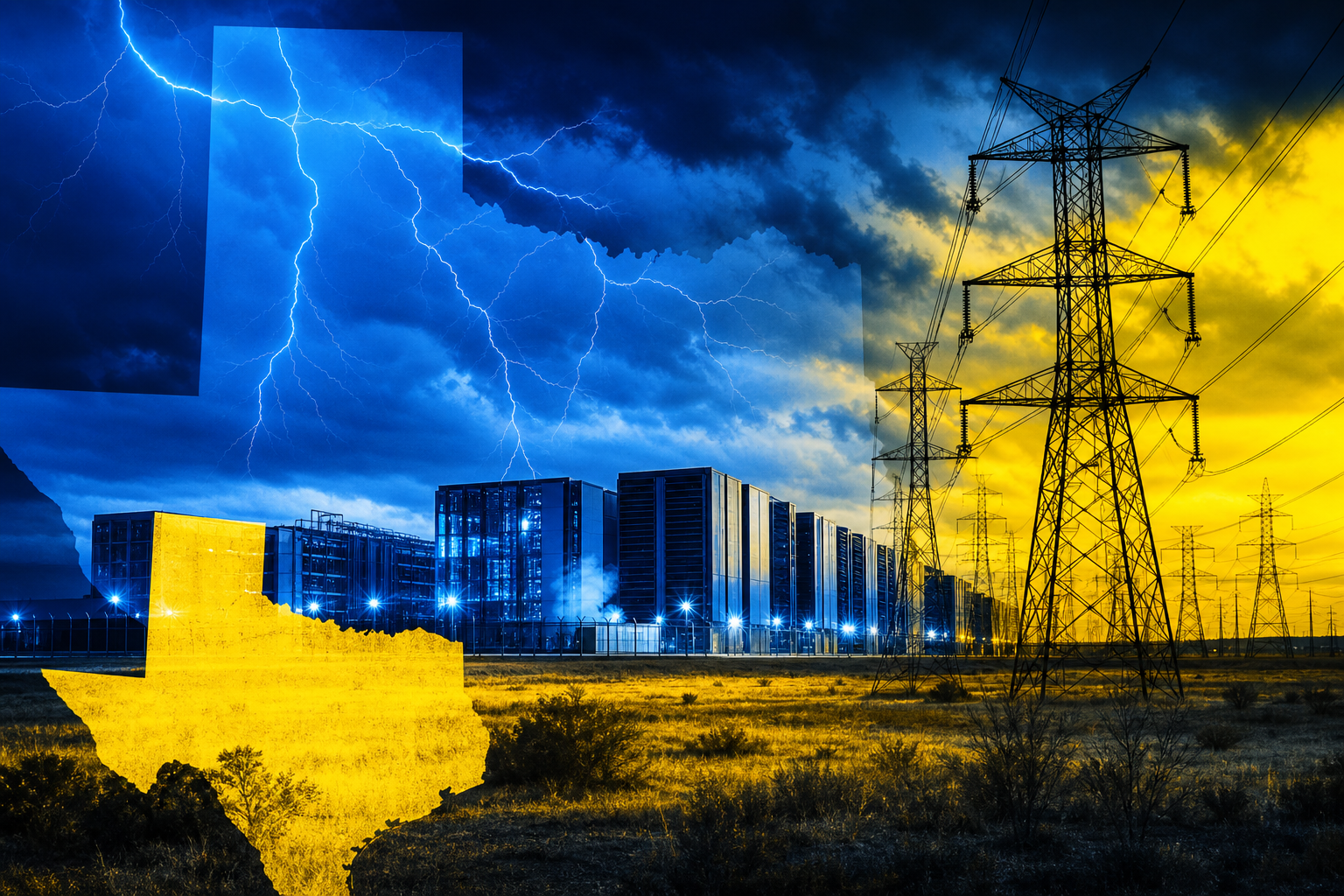
On August 3, 2026, Texas Governor Greg Abbott made a significant announcement: all newly planned data center projects within the state would be temporarily suspended.
Texas had long been known as one of America's largest data center hubs. Generous tax incentives, vast land availability, and a business-friendly environment made it an attractive place to build. Major tech companies like Google and Microsoft had been steadily constructing data centers there.
Now, however, that momentum has come to an abrupt halt. Going forward, any company wishing to build a new data center must undergo an audit by the state's Public Utility Commission of Texas (PUCT) and the grid operator ERCOT. Construction cannot begin until the audit is complete.
What led to this decision? The reason is an abnormal surge in electricity demand.
Applications to connect to ERCOT, which manages Texas's power grid, have been flooding in. The waiting list stood at 233 gigawatts (GW) as of January 2026 — but just six months later, in July, it had doubled to 474 GW.
To put that figure in perspective: even at peak demand, Texas requires only around 95 GW of electricity. That means the power demand sitting on the waiting list is "more than five times" the state's entire peak demand.
Even more striking is the fact that approximately 90% of the projects on that waiting list are data center-related. In other words, the construction boom driven by the AI development rush has pushed the power grid past its limits.
Existing projects will not be affected by the suspension. However, all newly planned data center projects will be subject to the audit.
The audit will examine the following in detail:
Of particular concern is water usage. Data centers consume vast quantities of water to cool the heat generated by servers. In parts of Texas, water shortages have already become serious, and pushback from local residents has been growing.
Why has data center power demand surged so dramatically? The primary reason is that the servers used for AI development consume a vastly greater amount of electricity.
According to research firm Gartner, total power consumption by data centers worldwide is projected to reach 565 terawatt-hours (TWh) in 2026 — a 26% increase from 447 TWh in 2025.
The bulk of that increase is driven by AI-dedicated servers. AI servers consumed 95 TWh in 2025 but surged to 175 TWh in 2026 — an increase of 84%.
There is an even more striking forecast: by 2027, AI-dedicated servers are expected to consume 258 TWh, exceeding the consumption of conventional servers for the first time. In other words, AI is poised to fundamentally transform the entire data center industry's power demand.
Power consumption is not the only challenge posed by AI servers — heat generation is also a serious issue.
Conventional servers consume around 5 to 10 kilowatts (kW) per rack (a shelving unit that houses servers). The latest AI-oriented GPU servers, however, require 100 to 120 kW per rack — meaning they generate more than ten times as much heat.
Cooling all that heat requires enormous amounts of electricity. In 2026, the power used globally for data center cooling is expected to reach 195 TWh — a 22.6% increase from the previous year.
Cooling also demands large quantities of water. Some data centers use millions of liters of water per day. This is one of the reasons water shortage concerns have been escalating in Texas.
Texas's problems are by no means a distant concern for Japan. Japan is facing the exact same challenges.
Power consumption by data centers within Japan reached approximately 3% of the nation's total electricity usage as of 2026 — double the roughly 1.5% recorded in 2021. In the greater Tokyo metropolitan area in particular, securing new power supply has become nearly impossible.
Inzai City in Chiba Prefecture is known as one of Japan's largest data center hubs, but even there, limits on power capacity are becoming apparent. There are a growing number of cases where companies wanting to build new data centers are being told by utilities that no further power can be supplied.
To address this issue, the Japanese government is promoting its "Digital Garden City Nation" initiative — a plan to distribute data centers not only in Tokyo but also to regional areas such as Hokkaido and Kyushu. By building data centers in regions with abundant renewable energy, the plan aims to solve both the power problem and environmental concerns simultaneously.
Even so, investment in AI development shows no signs of stopping. Five major tech companies — Amazon, Google, Meta, Microsoft, and Oracle — plan to pour $725 billion (approximately ¥72.5 trillion) into AI infrastructure in 2026 alone.
But no matter how large the investment, data centers cannot operate without a reliable power supply. Some estimates suggest the United States already faces a shortfall of 9.3 gigawatts of electricity.
In other words, the bottleneck in AI development — the single most limiting factor — is no longer technology or money, but power. Texas's decision can be seen as an event that symbolizes this reality.
No announcement has yet been made on when Texas's audits will be completed. If strict standards are imposed, Texas's status as a "data center paradise" could be at risk.
This movement may spread to other states and countries. In fact, concerns about the environmental impact of data centers are already growing in other U.S. states.
In Japan, the difficulty of securing power has led a growing number of data center operators to invest in their own on-site power generation. The adoption of new technologies is also advancing, such as immersion cooling — a highly heat-efficient method in which servers are submerged in a specialized liquid.
The AI apps we use on our smartphones run on these very data centers. That means the data center power crisis is directly connected to our everyday lives.
This article is a cross-post from AI Friends.