AI・テクノロジー
Who Are the 30% Immune to AI? | Anthropic Study Reveals the Common Traits
機械翻訳 / Machine-translated
A
AI Friends
2026年4月26日・27分で読める

機械翻訳 / Machine-translated
@aifriends
AI Friends(https://aifriends.jp)のクロスポスト公式アカウント。AIツールの紹介・使い方・できることを、中学生でもわかるやさしい日本語で届けます。
Have you ever felt anxious that AI might take your job? On April 20, 2026, a survey by Anthropic (the developer of Claude) reported by ITmedia provided a clear answer to that fear.
About 30% of workers are barely affected by AI, and they share a common thread: physical presence, face-to-face interaction, and on-site capability.
At the same time, hiring among younger workers is slowing sharply. This article breaks down the full scope of the survey and the career strategies Japanese readers should pursue right now—explained in plain language anyone can understand.
Let's start with the basics of the survey.
Anthropic is the developer of Claude, a conversational AI often described as a rival to ChatGPT.
Anthropic published its first report in March 2026, and ITmedia covered it in detail in Japanese on April 20.
The Anthropic Economic Index is a metric that analyzes millions of actual conversations held with Claude to visualize which tasks within which occupations AI is being used for.
Think of it as a POS system for the labor market—one that tallies the best-selling items at a store, but for jobs.
Unlike conventional predictions of "what AI could theoretically replace," the revolutionary aspect is that it shows in numbers what is actually being replaced.
The key term here is "observed exposure."
Exposure refers to how much a worker is being affected by AI—essentially, the degree to which AI is taking over their work.
It's similar to measuring radiation dose in a health checkup: it quantifies real-world impact.
"Theoretically possible" and "actually happening" are two different things—this research is groundbreaking precisely because it bridges that gap.
The analysis covered approximately 800 tasks listed in O*NET, the occupational database maintained by the U.S. Bureau of Labor Statistics (BLS).
It's like comparing all 800 recipes in a cookbook with the dishes actually being served at restaurants.
The results revealed a significant gap between theory and reality.
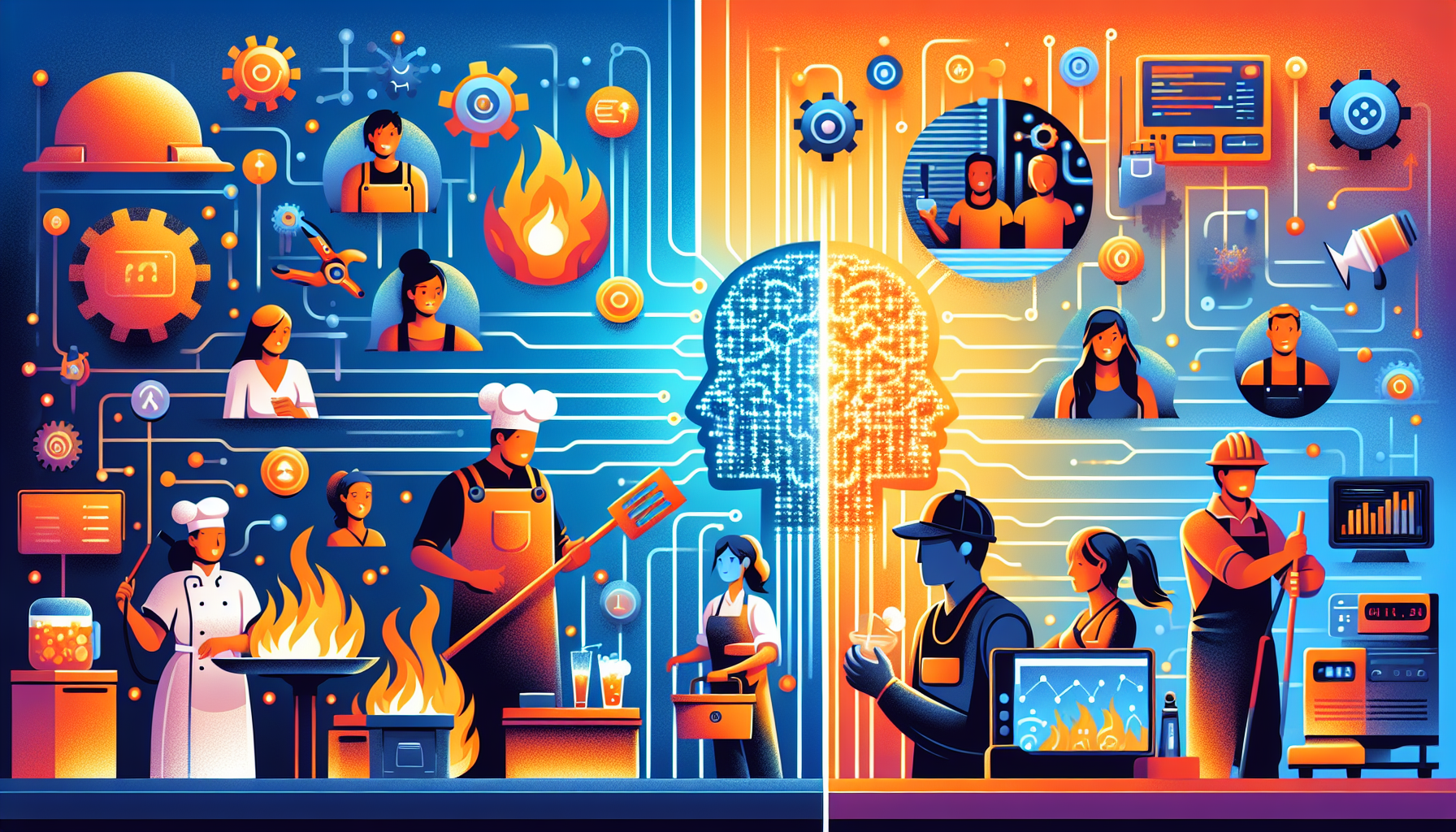
Now for the heart of the matter. Anthropic identified three clear common traits among the "AI-resilient 30%."
The first trait is physical, hands-on work.
Typical examples include cooks, motorcycle mechanics, dishwasher operators, and lifeguards.
AI may be excellent on a screen, but it currently cannot wield a frying pan or disassemble a broken engine.
Just as AI cannot replace a professional baseball player, jobs that involve physical movement are likely to remain safe for the foreseeable future.
The second trait is occupations where face-to-face human connection is the source of value.
This includes bartenders, hairdressers, care workers, hostesses, and courtroom attorneys.
The value of a bartender who listens to your bad day over the counter cannot be replaced by an AI chat service.
"Human warmth and empathy" remains a domain that text-generating AI has yet to replicate.
The third trait is work that requires real-time judgment on-site.
Pool lifeguards, construction workers, firefighters, paramedics, and agricultural workers are prime examples.
AI cannot rescue a drowning child at a pool via a web conference—this obvious reality underpins the resilience of this 30%.
The strength of "on-site work" has been a consistent finding in McKinsey's 2017 predictions and Goldman Sachs' estimates alike.
Conversely, the occupations most affected by AI have also become clear. Notably, higher-education, higher-income jobs tend to face greater exposure.
The top occupations by exposure include:
Three out of four tasks performed by programmers can be handled by AI like Claude—a startling figure. Bank tellers and call center workers also appear on track to be replaced by AI within the next few years.
The reason is simple.
Generative AI excels at digital tasks: writing text, performing calculations, and writing code.
The more a job can be completed in front of a computer, the easier it is for AI to take over—Anthropic's message is clear: "AI is coming for the upper tier of knowledge work first."
Importantly, 57% of all tasks fall under "augmentation" (AI making humans more capable), while 43% fall under "automation" (AI replacing humans entirely).
AI doesn't just take jobs—in many cases, it serves as training wheels that make people smarter.
Rather than programmers being replaced by AI, the emerging reality is that programmers who use AI will be the ones who survive.
There have been countless studies on AI and employment. Let's look at what sets Anthropic's research apart.
Landmark studies from McKinsey (2017), Goldman Sachs (2023), and Oxford University (the 2013 Frey & Osborne paper) all estimated "what is technically replaceable" using expert panels or machine learning models. It's like a commentator predicting that a ramen shop might eventually be replaced by robots—separate from whether that replacement actually happens.
Anthropic, by contrast, analyzed millions of actual conversation logs from Claude.
It's a restaurant's approach of "tallying what customers actually ordered from the order history"—reflecting real-world behavior rather than theoretical speculation.
This is a study only an insider company, able to leverage its own AI usage data, could conduct.
Within Japan, Nomura Research Institute announced in 2015 that "49% of jobs could be replaced by AI," and the Ministry of Economy, Trade and Industry's "DX Report" has produced similar estimates. However, a Japanese-equivalent "observed exposure" metric has yet to be developed, and surveys based on actual usage data like Anthropic's remain scarce domestically.
Let's think through some concrete scenarios. Four working individuals' cases help us understand what is happening in Japan.
Atsushi works at a Tokyo IT startup, where he joined straight out of university as a web developer.
Lately, however, since ChatGPT, Claude, and Cursor appeared, most of his code can be generated by AI.
He feels uneasy, as if "my work is being absorbed by AI."
Anthropic's data shows 75% of programmers' tasks are replaceable.
Atsushi's best options are to become a skilled user of AI tools, or to develop "face-to-face capabilities" in areas like product design and client relations.
Bunta runs a bar in Ginza.
He had worried about AI taking his job, but according to the Anthropic survey, bartenders belong to the 30% group with zero exposure.
Reading a customer's expression, crafting a cocktail to suit their mood, and lending an ear to their troubles—these are things AI simply cannot do.
It's safe to say Bunta's livelihood is secure for at least 5–10 years.
Chihiro makes precision molds in Ota Ward, a job requiring accuracy to the nearest 0.01 millimeters.
While AI can operate machine tools, the seasoned intuition that says "at today's temperature with this material, feed it 0.1 seconds earlier" cannot yet be replicated.
Chihiro's skills combine two pillars of resilience—physical expertise and on-site sensibility—and there is even a chance that Japan's manufacturing sector, paired with AI, could reclaim its global standing.
Daichi handles customer support for an e-commerce company in Osaka.
The Anthropic survey suggests over 60% of his tasks are replaceable, and AI chatbots are already becoming the standard for first-line responses within his company.
To survive, Daichi needs to shift toward handling complaints and VIP customers that AI cannot manage, or become an AI operator (trainer) himself.
Here are five especially striking figures from the survey:
A. A simple checklist can help.
Ask yourself: (1) Is my work entirely done in front of a computer? (2) Does it require physical movement or on-site judgment? (3) Does it involve face-to-face work that engages people's emotions? If you answered yes to (2) or (3), you're likely in the 30%; if your work is primarily (1), you're probably in the 70%.
For a more precise answer, you can search your occupational code in the "AI Exposure Index" published by MindStudio in the United States.
A. It cannot be stated definitively yet, but signs are emerging.
Recruit's 2026 report shows "office job postings down 12% year-on-year," while "caregiving, food service, and construction face severe labor shortages."
This broadly aligns with Anthropic's findings, and Japan appears to be following the same pattern: white-collar jobs shrinking, hands-on jobs remaining.
A. "Finished" is the wrong word—"transformed" is more accurate.
The productivity of those who can effectively use Claude, Cursor, and GitHub Copilot is said to be 3–5 times that of non-users, and the income gap between those who can and cannot use AI is already reaching hundreds of thousands of yen annually.
The realistic framing is not "humans replaced by AI" but "people who can't use AI replaced by those who can."
A. Caution is warranted, but it would be wrong to say "give up."
While hiring for 22–25-year-olds has declined, there is data showing that demand for junior engineers who can use AI is actually growing.
Rather than just "writing code," the safer path is to develop a broad skill set that includes requirements definition, architectural design, and AI utilization.
A. Absolutely—and opportunities are expanding.
Fields like caregiving, construction, food service, and security face a chronic labor shortage, and hiring of middle-aged career changers with no prior experience is on the rise.
There are even cases of programmers transitioning to carpentry or bartending.
If you have physical capability and strong interpersonal skills, a surprising reversal is underway: hands-on jobs are becoming more stable than white-collar ones.
A. It's part of Anthropic's strategy of "responsible AI development."
By making its social impact transparent, the company aims to earn the trust of regulators, governments, and the public.
While OpenAI and Google continue to issue optimistic announcements, Anthropic's "honest approach" has earned recognition from investors as well—and it was reported in March 2026 that Anthropic's revenue had surpassed OpenAI's.
AI is functioning neither as an "enemy" nor a "savior," but as a mechanism that is beginning to polarize the world of work.
Will you join the "AI-resilient 30%," or become part of the "70% who master AI"? The choice is still yours—but only right now.
Anthropic's data is not meant to fuel anxiety. Read it as a map for choosing your next step, and there is no more practical resource available.
The era of deciding your own professional future—by reading the data and making your own call—has arrived.
This article is a cross-post from AI Friends.