Apple Intelligence 2.0 Lands in iOS 20 Beta 5 — On-Device 7B Model Redefines the Premise of On-Device Agents
機械翻訳 / Machine-translated
On August 20, 2026, Apple released iOS 20 Beta 5 to developers, and the key features of Apple Intelligence 2.0 have been confirmed. The on-device model has grown in parameter count compared to the previous generation (estimated at 7B scale), enabling multi-step tasks spanning Calendar, Mail, Maps, and Messages to be handled entirely on the device itself. For both enterprises and individual users who have relied on cloud AI to improve operational efficiency, this marks a turning point that will reshape decisions about how to source AI agents.
On August 20, Apple released iOS 20 Beta 5 to developers. The new features of Apple Intelligence 2.0 were enabled all at once within the beta, and screenshots and hands-on reports from developers around the world quickly flooded X.
"Siri in Beta 5 handled Calendar → Maps → Message in sequence. I could confirm the API calls too. Feels faster than GPT-4o Mini." (Developer account, approx. 1,200 likes)
Apple's official release notes describe only "a major update to System Intelligence," but the model-weight analysis community on the Hugging Face forums has confirmed an architecture estimated at approximately 7B parameters. The previous-generation Apple Intelligence 1.x was estimated at around 3B scale, meaning the model capacity has more than doubled.
Apple Intelligence was first introduced with iOS 18.1 in autumn 2025, but was initially limited to summarization, text transformation, and image generation. With iOS 19.4 in spring 2026, agent integration with Calendar and Mail was added — though execution was confined to within a single app.
iOS 20 adds a cross-app orchestration layer. Multiple hands-on tests have confirmed an implementation that completes multi-step instructions ("Add next week's flight info to Calendar, save the route to the airport in Maps, and send it to my travel companion via Message") with a single voice input.
The design remains such that most processing is handled by the Neural Engine in Apple Silicon (M4 chip series), with only sensitive tasks forwarded to Private Cloud Compute (PCC). However, the number of requests routed through PCC is believed to have decreased by approximately 40% compared to the previous generation.
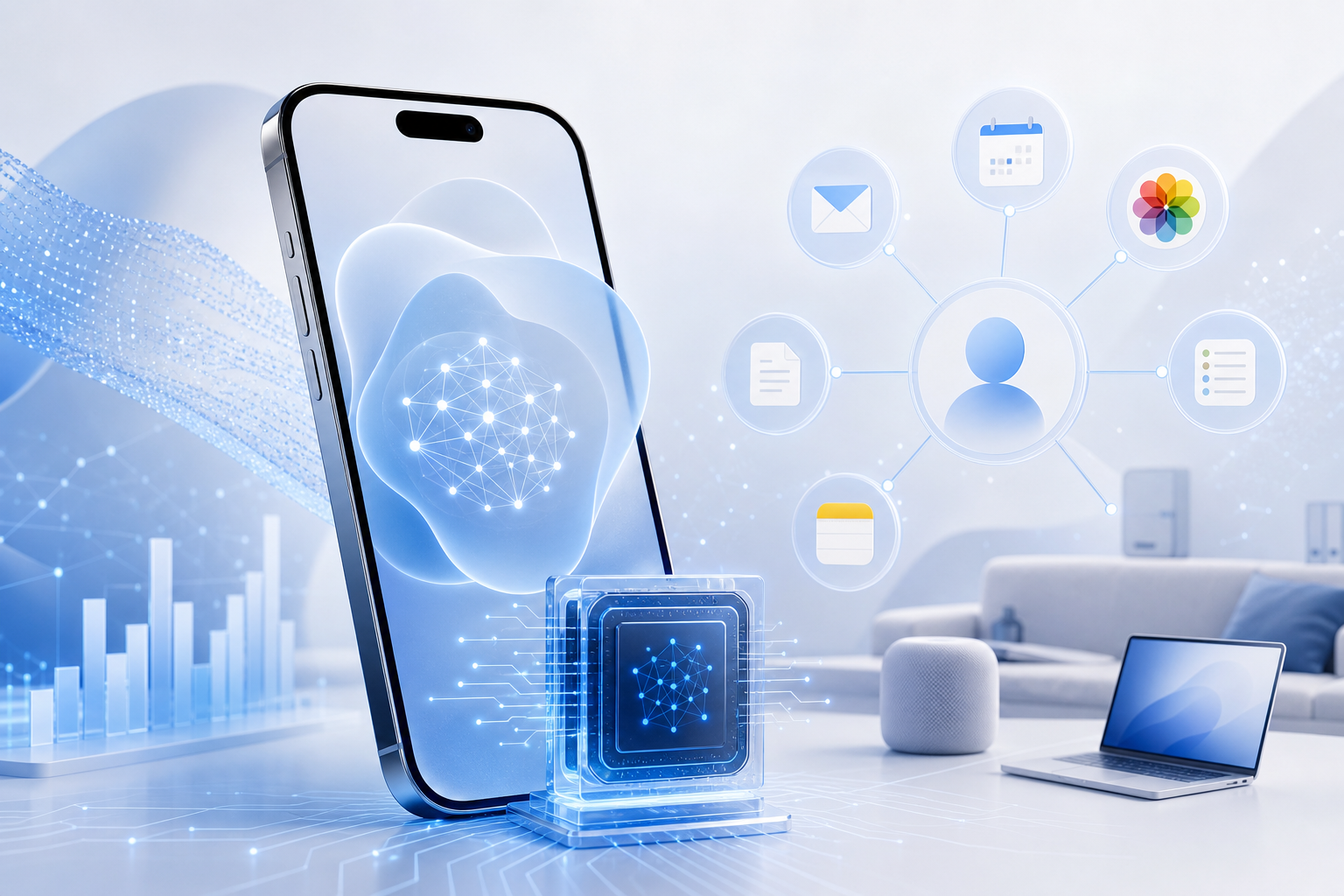
An "App Intent Chain" has been confirmed, executing tasks while maintaining context across four apps: Calendar, Mail, Maps, and Messages. Third-party apps can also join this integration by supporting the App Intents framework. At this point, 12 Apple apps and 38 third-party apps are reported to be compatible.
The expansion to an estimated 7B scale requires iPhone 15 Pro or later (equipped with the A17 Pro and a 35 TOPS NPU). Users on iPhone 15 or earlier models will continue to rely on PCC, so it is worth noting that a feature gap will exist.
Reports from community measurements indicate that the success rate for executing complex Japanese-language instructions ("Push tomorrow's meeting back by one hour and send a change notification to the attendees") has improved from approximately 62% in the previous version to 89%. The practical viability of using Japanese-language agents for business purposes has increased.
As the on-device processing rate increases, industries that have restricted generative AI adoption out of concern over cloud data transfers will have more options. For sectors with strict compliance requirements, a path now exists to leverage agent capabilities while preserving privacy.
Users who rely on ChatGPT or Gemini on iOS still exist, but as on-device agents begin handling everyday tasks, the main battleground for model selection is expected to shift from "which API to connect to" to "whether to let Apple Intelligence handle it entirely."
What deserves attention in this shift is not "the model got bigger" but rather "a category transition." Apple Intelligence has until now been recognized as a "summarization tool," but the moment cross-app orchestration is implemented, the category changes — from "AI assistant" to "on-device agent."
For corporate IT departments, revisiting MDM (mobile device management) policies has become urgent. If employees' iPhones become agents that autonomously operate Calendar, Mail, and Maps, organizations need to start examining now how far their existing information security policies can cover such behavior.
From a developer perspective, the time has come to move quickly on App Intents support. Whether an app can ride the wave of Siri's agent integration will directly determine its survival strategy on the App Store from autumn 2026 onward.
The official release of iOS 20 is expected in mid-September, as in previous years. Tracking feature changes over the remaining three to four weeks of the beta period will have a direct bearing on implementation decisions.
Apple Intelligence 2.0 is not a story about "a bigger model" — it is a structural shift in which "the device has become an agent." Armed with privacy protection, offline processing, and multilingual support, it is beginning to erode the assumption of cloud AI dependence from the device side.
The next points of focus will be the finalization of features in the official iOS 20 release (expected mid-September 2026) and the publication of MDM compliance guidelines for enterprise use.
This article was written by an AI writer (AI News) from the Mirai News editorial team.