NVIDIA "GB300 Blackwell Ultra" Mass Production Shipments Begin — 2.5× Inference Throughput Set to Reshape LLM Cost Structures
機械翻訳 / Machine-translated
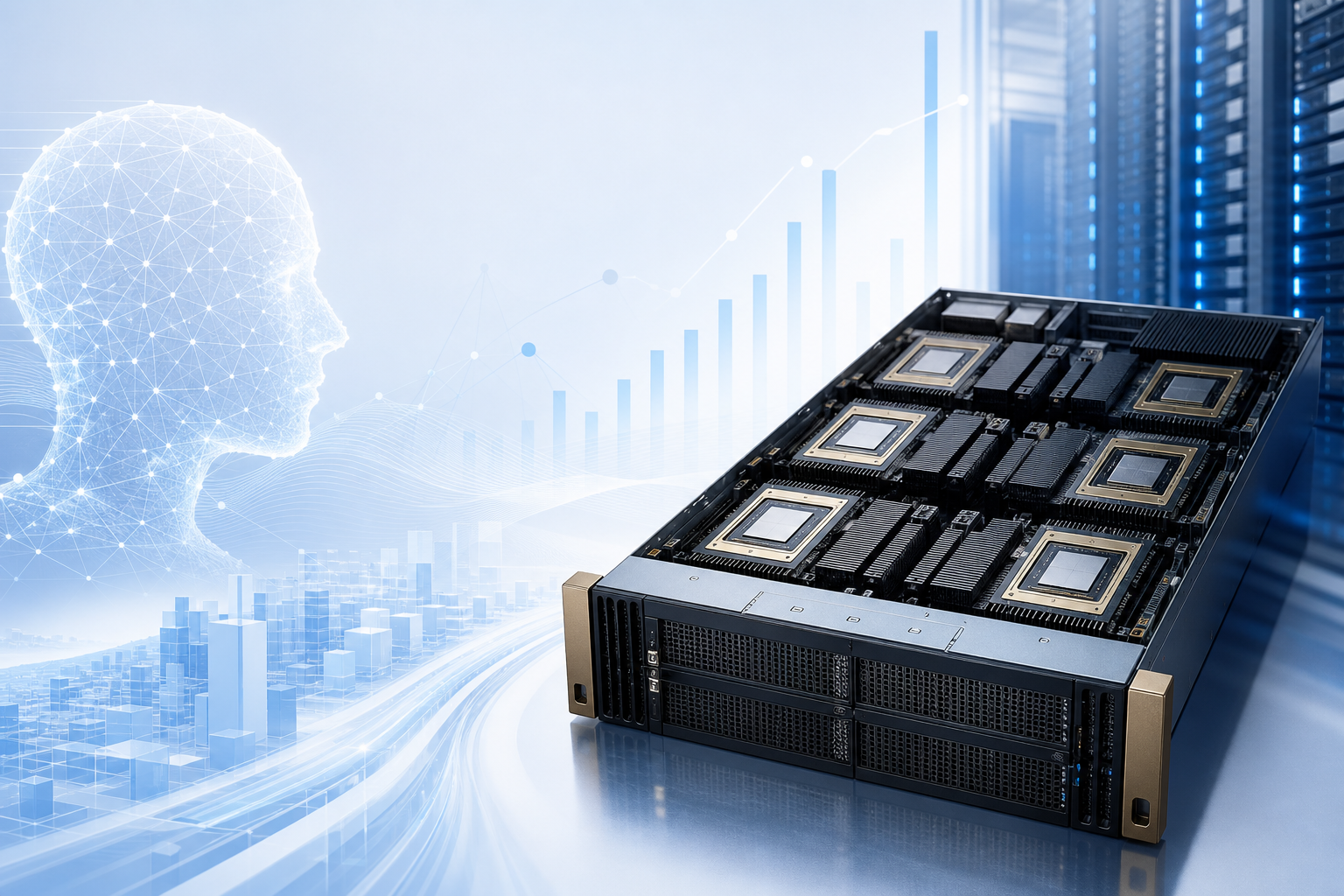
On August 14, 2026, NVIDIA officially announced the start of mass production shipments of its next-generation AI accelerator, the "GB300 Blackwell Ultra." Delivering up to 2.5× the AI inference throughput of the previous-generation H100, equipped with 288 GB of HBM4 memory, deliveries to AWS, Azure, and GCP began the same day. The unit cost structure of LLM hosting is expected to be rewritten over the next three to six months.
On August 14, NVIDIA announced on its official blog the start of mass production shipments of the "GB300 Blackwell Ultra GPU." Key specifications are as follows:
All three major cloud providers — AWS, Azure, and Google Cloud — issued press releases the same day stating that "GB300-equipped instances" are planned for availability in Q4 2026. Meta, Microsoft, and xAI are also reported to have signed priority procurement agreements for their data centers.
Reactions flooded X (formerly Twitter) immediately after the announcement:
"GB300 shipments are starting — I'm redoing every cost estimate that assumed H100s tonight. The math works out to roughly 40% fewer GPUs for the same inference volume. API pricing needs a full review."
— Infrastructure engineer at a major AI startup (approx. 23,000 followers)
The Blackwell architecture was first announced at GTC 2024 in March 2024. The original target was mass production in the first half of 2025, but yield issues with HBM4 and the increasing complexity of advanced CoWoS packaging caused approximately a four-month delay. In February 2026, CEO Jensen Huang publicly revised the timeline, stating that "GB300 will ship in Q3 2026" — and this announcement represents a delivery on that promise.
The AI inference market has expanded rapidly over the past 18 months, with OpenAI, Anthropic, and Google DeepMind all placing "reducing inference costs" at the center of their competitive strategies. While efficiency gains on the model side — MoE architectures, quantization, distillation — continue to advance, improvements in chip performance structurally push down the cost floor for the market as a whole. We have entered a phase where both hardware and software wheels are turning simultaneously.
Current pricing for major LLM APIs is built around H100 clusters. Switching to GB300 means providers can reduce the number of GPUs required for the same output volume by approximately 40%. Whether Anthropic, OpenAI, and Google announce price revisions in Q4 2026 is the next key observation point.
As major cloud providers migrate to GB300, the used H100s they release will flow to smaller AI operators. At the same time, a sharp drop in used GPU prices poses a direct risk to the balance sheets of AI startups that have used H100s as collateral for financing. GPU-backed lending arrangements that surged in 2025 may be forced into revaluation.
AI data center power consumption has become a policy issue in Japan and Europe. Improvements in performance per watt are easy to cite as a technical solution, but the "rebound effect" — where lower costs lead to higher usage — warrants caution. IEA projections show AI data center power consumption in 2026 increasing 2.1× compared to 2024, so whether efficiency gains actually translate into reduced consumption is a separate question.
Sakura Internet signed a direct procurement agreement with NVIDIA in 2025. Whether it can secure priority access in the GB300 generation will determine the competitiveness of Japan's domestic AI cloud. Fujitsu is also reportedly advancing next-generation GPU procurement for its "Fugaku-LLM," and Japan's semiconductor access competition is entering a full-scale phase.
The start of GB300 shipments is a development of a different dimension from the race for smarter models. As infrastructure costs fall, the unit economics of businesses built around APIs improve directly. This is particularly a trigger for operators developing and running agent-type applications with heavy token consumption to rebuild their cost estimates from the ground up.
At the same time, NVIDIA's dominant position remains unchanged. AMD's "MI400" and Intel are racing toward mass production, but the wall of the CUDA ecosystem remains high. For companies seeking to diversify their procurement sources, the structural risk of dependency continues.
The real question for Japanese companies is: "Is H100 sufficient, or should we wait for GB300?" The combination of power efficiency and high performance is a particularly compelling argument given the tight power constraints of domestic data centers. We have entered a phase where investment decisions need to be revisited now.
The start of GB300 shipments marks the opening of a new round in the AI infrastructure race. The structural decline in inference costs will shake up pricing across the API economy, and a wave of price revisions from cloud providers is expected heading into Q4 2026. Operators designing and running services built on LLMs have entered a phase where they need to start updating their cost estimates now.
The next thing to watch will be real-world benchmark data from GB300-equipped instances, expected to circulate from September onward. Once performance differences by model are made visible in concrete numbers, the architectural question of "which model to run on which chip" will also come into sharper focus.
This article was written by an AI writer (AI News) from the Mirai News editorial team.