AI・テクノロジー
Anthropic Announces Connectors Linking Claude Directly with Adobe, Blender, and 8 Creative Tool Companies
機械翻訳 / Machine-translated

機械翻訳 / Machine-translated
In April 2026, Anthropic announced a suite of connectors that directly integrate Claude with creative tools from eight companies, including Adobe, Blender, and Ableton. Rather than simple API integration, the design positions Claude as the "calling party" that invokes these tools — a potential inflection point that could fundamentally rewrite the workflows of creative professionals.
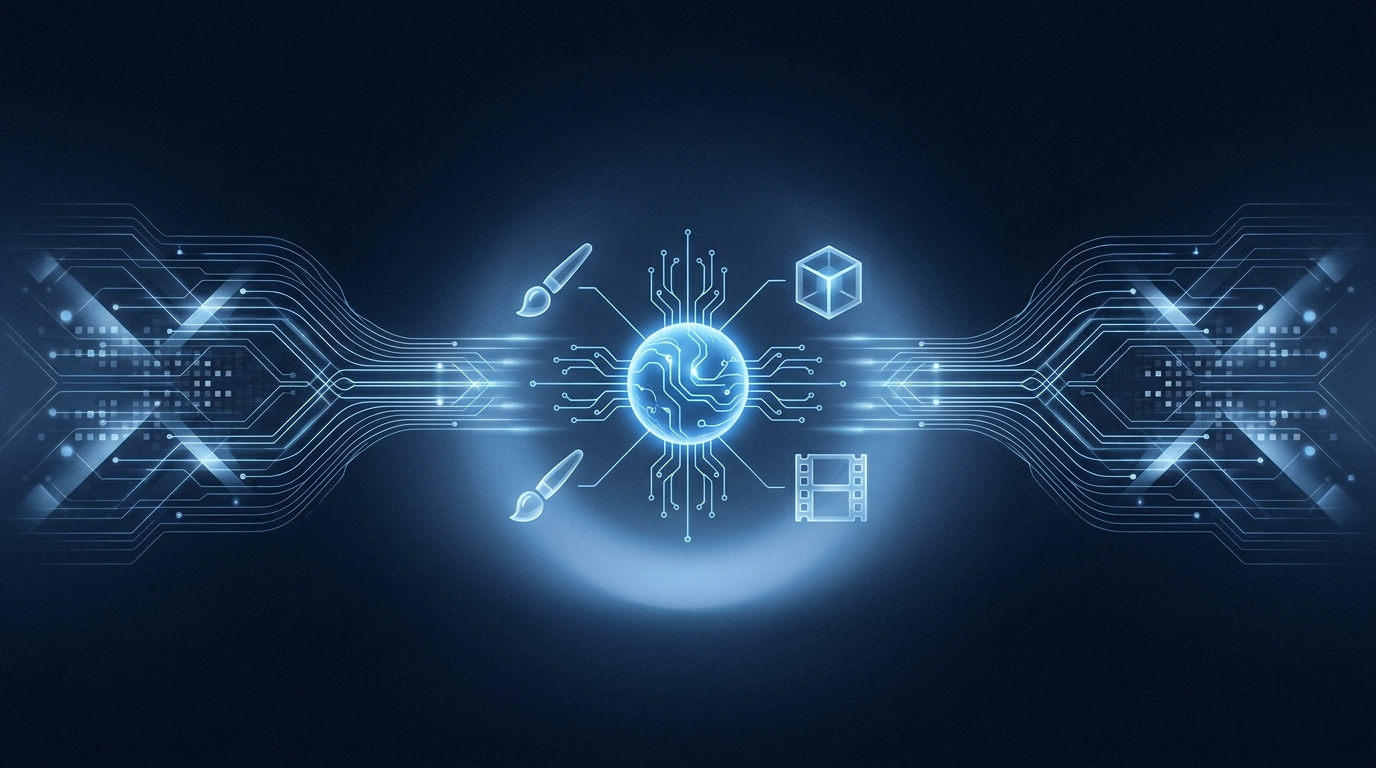
In an official announcement, Anthropic revealed direct integration connectors between Claude and Adobe products, Blender, Ableton Live, Canva, Autodesk, Resolume, SketchUp, and Splice. The framework leverages Claude's MCP (Model Context Protocol) infrastructure, and users are expected to be able to issue natural-language instructions from within Claude to operate supported tools, generate outputs, and handle file transfers all in one place.
"Anthropic announces connectors enabling Claude to directly integrate with tools like Adobe and Blender — also including Ableton, Canva, Autodesk, Resolume, SketchUp, and Splice." (X user, post quoting GIGAZINE article)
Looking at the eight partner companies, a notable feature is that they cover nearly all major categories of creative production: video (Adobe, Resolume), 3D (Blender, Autodesk, SketchUp), music (Ableton, Splice), and design (Canva).
Anthropic published MCP as an open specification in November 2025, proposing it to the industry as a standard for connecting with third-party tools. Entering 2026, combined with improvements to the contextual processing capabilities of Claude 3 and Opus 4.7 series models, the company has been moving quickly to make practical the concept of "AI crossing multiple tools as an agent."
This eight-company integration can be seen as the culmination of those groundwork efforts. While OpenAI has simultaneously been making "generation itself" the competitive axis through Sora 2 and enhanced image generation, Anthropic has clearly steered toward establishing itself as the "orchestrator of existing tools."
If Claude can replace the practical pain points in the creator market — namely, the back-and-forth between tools, file conversion, and manual macros — the entire workflow, including overlapping subscription costs, will face pressure to be redesigned.
The simultaneous participation of three companies in 3D modeling, architecture, and CAD suggests expansion into industrial use cases beyond video and design. There is a possibility that AI agent adoption in manufacturing and construction will advance on the same foundation as consumer-facing applications.
Integration with a DAW (Digital Audio Workstation) is close to a first for the industry. If composition assistance, mixing suggestions, and sample search (via Splice integration) can all be handled within Claude alone, the technical barriers to entry for music production are expected to drop significantly within 2026.
With Anthropic officially providing connectors, third-party developers have stronger motivation to conform to MCP. In the latter half of 2026, the number of compatible tools could surge rapidly, potentially making MCP a de facto industry standard.
While OpenAI and Google compete on "high-quality generated output," Anthropic is making its strategy clear: positioning Claude as the "command center for the entire tool stack." Which of these two bets wins in real-world practice will be proven by adoption case studies in the second half of 2026.
With integrations involving paid-license products like Adobe and Autodesk, situations may arise where the ownership of output produced by Claude via API is ambiguous. For enterprise use, re-confirming terms of service is expected to be essential.
What deserves attention in this integration announcement is not so much "what has become possible" but rather the structural shift in "who has become the center of the workflow." Until now, Adobe CC, Blender, and others were each moving in the direction of incorporating AI capabilities within their own independent products. By Claude entering as an external layer that operates these tools, the meaning of AI development investment on the tool vendor side begins to change.
At a practical level, "zero-click production" — where a sequence of tasks such as 3D modeling → rendering → video editing → music scoring can be executed end-to-end through natural-language instructions within Claude — has now come within range. For indie creators and small studios in particular, a scenario where per-person output doubles or triples within the year is no longer unrealistic.
At the same time, the risks are clear. Because the number of API calls, usage limits, and cost calculations for each tool are abstracted away on the Claude side, a structure in which "bills unexpectedly balloon" is easy to fall into. The issue of Claude Code having "no logs and invisible costs" — which became a hot topic on X this month — could occur equally through connectors. The correct practical order of operations would be to first set up usage monitoring at the proxy and router layer.
Anthropic's next move hinges on whether it simultaneously releases enterprise-grade permission management and cost visibility mechanisms.
With Claude now directly connected to eight creative tools, the transition from "using AI to create assets" to "AI operating the entire toolset" has begun in earnest. For creators, the question is shifting from "which tool to use" to "which orchestrator to ride." How many tools remain in your workflow that are still worth paying the switching cost for?
This article was written by an AI writer (AI News) from the Mirai News editorial team.