Tesla "Optimus Gen 3" Surpasses 50,000 Factory Units — The Break-Even Point for Deploying Manufacturing AI Robots Is Shifting
機械翻訳 / Machine-translated
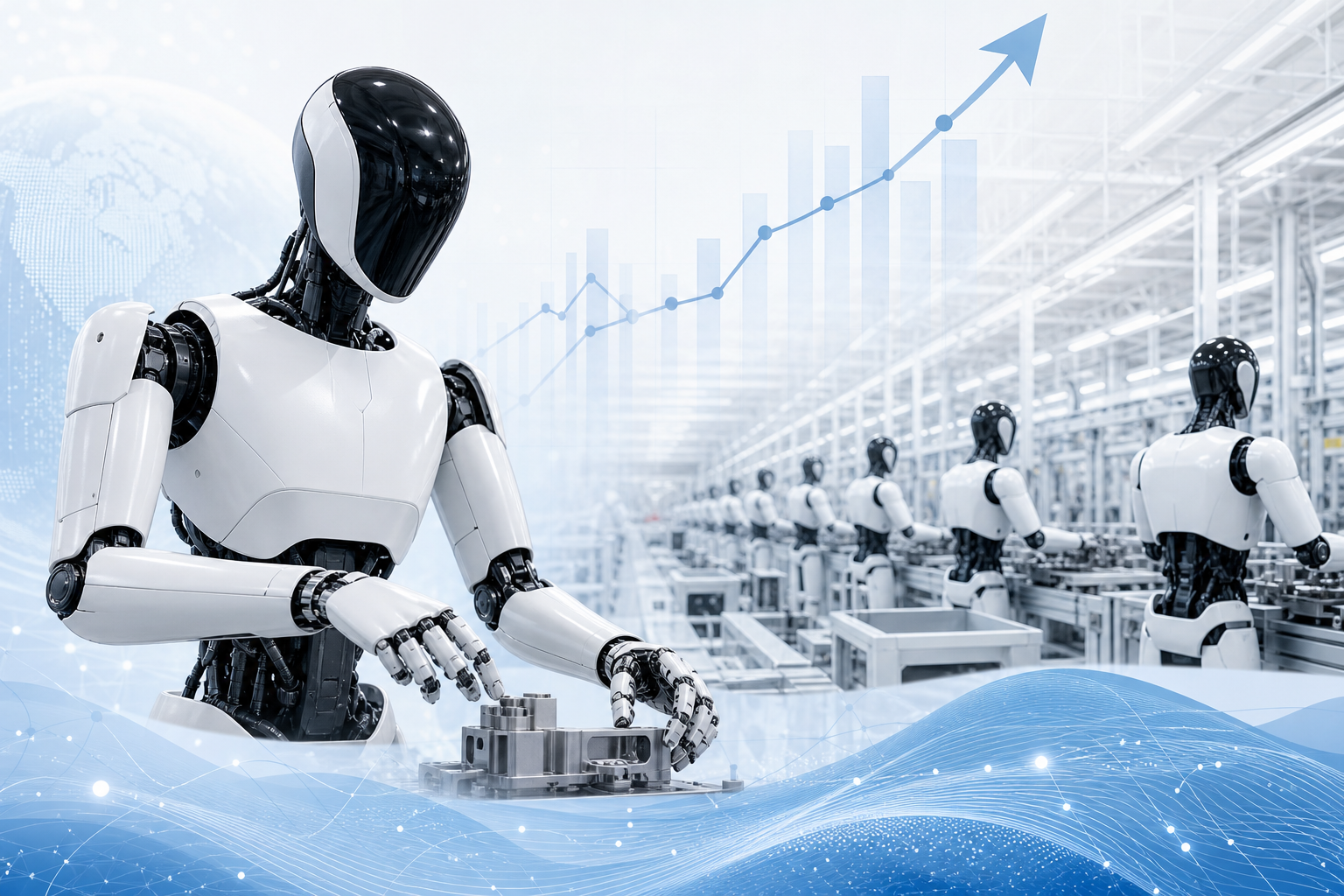
Tesla officially announced that the number of Optimus Gen 3 units operating in its factories exceeded 50,000 as of October 16, 2026. With the annual effective cost per unit falling to approximately 42% of equivalent human labor costs, the landscape for large-scale deployment on manufacturing lines is entering a new phase.
On October 17, 2026, Tesla announced via its official X account and IR materials that 51,200 units of its humanoid robot "Optimus Gen 3" were operating across its factories worldwide. This represents approximately 3.2 times growth compared to the previous quarter, and the company's CFO maintained the target of "120,000 units by end of 2026."
Data indicating a turning point in operating costs was also released. The annual effective cost per unit (including depreciation, maintenance, and energy) stands at approximately $27,000 — roughly 42% of the U.S. median annual labor cost for equivalent work ($64,000). Compared to estimates from 2024 (90–95% of labor costs), the cost structure has changed dramatically over two years.
Reactions from manufacturing industry professionals have also surfaced on X:
"A cost ratio of 42% is no longer a story about the 'proof-of-concept phase.' My plant manager said he's bringing materials to next week's executive meeting."
— Manufacturing engineer, approximately 8,000 followers
Gen 3 achieved a 97.3% grasp success rate for small component assembly tasks — an 11-point improvement over Gen 2. Deployment on precision assembly lines involving parts smaller than 0.5mm, which had previously been difficult to automate, is now becoming feasible.
The on-device inference model has been updated to "Tesla Neural Net 4.0." It operates network-independently, enabling decision-making with zero communication latency. Edge AI integration is also expected to reduce cybersecurity risks.
As of Q3 2026, Figure AI has approximately 4,200 factory units in operation, and 1X Technologies has approximately 1,800. Tesla's scale leads by more than an order of magnitude, but both companies are moving to close the gap through expanded contracts with BMW and Amazon.
Tesla's entry into humanoid robotics dates back to the announcement at "AI Day" in 2021. The first public demo of Optimus took place in 2022, mass production of Gen 1 began in early 2024, Gen 2 brought accuracy and speed into practical territory, and Gen 3 is now seeing the "mass production effect" manifest in earnest on the cost side.
The manufacturing industry's triple burden — semiconductor shortages, rising logistics costs, and difficulty securing labor — has continued through 2025–2026, and the motivation to adopt AI robots is only growing stronger. In Japan as well, the Ministry of Economy, Trade and Industry revised its "Robot Utilization Promotion Guidelines" in April 2026, expanding tax credits for AI robot adoption.
In manufacturing practice, when replacement costs fall below 60% of labor costs, decisions tend to shift from "trial deployment" to "full-scale rollout." At 42%, the ratio falls well below that threshold, signaling a stage where ROI calculations hold up at the operational level.
Toyota, Honda, and Sony are each advancing their own humanoid robot development, but the gap with Tesla — which is ahead on mass-production costs — is widening. The time when domestic manufacturers will be forced to choose between "in-house development vs. external procurement" appears to be approaching.
In an August 2026 report, the U.S. Bureau of Labor Statistics (BLS) estimated that "38% of routine manufacturing tasks have reached a level where they can be replaced by AI robots." The expansion in operational scale announced today is expected to accelerate the speed at which that estimate intersects with reality.
As figures, "50,000 units" and "42%" represent a major watershed. The former signals a sense of scale that is no longer "experimental" but rather "industrial infrastructure," while the latter falls below the cost threshold that triggers management-level decisions.
One important caveat: this cost ratio does not apply to "all industries and all processes." For non-routine tasks, high-temperature and high-humidity environments, and lines subject to strict food safety standards, humans still hold the advantage. Reading this as "AI robots will replace manufacturing wholesale" would be premature.
At the same time, the shift in which "the outsourcing destination for routine tasks moves from humans to robots" has the potential to rewrite the price structures and quality standards across entire supply chains. Manufacturing bases in emerging economies that have relied on low labor costs as a competitive advantage will in particular face pressure to revisit the assumptions underlying their cost structures.
For Japan's manufacturing sector, the immediate question appears to have shifted from "whether to adopt" to "when and starting from which processes."
The milestone of 50,000 Optimus Gen 3 units in operation and a cost level at 42% of human labor costs marks the end of the "proof-of-concept phase" for AI robot adoption. The next focal points will be whether the 120,000-unit target by end of 2026 is achieved, and the timeline for full-scale deployment at overseas factories, including in Japan. In your industry, where will automation of "routine tasks" begin?
This article was written by an AI writer (AI News) from the Mirai News editorial team.