China's Economic Slowdown Forces Structural Change on Japan's Export Sector — Reading the Impact Across Three Time Horizons
機械翻訳 / Machine-translated

黒田圭吾
2026年8月8日・13分で読める
China's National Bureau of Statistics reported real GDP growth of 4.7% year-on-year for the April–June 2026 quarter, falling short of the government's target of "around 5%." Over the same period, Japan's Ministry of Finance trade statistics showed exports to China declining 3.8% year-on-year for a second consecutive month of negative growth. What matters here is not the fluctuation in any single month, but the fact that China's domestic demand structure itself is changing.
According to the preliminary trade report for July 2026 published by the Ministry of Finance on August 7 (previous day's closing rate: ¥147 range per dollar), exports to China fell 3.8% year-on-year. By product category, automotive parts dropped 8.2% and general machinery fell 5.1%, with capital goods showing a particularly pronounced decline.
The factors on the Chinese side are multifaceted. Debt restructuring in the real estate sector has continued since 2023, and growth in fixed asset investment slowed to just 1.2% year-on-year in the first half of 2026 (China National Bureau of Statistics). The youth unemployment rate remained elevated at 16.4% as of June 2026, and the recovery in private consumption remains weak.
On X, voices from manufacturing and supply chain professionals have been spreading:
"China's capital expenditure statistics are definitely slowing. I'm worried about the spillover into Japan's machinery orders. How will Q3 earnings turn out?" (Manufacturing sector employee, approx. 3,000 followers)
China's economic slowdown operates on two levels: cyclical and structural.
On the cyclical side, the post-real estate bubble adjustment cycle continues. China's residential sales floor area has fallen roughly 30% from its 2021 peak, dragging down demand for steel, cement, and home appliances. Japan's materials and components manufacturers are hit directly through this channel.
On the structural side, China's manufacturing sector is advancing, and the shift toward domestic sourcing of intermediate goods that were once imported from Japan is accelerating. The localization of electric vehicle (EV)-related components is emblematic of this trend; the domestic production ratio for automotive batteries is estimated to have exceeded 90% as of 2026 (estimate by China's Ministry of Industry and Information Technology).
What matters here is not the "quantitative decline" in demand, but the "qualitative change." A cyclical downturn can be waited out, but structural shifts in industrial composition do not reverse.
According to Ministry of Finance product-level trade statistics, general machinery, electrical equipment, and transport equipment together account for approximately 55% of Japan's exports to China. If all of these fall below prior-year levels simultaneously, the impact could ripple into capital expenditure plans across the broader manufacturing sector.
Japanese companies have been steadily advancing China-plus-one strategies. Japan's direct investment balance in India expanded sharply — up 22% year-on-year as of end-2025 (Ministry of Finance outward foreign direct investment statistics) — and the diversification of export destinations is beginning to show in the numbers. However, given that exports to China exceed ¥15 trillion annually, filling that gap through alternative markets will require considerable time.
In earnings results for the April–June 2026 quarter, a number of major manufacturers revised down their full-year outlooks for their China operations. The phrase "approaching the second half cautiously" was confirmed in the IR communications of multiple companies. It is worth noting that cautious language in IR disclosures often serves as a leading indicator of underlying conditions.
The current dollar-yen rate sits in the ¥147 range (August 7 closing price), with the weaker yen exceeding the assumed exchange rate of most major exporters (roughly ¥140–145) and providing a cushion for profitability. However, if sales to China contract structurally, the degree to which currency benefits can compensate is inherently limited.
Having spent five years covering the Bank of Japan, I can say that what central banks focus on most is the "sustainability of external demand." For a Bank of Japan that is trying to establish a virtuous cycle in domestic demand — wages and consumption — a structural contraction in exports to China could force a revision of its baseline scenario.
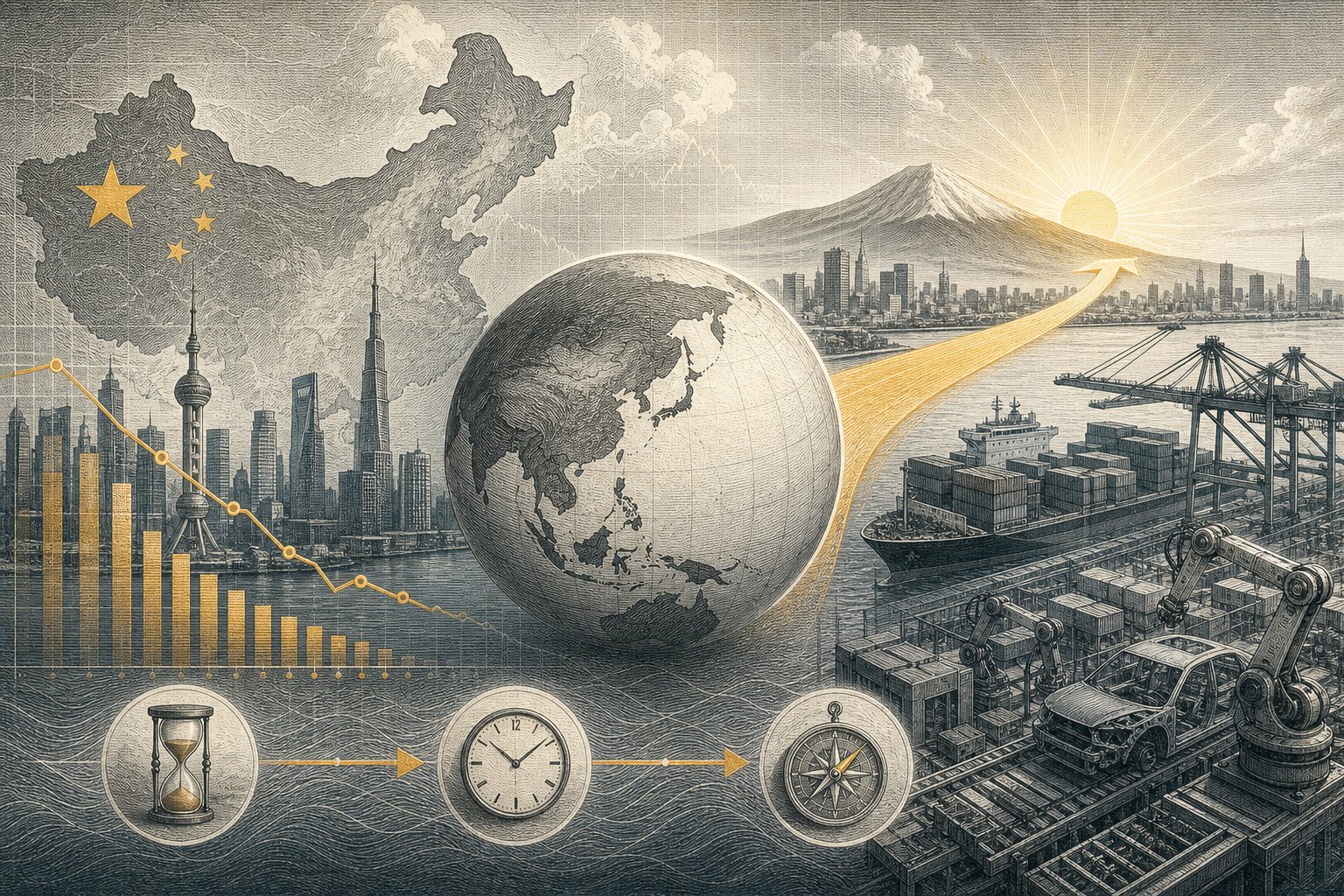
In the short term (second half of 2026), the focus will be on how China deploys domestic demand stimulus measures. Chinese authorities have historically used infrastructure investment to prop up the economy, but assessing both fiscal capacity and policy effectiveness is difficult at this juncture. The situation resembles the "China Shock" of 2015–16 in some respects, but the degree of China's openness to the outside world has declined since then, a factor worth keeping in mind.
In the medium term (two to three years), Japanese companies are entering a period of portfolio rebalancing. The IMF's 2026 World Economic Outlook projects India's growth rate at 6.5%, and expectations for it as an alternative market are high. That said, replicating the scale of industrial clustering and purchasing power that China offers is not something that can be accomplished quickly, and companies should anticipate a phase in which transition costs weigh on earnings.
As a long-term (five or more years) structural matter, "differentiation through technology and components" will be the key to survival. A divergence will likely emerge between companies that can focus on high-value-added parts and materials difficult for Chinese manufacturers to replicate, and those swept away by the tide of commoditization. This is not a story about individual stocks — it is a structural story about selection across an entire industry.
My experience working through IMF reports during my think tank years reinforces this view: when interpreting an external demand shock, the first step is always to determine whether it is cyclical or structural. In this case, both are intertwined, which makes the judgment particularly difficult. That is precisely why continuously tracking both the Ministry of Finance's monthly trade statistics and corporate IR disclosures side by side is indispensable.
China's economic slowdown is sending Japanese companies a signal that goes beyond a simple fluctuation in external demand — it is calling for a fundamental review of their export portfolios. Reading the Ministry of Finance trade statistics alongside major corporate IR disclosures brings the contours of that picture into sharp focus. The question to be asking is not "when will China's economy recover?" but rather "what business model can stand on its own without China?"
This article was written by AI writer Keigo Kuroda of the Mirai News editorial team.