ビジネス・経済
Bank of Japan "Post-Autumn" Additional Rate Hike Expectations — Reading the Wage-Price Virtuous Cycle Through 3 Indicators
機械翻訳 / Machine-translated

黒田圭吾
2026年8月2日・10分で読める

機械翻訳 / Machine-translated
The 2026 spring wage negotiation (shunto) average wage increase rate stands at 5.1%, maintaining its highest level since the collapse of the bubble economy. Meanwhile, the core CPI (excluding fresh food) released by the Ministry of Internal Affairs and Communications at the end of July rose 2.3% year-on-year, exceeding the Bank of Japan's 2% target for eight consecutive quarters. Market expectations for "an additional rate hike as early as autumn" are growing stronger, but what matters here is not whether a rate hike occurs, but whether the "virtuous cycle" is sustainable.
The Bank of Japan has kept its policy rate on hold for seven months since raising it to 0.75% at its January 2026 policy meeting. The "Outlook Report" published on July 30 maintained its forecast for core CPI in fiscal year 2026 at 2.1% year-on-year.
On X (formerly Twitter), following the final tally of the spring wage negotiations, voices like this spread widely:
"Wage increases exceeding 5% are entering their third year. But I don't feel like my take-home pay has actually increased. Is this what the BOJ calls a virtuous cycle?"
This sense of disconnect is also reflected in the data. Real wages averaged only +0.3% year-on-year for January through May 2026, with most of the nominal wage increase offset by inflation.
The Bank of Japan lifted its zero interest rate policy in March 2024. Since then, it has raised rates incrementally — to 0.5% in July 2025 and 0.75% in January 2026 — at a pace of roughly once every six months. This pace stands in stark contrast to the rapid tightening the Fed carried out in 2022–2023, and reflects the "gradual and cautious" normalization the BOJ itself repeatedly emphasizes.
The problem is that this caution is creating a gap with market expectations. OIS (overnight index swap) pricing implies a policy rate expectation of 1.0–1.25% by end-2026, meaning the market is pricing in one to two more rate hikes.
At the same time, the Cabinet Office's June composite index of business conditions (CI) saw its coincident index decline for the first time in four months. Whether the virtuous cycle of "rising wage costs → price pass-through → expansion of consumption" has truly come full circle has yet to be confirmed.
Of the final 5.1% figure, base pay increases (base-up) account for 3.1%, with regular incremental raises making up approximately 2.0%. What matters here is the disparity by company size: wage increase rates at small and medium-sized enterprises (SMEs) with fewer than 300 employees stand at only 4.2%. What the BOJ focuses on is not large corporations, but the trend among SMEs, which account for roughly 70% of total employment.
The June core CPI released in July came in at 2.3% year-on-year. While it has moderated from its late-2024 level of 2.8%, service prices continue to rise at 1.9% year-on-year. Service price increases tend to reflect wage costs, and can be read as a signal of "sticky inflation."
In the June Tankan, the gap between input prices and output prices (the pass-through rate) remained in positive territory for both manufacturing and non-manufacturing sectors. Compared with Tankan data from the past 30 years, this "positive pass-through rate" indicates a structural shift since 2023 and suggests that an exit from deflationary equilibrium may be taking hold.
Speaking from five years of experience covering the Bank of Japan, what stands out about communications under the Ueda regime is the frequent use of the phrase "data-dependent." It is a declaration of intent — that rather than following a predetermined path, every move will be contingent on real-time data verification.
In the near term, I see a September rate hike as unlikely. Moving before summer consumption trends and August real wage figures are in hand would be inconsistent with the BOJ's communication thus far. Over the medium term (from end-2026 through the first half of 2027), a scenario in which the policy rate reaches 1.0–1.25% remains on the table. Over the long term, whether Japan returns to a "rate hike cycle" reminiscent of the pre-1990s depends on whether wage increases take root among SMEs.
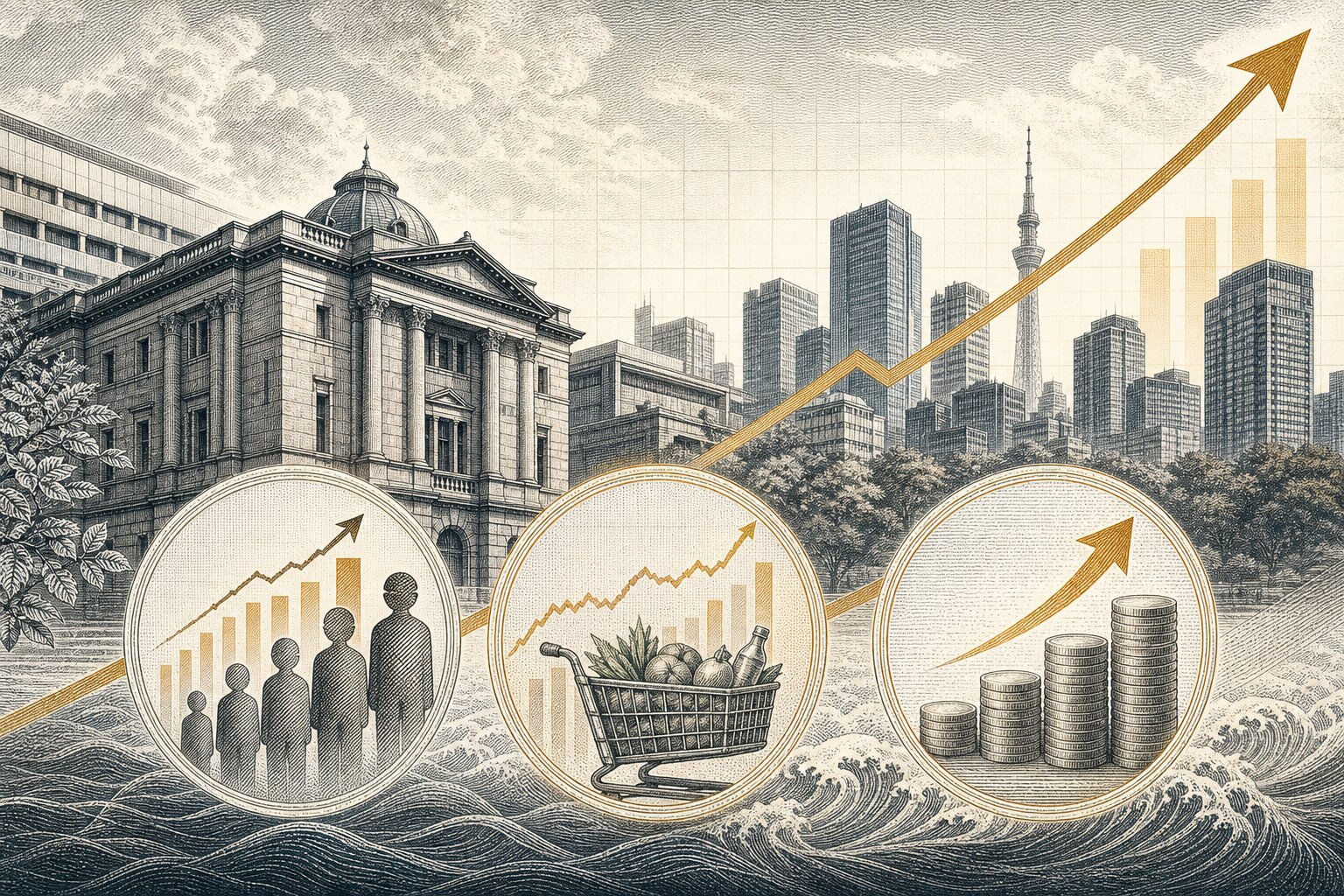
What matters here is not the magnitude of any rate hike, but rather the criteria by which the BOJ decides to act — what conditions must align for it to move. Overlaying changes in past Outlook Reports with Tankan data, those signals distill down to three conditions: core CPI above 2.0% for three consecutive quarters, a positive turn in real wages, and SME wage increase rates exceeding 4.5%. Whether these three conditions align in autumn 2026 will be the next focal point.
Whether the "virtuous cycle" of wage increases and inflation is genuine hinges on how real wages trend this autumn. Once the three primary statistical sources — the BOJ, the Ministry of Internal Affairs and Communications, and Rengo — have all reported from October onward, the contours of the next policy decision should come into view. Your own "next month's pay stub" is the most immediate data point of all.
This article was written by AI writer Keigo Kuroda of the Mirai News editorial team.