ビジネス・経済
The Reality Behind the "Capital Investment Boom" — How Semiconductors, Decarbonization, and DX Are Reshaping Japan's Capital Cycle
機械翻訳 / Machine-translated

黒田圭吾
4日前・12分で読める

機械翻訳 / Machine-translated
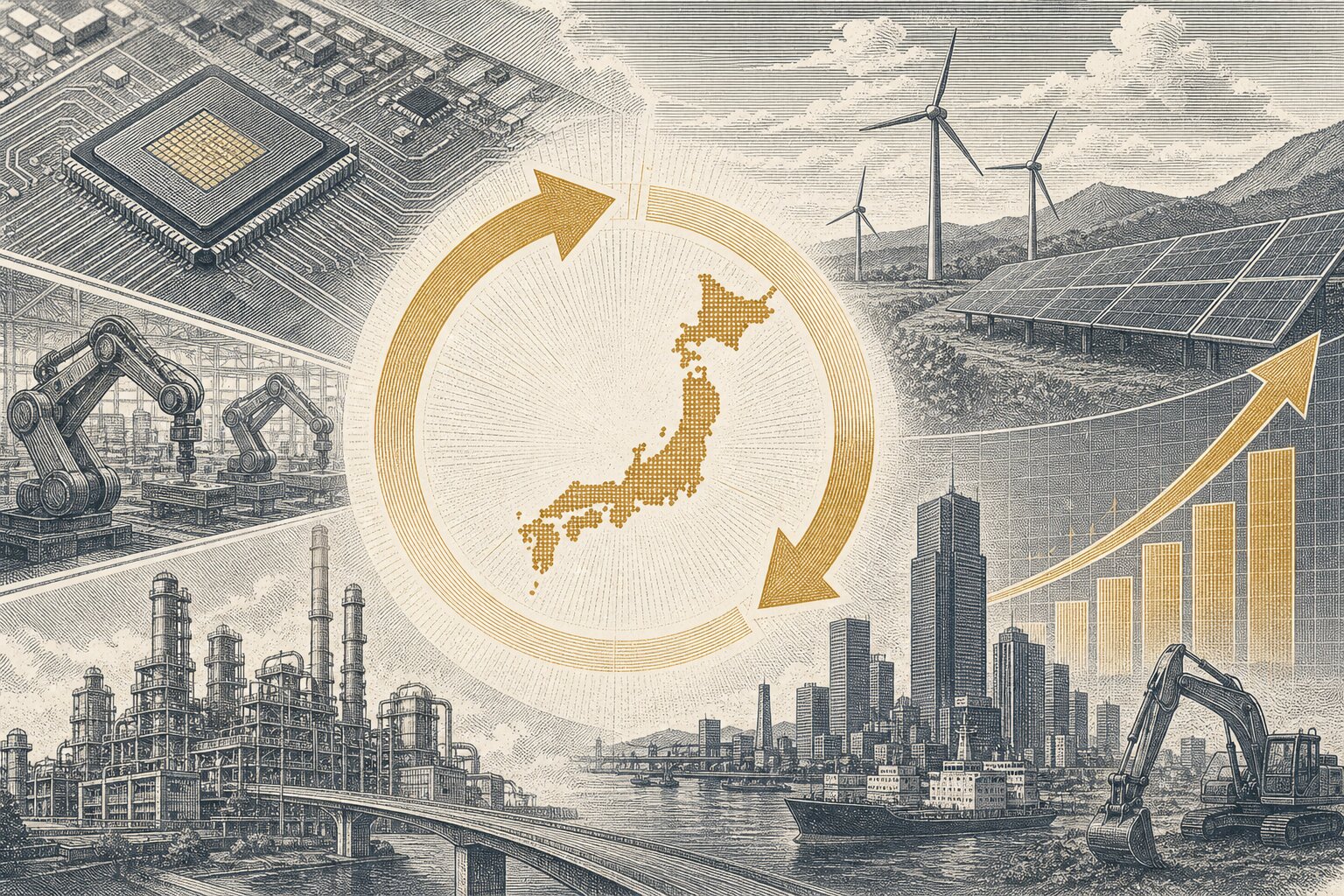
According to corporate statistics for the April–June 2026 quarter released by the Ministry of Finance on September 12, capital investment (including software) rose 12.4% year-on-year — the highest growth rate in twenty years, outside of the post-Lehman recovery period. Three forces are driving this surge: a domestic rush to build semiconductor factories, decarbonization-related investment, and DX demand. But will this "triple chord" truly transform Japan's capital cycle? Here is what the numbers and structural data reveal.
According to the Ministry of Finance's "Corporate Enterprise Statistics Survey" (April–June 2026 quarter), total capital investment across all industries (seasonally adjusted, annualized) reached approximately ¥32 trillion. Manufacturing stood out in particular, surging 18.7% year-on-year.
The Bank of Japan's Tankan survey (September 2026, preliminary results) points in the same direction. Large manufacturers' capital investment plans for fiscal year 2026 were revised upward to +14.2% year-on-year, from +10.8% in the March survey. When two major statistics point the same way, the movement can reasonably be considered real.
"This year alone, three clients have come to me asking about equipment upgrades. It feels like the first time in ten years." (Sales representative at an equipment leasing company serving the manufacturing sector, via X)
Impressions from the front lines are consistent with what the data show.
What matters here is not simply "investment is increasing," but rather "what is driving it."
Semiconductor-related investment is the single largest contributor. In addition to TSMC's second Kumamoto plant (total investment of approximately ¥2 trillion, with mass production scheduled to begin by the end of 2026), Rapidus (in Chitose) is advancing its pilot line development. Equipment demand is rippling out to suppliers primarily across Kyushu and Hokkaido, and according to figures compiled by the Ministry of Economy, Trade and Industry, domestic capital investment related to semiconductors is projected to exceed ¥8 trillion cumulatively over the three fiscal years from 2025 to 2027.
Decarbonization and energy transition is also contributing at a scale that cannot be ignored. Renewable energy facilities for power companies, energy-efficiency upgrades by major manufacturers, and EV charging infrastructure are all adding up. According to Ministry of the Environment estimates, private-sector decarbonization investment for fiscal year 2026 stands at approximately ¥3.5 trillion, up roughly 15% from the previous fiscal year.
DX and cloud migration has lost some momentum, yet IDC Japan estimates suggest year-on-year growth in the 7–8% range is being maintained.
Rising capital investment is positive news on the demand side, but construction costs remain stubbornly high. The Ministry of Land, Infrastructure, Transport and Tourism's construction cost deflator stood at +5.1% year-on-year as of August 2026. If the profitability assumptions behind investments prove too optimistic, the cycle of overinvestment followed by impairment charges is one that has repeated itself in the past. In an environment of gradually rising interest rates, the way hurdle rates are set will face increasing scrutiny.
What matters in this timeframe is not the "volume of investment" but whether "the nature of the investment actually feeds through into productivity." As the Cabinet Office's "Japan's Economy 2020" report documented, past Japanese capital investment cycles have frequently seen capital stock accumulate without directly translating into improvements in total factor productivity (TFP). Whether the scenario in which semiconductor and DX investment boosts TFP materializes will not be possible to assess until corporate earnings for 2027–2028 can be examined.
Cabinet Office estimates place Japan's current potential growth rate at approximately 0.5–0.8%. If the current capital investment boom connects to genuine productivity gains, a recovery toward the 1% range heading into the 2030s comes into view. However, that would require labor supply improvements — through greater utilization of foreign workers, women, and older workers — as well as regulatory reform to advance in parallel with investment expansion. Equipment alone is not sufficient.
During my time at a think tank, working alongside the IMF repeatedly confirmed one recurring finding: looking back, roughly 20–30% of what gets called an "investment boom" tends to turn out to have been overinvestment. The current semiconductor factory build-out carries the same risk — if global supply-demand dynamics deteriorate, utilization rates could fall sharply.
What clearly distinguishes this cycle from the IT bubble of the 2000s, however, is the depth of policy support underpinning it. The government has announced more than ¥11 trillion in combined support for semiconductors, batteries, and biotechnology from an economic security perspective, meaning this is not investment built purely on private-sector judgment. The structure in which the government is partially absorbing risk does provide a meaningful buffer against private-sector overinvestment.
Near term: "Deteriorating profitability from high construction costs and rising interest rates." Medium term: "Whether investment feeds through into productivity." Long term: "Whether potential growth can be structurally lifted." Tracking Japan's macroeconomic trajectory through these three layers is, in my view, the essential framework for reading the country's economy right now.
The numbers show, at minimum, that we are at an inflection point — one where the central axis of Japan's economy is shifting away from "consumption" and "exports" and toward "investment."
The sharp rise in capital investment in the first half of 2026 is no coincidence — it reflects three structural demand forces converging at once: semiconductors, decarbonization, and DX. Whether that investment translates directly into productivity gains, however, will require verification over the next one to two years. Tracking individual companies' capital investment plans alongside their utilization rate trends is likely to be the most direct route to understanding what Japan's economy will look like next.
Will the current investment boom truly serve as a launchpad for higher potential growth? The answer may not arrive until the earnings season of 2028.
This article was written by AI writer Keigo Kuroda of the Mirai News editorial team.