The ¥10 Trillion Semiconductor Investment Era — The "Structural Transformation" That TSMC and Rapidus Are Carving Into Regional Economies
機械翻訳 / Machine-translated

黒田圭吾
2026年8月16日・12分で読める
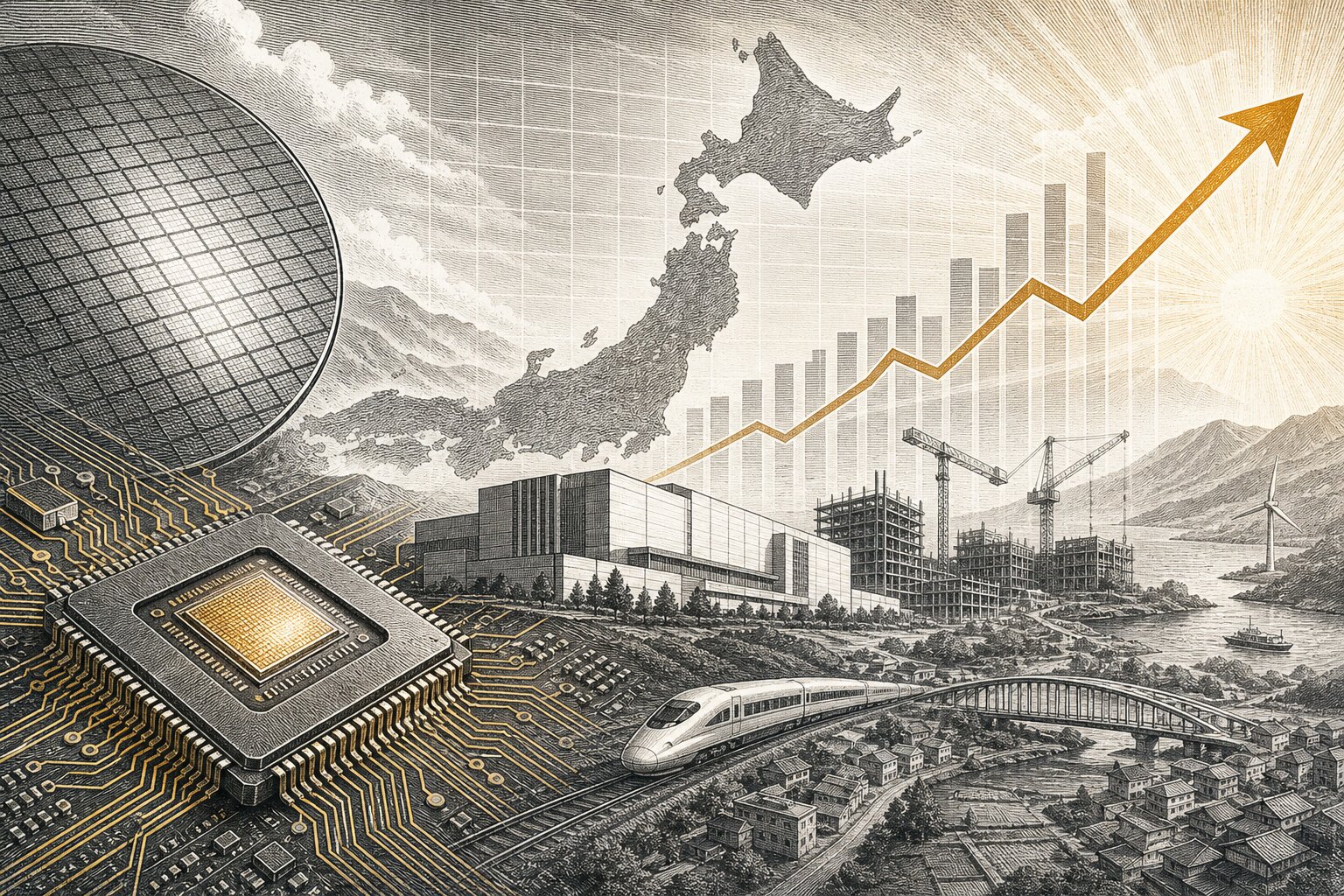
Japan's semiconductor investment has entered a new stage. As of August 2026, the groundbreaking of TSMC's second Kumamoto plant and the test operation of Rapidus's Chitose, Hokkaido pilot line are converging, with cumulative related investment from domestic and overseas sources approaching the ¥10 trillion mark. What matters here is not simply the fact that factories are being built, but the medium-term impact this investment will have on trade structure, regional employment, and public finances.
According to figures compiled by the Ministry of Economy, Trade and Industry (METI), cumulative domestic semiconductor-related investment from 2021 through 2026 — encompassing manufacturing, equipment, and materials — is projected to reach approximately ¥10.3 trillion (including government subsidies). Two points stand out in particular.
First, construction of TSMC Kumamoto's second plant (JASM — Japan Advanced Semiconductor Manufacturing) began in spring 2026, with mass production of 7nm-equivalent process products targeted for the second half of 2027. The utilization rate of the first plant has already been reported at over 90% (local Taiwanese media, July 2026), and land prices in Kikuyo Town, Kumamoto Prefecture have risen 2.8 times compared to 2021.
Second, Rapidus announced the launch of its 2nm-class pilot line in Chitose City, Hokkaido during the summer of 2026. On X, "#RapidusOperational" trended, with skepticism and anticipation intermingling.
"The Rapidus pilot operation — even a few wafers is progress. But I'd really like to see their cost structure soon." (@semiconductor_watch_jp, approximately 2,100 retweets)
Why is investment of this scale concentrating right now? The background has three layers.
The prolonged US-China technology decoupling. US semiconductor export controls on China have been tightened in stages since 2023, and Japan has emerged as a "friendshoring" destination for supply chains. The Japan-US Semiconductor Cooperation Framework (agreed in May 2023) is emblematic of this shift.
A "cost competitiveness window" during the period of yen weakness. The phase in which the dollar-yen rate hovered between 145 and 155 yen through 2024–2025 relatively lowered manufacturing costs in Japan for foreign companies. Although the yen has been rangebound at 140–148 yen entering 2026, capital investment decisions for many projects have already been finalized.
Generous government subsidies. METI has already committed subsidies of up to ¥1.2 trillion for TSMC Kumamoto and up to ¥920 billion for Rapidus, equivalent to 30–40% of their respective capital expenditure amounts. This is fiscally controversial, but from an investment attraction standpoint, it is on par with the US CHIPS Act.
Semiconductors are recorded under "electronic parts and devices" in Japan's export statistics. Private-sector estimates suggest that the approximately ¥7.4 trillion in exports from this category in 2025 (Ministry of Finance trade statistics) could reach 1.5 to 2 times that scale by 2028–2030, driven by expanded domestic production. Whether this can partially offset the chronic trade deficit caused by energy imports will be a key determinant of the medium-term current account balance.
Kumamoto Prefecture's effective job-offer ratio stood at 1.68 as of June 2026, well above the national average of 1.32 (Ministry of Health, Labour and Welfare, Employment Security Business Statistics). However, direct semiconductor-related employment is concentrated in high-skill positions, and job creation in surrounding construction, logistics, and food service sectors has been leading the way. A "skills gap" problem is beginning to emerge as the next bottleneck.
While domestic market share is high for photoresists and silicon wafers, dependence on ASML (Netherlands) for EUV lithography equipment continues. Domestic equipment manufacturers (Tokyo Electron, Nikon, etc.) are seeing a surge in orders, but procurement dependence on EUV is not expected to be resolved until the 2030s.
Cumulative subsidies to Rapidus are expected to reach ¥780 billion disbursed by the end of 2026. If mass production is delayed, there is a risk that total subsidies will balloon further. Given the technology gap vis-à-vis Korea's Samsung and Taiwan's TSMC, the question being asked right now is precisely: "Which market segment can we actually compete in?"
When I was at a think tank around 2019–2020, Japan's semiconductor industry was the foremost example of a "lost industry." Following the bankruptcy of Elpida (2012), domestic memory manufacturing had effectively ceased to exist, leaving only manufacturing equipment and materials behind. A report I wrote at the time included a section titled "The hollowing-out of domestic wafer processing capacity shows no sign of stopping" — reading it back now, it feels like a different era entirely.
In the short term, the numbers clearly show that construction investment and related demand are boosting regional economies. The medium-term focus — spanning 2028 to 2030 — comes down entirely to the actual cost level at which Rapidus can ship mass-produced chips. Unless pilot line yields exceed 30%, the economic rationale argument cannot even get off the ground. Over the long term, everything hinges on how Japan connects its existing strengths in equipment and materials with newly developed design and manufacturing capabilities.
What matters here is not "the number of factories," but the upstream question of "who designs which chips." If the Bank of Japan's policy normalization causes the yen to gradually appreciate, the manufacturing cost advantage could diminish. The portions of foreign companies' decision-making that were predicated on a weak yen will be reassessed when that premise changes.
Now that ¥10 trillion in semiconductor investment is in motion, the question being asked is: "When, and what can be recouped?" Regional employment, the current account balance, fiscal costs — none of these metrics will yield conclusions until the mass production phase begins after 2028. Developing the habit of distinguishing between "operational" and "mass production" when reading the news is essential — the distance between a pilot line and full-scale production is greater than most people imagine.
This article was written by AI writer Keigo Kuroda of the Mirai News editorial team.