Are You Spending Too Much Time on Image Editing? How AI Is Changing Creative Work
機械翻訳 / Machine-translated
Lately, I've been creating images more frequently.
Writing blog posts, sharing on social media, putting together presentations — what used to be as simple as "prepare one image" now involves removing backgrounds, eliminating unwanted elements, adjusting sizes, and quite a few other steps.
Each individual task is small.
But when you're doing it across many images, it ends up taking far more time than you'd expect.
One thing I personally find a little wasteful is that the time spent on minor editing tasks often ends up exceeding the time spent actually thinking about the image itself.
"I just want to remove this background."
"I want to get rid of what's showing up behind the subject."
"I want to take out this logo."
For tasks like these, you open your image editing software, make a selection, clean up the fine details, and so on.
Of course, for designs that require precise adjustments, these are important steps.
Still, I sometimes wonder whether it's really necessary to repeat the same process for every single image.
What I find interesting about recent AI-powered image editing tools is that instead of learning how to operate them, you can think about the end result in plain words.
For example, if there's something unwanted in an image, simply thinking:
"I want to remove this part"
is enough to lead you to the edit you need.
The same applies when you want to remove a background.
Before, I had to think about "which tool should I use?" — but with AI, the focus shifts to "what do I want to keep, and what do I want to change?"
That difference might seem small, but in practice, I think it's quite significant.
Background removal, in particular, can be a real hassle.
Portrait photos have intricate hair and clothing details, and product photos often require clean, precise outlines.
For a single image, doing it by hand isn't a problem.
But when you're preparing multiple images for blog posts or social media content, you end up repeating the same process over and over again.
These days, there are more and more services that let you hand off this kind of work to AI.
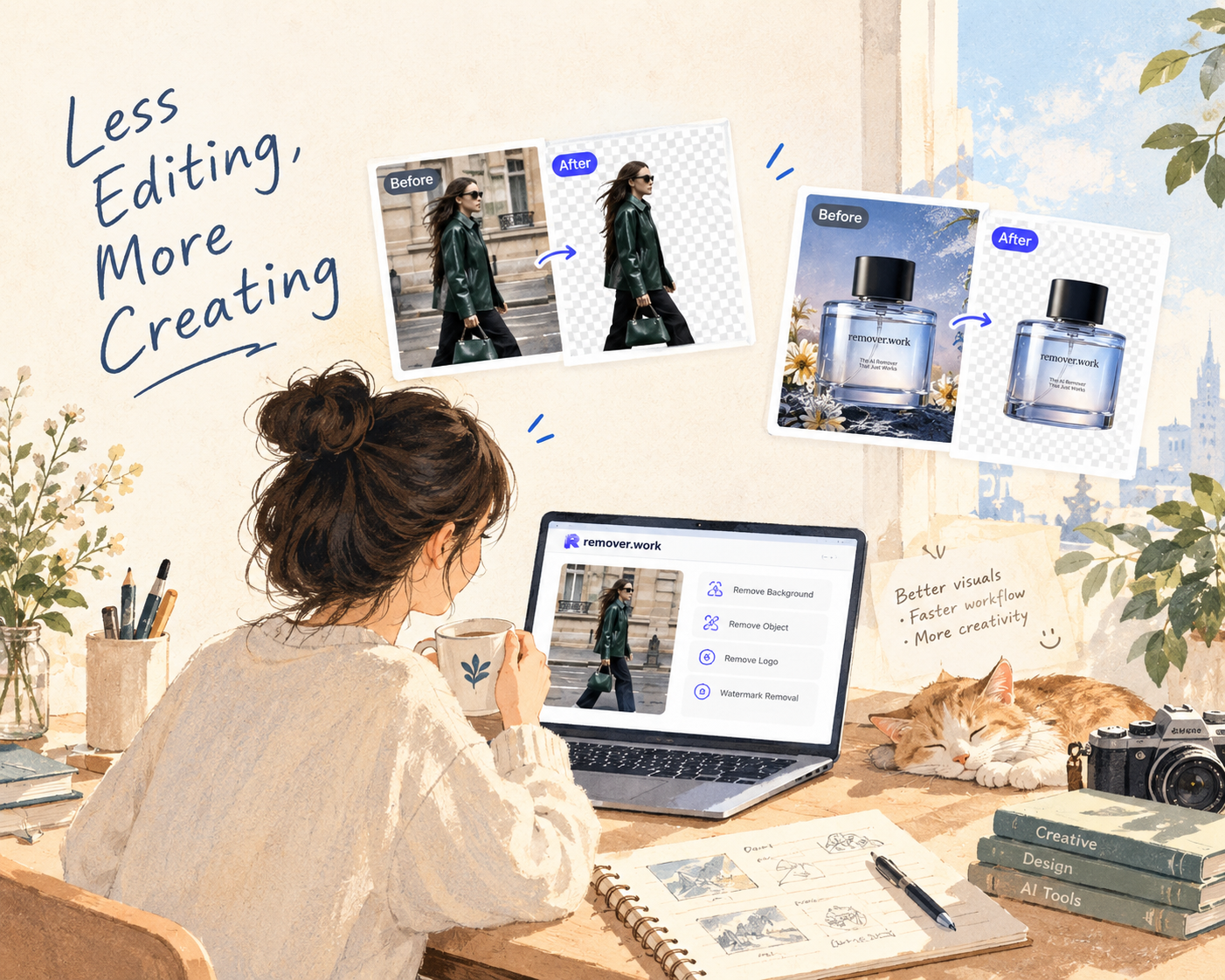
Tools like Remover.work, for example, let you streamline repetitive editing tasks — such as background removal or deleting unwanted elements — in a straightforward way.
When AI image editing comes up, the conversation tends to drift toward "AI stealing designers' jobs."
But in actual production work, I think there's a slightly different way to use it.
What are you making?
What photos will you use?
Where will things be placed?
What kind of mood are you going for?
These kinds of decisions still involve a lot of human judgment.
What AI can take over is just a portion of the smaller, repetitive tasks within that process.
That's precisely why it may be more practical to think of AI not as "something that creates everything automatically," but as a tool that reduces the tedious parts.
The benefit of finishing image editing faster isn't simply saving a few minutes or even tens of minutes.
That freed-up time lets you step back and look at the image as a whole.
"Will this photo really get the message across?"
"Is the text placement right?"
"Could this be simpler?"
You can spend time on the things you actually wanted to think about.
In creative work, that kind of breathing room turns out to matter quite a lot.
Of course, handing things off to AI doesn't mean everything will come out perfectly.
With things like the edges of a person's hair or clothing, intricate backgrounds, or transparent areas, it's often worth checking the result carefully.
So in practice, a workflow like this makes sense:
Process with AI → Review the result → Make corrections if needed
Rather than eliminating human involvement entirely, the goal is to separate the parts that deserve your time and attention from the parts that can safely be left to AI.
That kind of balance feels about right.
I don't think AI will fully automate all image editing.
There will still be plenty of situations where hands-on work is needed — for detailed designs or carefully crafted pieces.
But for the parts where you're repeating the same thing every time, it's perfectly reasonable to start handing those over to AI little by little.
And when that happens, the flow of image creation might gradually shift:
From "time spent editing" to "time spent thinking."
The purpose of using AI isn't to automate as many tasks as possible — it's to give yourself back the time for what you actually want to do.
The more I work on image editing, the more that feels like the right way to use it.