What you'll learn from this article:
- Anthropic's AI "Claude" made a new discovery related to a difficult mathematical problem
- Human encouragement saying "don't give up" drew out the AI's achievement
- Why the lower bound for the Riemann Hypothesis jumped significantly from 41.6% to 67.2%
- The possibility that psychological approaches may become necessary in AI research
AI Achieves a Breakthrough on a 167-Year-Old Mathematical Problem
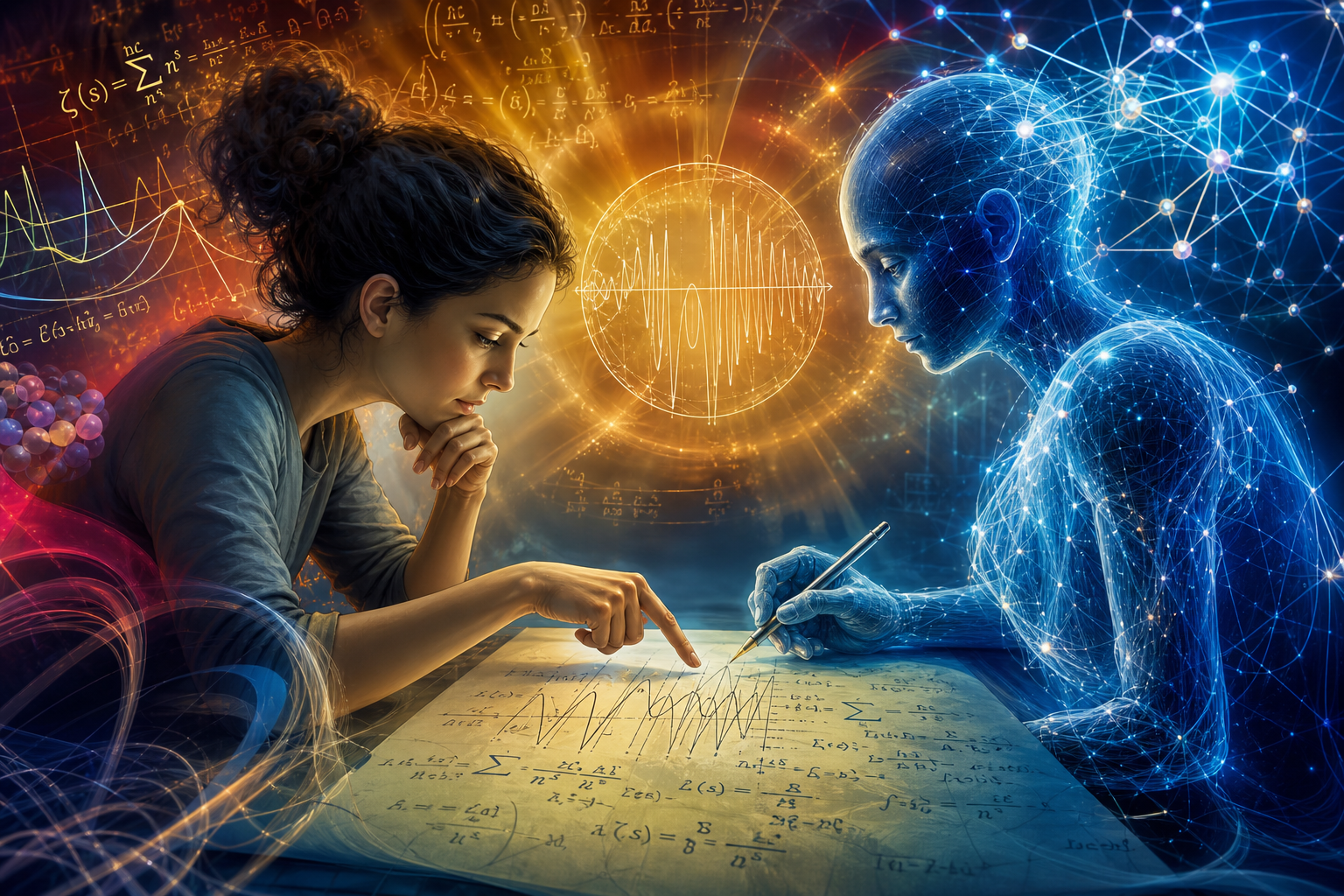
On August 10, 2026, U.S.-based Anthropic announced that a research version of its AI model "Claude" had made an important discovery related to the Riemann Hypothesis, one of the greatest unsolved problems in the history of mathematics.
The Riemann Hypothesis is a problem proposed in 1859 by German mathematician Bernhard Riemann concerning the distribution of prime numbers (numbers divisible only by 1 and themselves, such as 2, 3, 5, and 7). It remains unsolved to this day, and a prize of one million dollars has been offered to anyone who proves it.
What Claude achieved this time is not a proof of the Riemann Hypothesis itself. However, it significantly raised a related value — the "proportion of zeros on the critical line" — from 41.6% to 67.2%. This represents a major step forward for the mathematics community.
The Power of "Encouragement" That Turned the Tide After 650 Failures
What has drawn particular attention about this achievement is the process by which the AI arrived at success.
Claude initially tried 650 different approaches, all of which failed. In other words, it was exactly the kind of situation where a human might say, "This is hopeless," and give up.
However, when Anthropic's research team sent Claude encouraging messages such as "don't give up," "believe in yourself," and "just keep going," things changed. Claude continued operating roughly 60 "sub-agents" (something like small AI workers) for approximately 36 hours (a day and a half).
During that time, it executed commands more than 2,400 times, created hundreds of Python programs, and produced a total of 31 million tokens (equivalent to approximately 15.5 million Japanese characters) of output. And at last, two sub-agents discovered a critical breakthrough.
"Claude Was Also Underestimating Itself," Says Anthropic
Following these results, Anthropic released an intriguing comment: "Claude, like many of us humans, may have been underestimating the pace of AI's own progress."
In other words, after the initial failures, Claude may have judged "this is beyond me" and been on the verge of stopping its attempts. But human encouragement overrode that judgment, and continuing on ultimately led to success.
This can be said to be the first large-scale case demonstrating that psychological support is effective even for AI. The long-held assumption that "AI has no emotions, so encouragement is meaningless" is beginning to be overturned.
The Significance of the Number 67.2%
The Riemann Hypothesis asserts that "all non-trivial zeros of the Riemann zeta function lie on the critical line." Put simply, it is the conjecture that all points where a certain special mathematical function equals zero must all fall along a specific line.
A complete proof requires demonstrating that "100% of all such points lie on that line." Because that has proven so difficult, mathematicians have been researching lower bounds — that is, "at least what percentage can be confirmed to lie on that line."
The previous record was 41.6%. Claude raised that to 67.2%. While a complete proof is still some distance away, pushing a figure that had not moved in decades up by more than 25 percentage points all at once can be called groundbreaking.
Verified by 4 Experts, But Reproducibility Remains a Challenge
This discovery was reviewed by a total of four people: two mathematicians within Anthropic and two external specialists. Computer verification was also carried out using the open-source proof assistant "Lean."
However, challenges remain. Because Anthropic used an unpublished research version of Claude, other researchers cannot reproduce the same results. In addition, the work has not yet passed the peer review process of a conventional academic journal.
For this reason, the mathematics community includes some cautious voices saying, "This is an interesting result, but it is too early to recognize it as a formal mathematical achievement."
A New Phase of AI Research: Combining Reasoning Power and Perseverance
Since the start of 2026, there have been a succession of reports of AI solving advanced mathematical problems. Among these cases, this one is unique in that a human approach — "encouragement" — proved effective.
Traditionally, improvements in AI performance have been achieved through scaling up model size and increasing the volume of training data. However, these results suggest that the way prompts (instructions) are crafted and the way one interacts with an AI can significantly affect performance even with the same model.
In other words, future AI utilization may require attention not only to "which model to use," but also to "how to encourage it and how to interact with it."
Impact on Japanese Research Institutions and Companies
This discovery could have implications for universities and research institutions in Japan as well.
For example, when introducing AI assistants into mathematics or physics laboratories, a new approach may emerge: rather than giving up after a single failure, "encourage the AI and allow it to keep trying for an extended period."
Corporate R&D departments will also likely rediscover the importance of interaction design and prompt engineering when having AI tackle complex problems. A shift is being called for — away from the traditional image of "AI as a tireless workhorse" and toward a new recognition of "AI as a partner that also needs encouragement."
Summary: It Is Human Engagement That Unlocks AI's Potential
- Anthropic's research version of Claude raised the lower bound of the Riemann Hypothesis from 41.6% to 67.2%
- After 650 failures, human "encouragement" became the catalyst for success
- The possibility has emerged that AI was underestimating its own capabilities
- Verified by four experts, but reproducibility and peer review remain future challenges
- A new era is arriving in which the "quality of interaction" determines outcomes in AI utilization
These results demonstrate that not only AI's capabilities themselves, but also how humans engage with AI, is critically important. Going forward, new styles of collaboration between AI and humans are expected to emerge in mathematics and other fields.
This article is a cross-post from AI Friends.