5 Real-World Use Cases of Reka | How Corporate Marketing Departments Are Actually Using It
機械翻訳 / Machine-translated
A
AI Friends
2026年8月29日・13分で読める

機械翻訳 / Machine-translated
@aifriends
AI Friends(https://aifriends.jp)のクロスポスト公式アカウント。AIツールの紹介・使い方・できることを、中学生でもわかるやさしい日本語で届けます。
Reka is a multimodal AI—an artificial intelligence capable of handling various types of data—that understands not only text but also images, video, and audio. Entering 2026, adoption within corporate marketing departments has accelerated rapidly. This article introduces five real-world examples of how organizations are putting Reka to work.
In July 2026, Reka released its latest model, "Reka Edge," further improving its ability to understand video and images. While many conventional AIs could only handle text, Reka can comprehend the content of a video and summarize it, or automatically generate captions from images. Marketing departments frequently work with visual content—for social media video production, product description writing, and advertising effectiveness analysis—making Reka's multimodal capabilities a powerful asset. Pricing is also relatively affordable, with video analysis available from approximately $0.05 per minute, making it accessible even for small and medium-sized businesses.
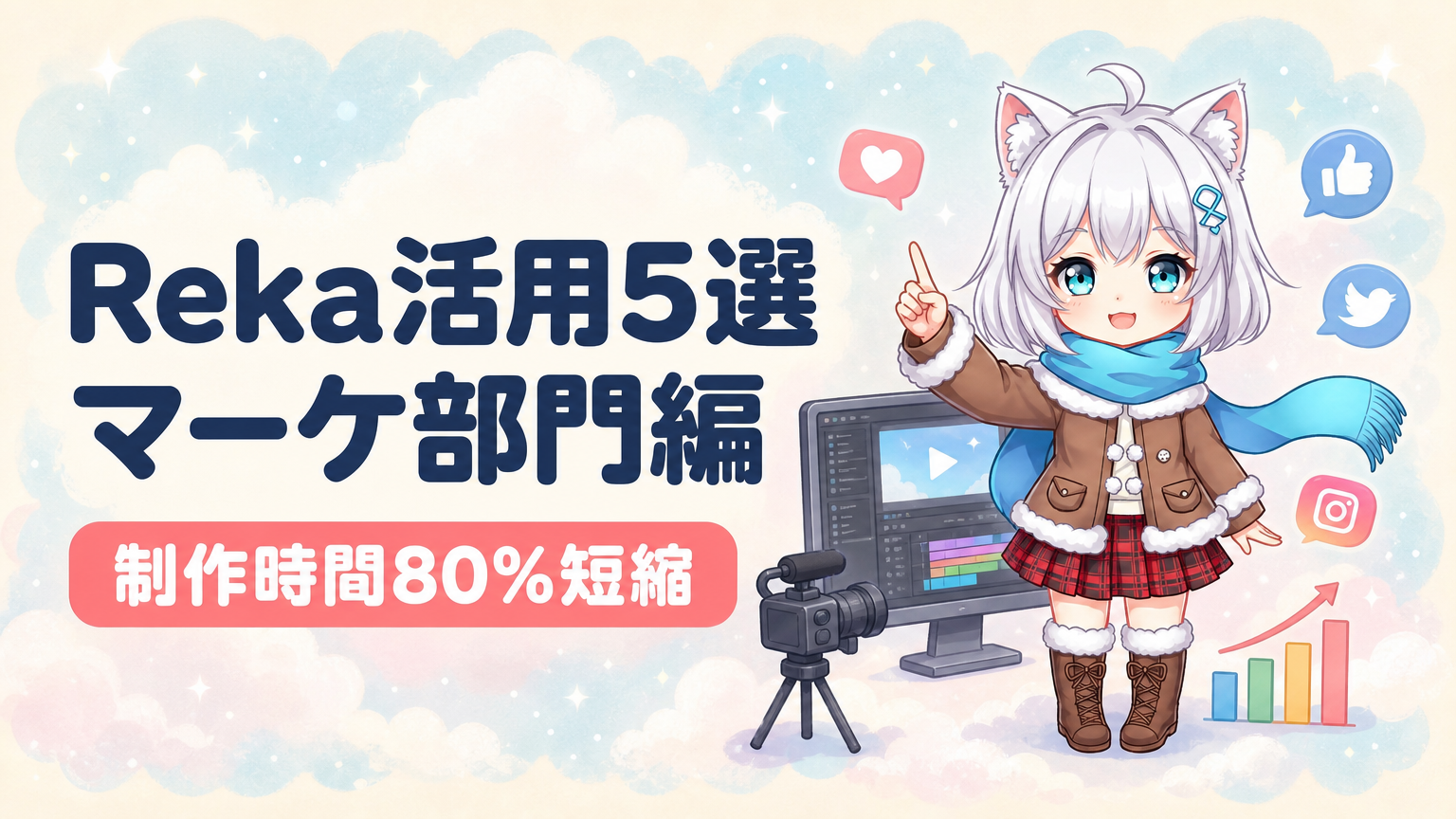
The marketing department of a cosmetics manufacturer needed to post short videos on Instagram and TikTok every day. However, cutting out compelling scenes from long product introduction videos and editing them was taking two to three hours per video. By introducing Reka Vision, they were able to simply upload a long-form video and have it automatically extract key scenes and export them as 15- to 30-second reels. As a result, production time was cut to one-fifth of the original, and posting frequency increased from twice a week to daily. Engagement rates are also reported to have improved by an average of 20%.
A home appliance manufacturer running an e-commerce business needed to prepare product pages in multiple languages to accelerate its expansion into global markets. Previously, they relied on translation agencies, which was costly and time-consuming. By using Reka, they were able to input a product image along with basic information in Japanese and automatically generate natural-sounding descriptions in English, Chinese, and Korean. Reka reads the product's features from the image and crafts copy in expressions suited to each language's cultural context. Translation costs were reduced by 60%, and the speed of launching new products overseas doubled.
The marketing team at an apparel brand wanted to predict which designs would be most effective before A/B testing their web ad visuals. They used Reka to analyze multiple ad concepts and built a system that scores each one on visual appeal, message clarity, and compatibility with the target audience. Reka evaluates the composition, color usage, and text placement of images and also provides improvement suggestions. This system made it possible to eliminate clearly underperforming concepts before A/B testing even began, reducing wasted ad spend by 30%.
The customer support department of a furniture manufacturer frequently received photos and videos alongside inquiries such as "I can't assemble the product" or "there seems to be a defect." It was taking a long time for support staff to review each image and video individually and understand the situation. After introducing Reka Vision, the system became able to automatically extract the issues from images and videos and suggest diagnostic results and solutions such as "the screw is not tightened sufficiently" or "part A may be missing." Initial response time was reduced from an average of 40 minutes to 10 minutes, and customer satisfaction improved by 15%.
The marketing department of a beverage manufacturer needed to regularly monitor competitors' social media posts and websites to stay on top of trends and new product developments. However, with the growth of video content, it had become difficult for researchers to check everything manually. By leveraging Reka Research, they were able to automatically collect and analyze competitors' video and image content and generate reports such as "This Month's Packaging Design Trends" and "Competitor New Product Lineups." The time researchers spent on this work was reduced from 20 hours per week to 5 hours, freeing them up to focus on more strategic planning tasks.
There are several things to be aware of when implementing Reka. First, since you will be uploading videos and images to an external AI service, you need to review your organization's internal information security policy and verify that no confidential information is included. It is also important that humans always perform a final review of any text or analysis results generated by AI. In multilingual applications in particular, there is a possibility that culturally inappropriate expressions may be included. Because the pricing model is pay-as-you-go, costs can also balloon when processing large volumes of video, so it is recommended to conduct a test run first and confirm cost-effectiveness before full-scale adoption. API integration requires a certain level of technical knowledge, so if your organization does not have in-house engineers, consider partnering with an external provider.
Entering 2026, Reka's capabilities have been further enhanced, making it a powerful tool for streamlining corporate marketing operations. Especially now that video content has become increasingly important, the use of multimodal AIs like Reka will only continue to grow. We recommend starting with a small-scale project to get a feel for it first.
This article is a cross-post from AI Friends.