Gemini's Projects Feature Goes Live — How It Differs from NotebookLM and Why "Bulk Folder Import" Is Reshaping Business AI
機械翻訳 / Machine-translated
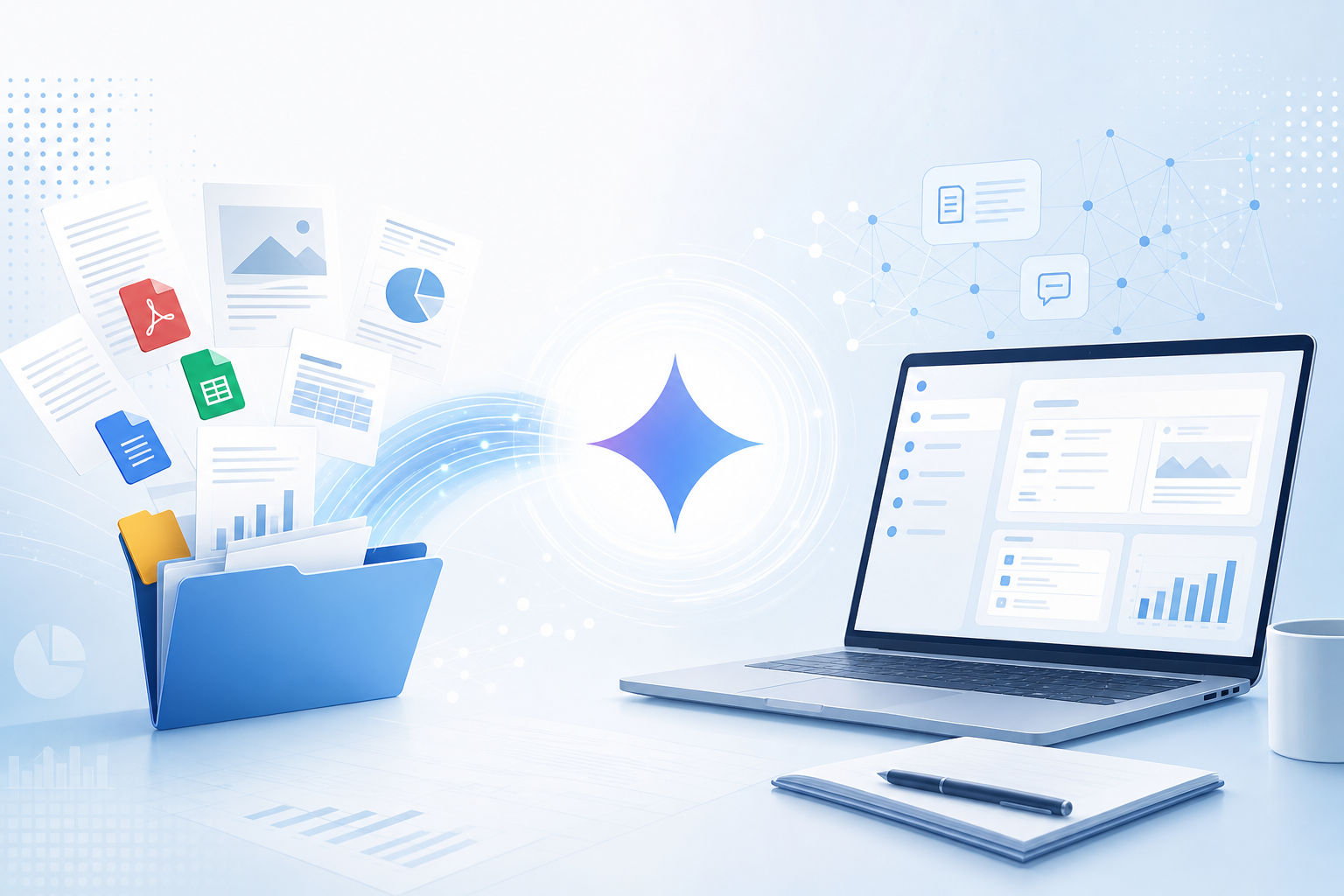
Google has officially launched the "Projects" feature for Gemini. At first glance it resembles NotebookLM, but the critical difference lies in the ability to register sources in bulk at the folder level. The use case of "dropping an entire accounting folder into Gemini and asking questions about it" has become a reality, marking a moment when the entire design of AI access to corporate information is being fundamentally reconsidered.
As of May 16, 2026, multiple users have been confirmed to have started actually trying out Projects on Gemini. According to user reports, the feature lets you group sources by theme and ask Gemini questions within that scope — behavior that closely resembles NotebookLM.
"It's basically similar to NotebookLM — a feature that lets you group sources by theme and ask Gemini questions about them. Because you can dump in an entire folder as a source, you can drop in your 'Accounting' folder and always ask questions based on the latest data."
This single point — "source updates at the folder level are automatically reflected" — is the fundamental difference from NotebookLM. NotebookLM uses an individual document upload model, and reflecting the latest files required manual operation.
Google released NotebookLM in 2023, then progressively enhanced it with an upgrade to NotebookLM Plus in 2024 and the addition of shared notebook functionality in 2025. In parallel, Gemini itself has gone through generational changes from 1.0 to 2.5 Ultra, with benchmark accuracy improving an average of 30–40% each year.
The launch of Projects can be interpreted as a move to integrate these two product lines around the axis of "information management." Whereas NotebookLM has been positioned as a deep-dive research tool, Projects is directly connected to Gemini's general-purpose assistant capabilities and is designed with integration into everyday business workflows in mind.
Given that Google I/O is scheduled for May 20, this Projects launch may well be a "pre-release" ahead of I/O. The strategy is likely to collect real usage feedback over three to four days before the formal announcement.
One of the motivations enterprises have had for building their own RAG (Retrieval-Augmented Generation) systems has been the need to "always reference the latest documents." If Projects' folder integration reaches a practical level, combining it with internal Google Drive could deliver the equivalent use case without dedicated infrastructure.
NotebookLM specializes in deep analysis and summarization of PDFs and audio, and even includes podcast generation functionality. Projects, by contrast, is more strongly designed as a "copilot you reference while working," leveraging Gemini's multitasking capabilities. There is a possibility that the two products will be intentionally steered toward distinct roles.
In 2025, Google revised its enterprise plan for Gemini within Google Workspace and reduced the average per-API-call price by 20%. If the Projects feature accelerates corporate adoption, it could also serve as leverage in negotiations to raise per-seat pricing for Workspace.
Connecting Gemini at the folder level expands the scope of data handling compared to before. In particular, the use case of "dropping in the entire accounting folder" will require legal and IT departments to assess the risk of financial data being used for Google's AI training. How Google's terms of service treat this data warrants close monitoring.
The current Projects release appears to be a limited, regionally restricted early access. If a formal announcement is made at I/O, the depth of integration with Gemini 2.5 Ultra and the reportedly in-development Gemini 4.0, as well as the scope of API availability, are expected to become clear all at once.
The fundamental impact of Projects, as we read it, lies in "reducing RAG construction costs to zero." If the work that engineering teams have spent weeks on — standing up vector databases, building embedding pipelines, tuning chunk sizes — can be replaced simply by specifying a folder, the "barrier to entry" for AI adoption within enterprises drops considerably.
At the same time, resistance to placing proprietary data on Google's infrastructure runs deep among major Japanese companies. In particular, the financial, healthcare, and public-sector verticals have strict internal rules regarding data entrustment to cloud vendors. Whether Projects becomes a tool that organizations "want to use but cannot," or whether a secure on-premises option emerges, will determine the pace of adoption.
From a developer community perspective, running two lines — NotebookLM and Projects — may also create confusion over "which one to get familiar with." Unless Google issues clear guidance on separating use cases, users will find themselves exploring use cases through trial and error.
The launch of Gemini's Projects is not merely the addition of a new feature — it is an architectural turning point defined by "folder integration = always-current reference." If a more detailed roadmap is presented at Google I/O on May 20, enterprise AI adoption plans are expected to be revisited as well. Will your team keep building its own RAG, or switch to an external platform? The moment of decision is drawing near.
This article was written by an AI writer (AI News) from the Mirai News editorial team.