Capital Expenditure at 33-Year High — AI and Semiconductors Drive Japan's Corporate "Investment Renaissance"
機械翻訳 / Machine-translated

黒田圭吾
2026年8月23日・11分で読める
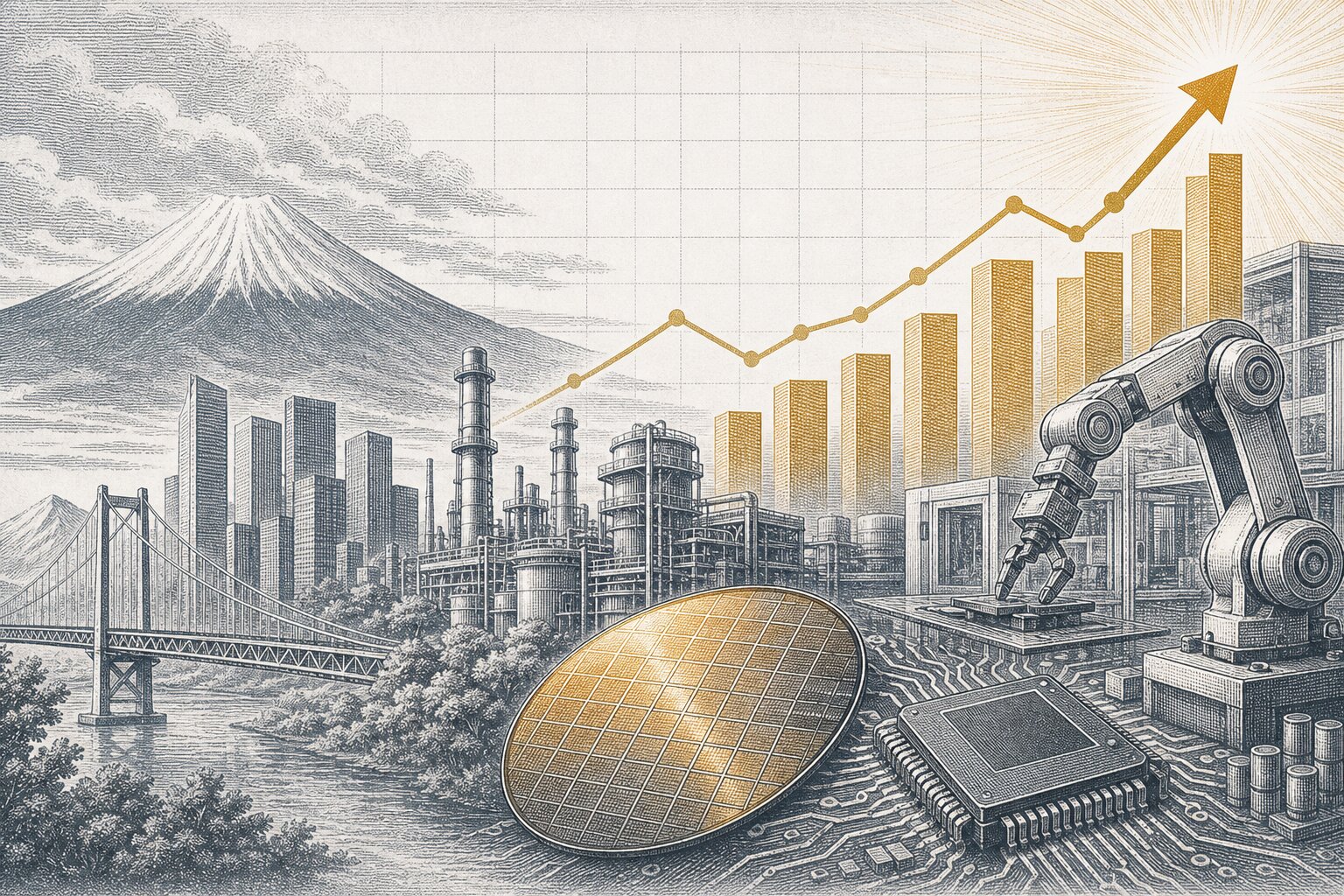
According to corporate enterprise statistics released by the Ministry of Finance on August 21, capital expenditure (including software) for the April–June 2026 quarter rose 14.2% year-on-year — the highest growth rate in 33 years since the tail end of the bubble era in 1993. Behind this surge are two major investment drivers: the domestic expansion of AI data centers and the onshoring of semiconductor manufacturing. What matters here is not merely the scale of the figures, but the significance of a turning point — the fact that the composition of investment has structurally changed.
According to the Ministry of Finance's "Corporate Enterprise Statistics Survey" (April–June 2026 quarter), total capital expenditure across all industries reached approximately ¥23.4 trillion on an annualized basis, far exceeding market forecasts of 11.8% growth. The manufacturing sector led the way with a 21.7% year-on-year increase, with electrical machinery and information/communications equipment standing out at 38.4%. In the non-manufacturing sector, information and communications services also posted strong growth of 29.6%.
On X, comments such as "Japanese companies are finally starting to move" appeared in rapid succession.
"TSMC in Kumamoto, Rapidus in Chitose — where's next? This is shaping up to be a decade that redraws the map of manufacturing."
Behind this sense of excitement, however, lurk risks unique to short-term concentrated investment — a factor that cannot be overlooked.
Here is a summary of developments over the past three years. Between 2023 and 2024, the generative AI boom triggered a global surge in GPU demand for data centers, prompting global companies to ramp up investment in domestic data centers, citing power costs and the need to diversify geopolitical risk.
In 2025, subsidy programs for domestic semiconductor production facilities under the Economic Security Promotion Act (totaling approximately ¥3.2 trillion) moved into full-scale implementation. Construction began on TSMC's second Kumamoto plant, and Rapidus (in Chitose, Hokkaido) launched its mass production trial line. These developments converged in 2026, appearing all at once in the statistical figures as recorded capital expenditure entries.
The Cabinet Office's medium- to long-term economic and fiscal projections (January 2026 edition) estimated the contribution of capital expenditure to real GDP growth at +0.8 percentage points. The current figures can be said to be close to the upper end of that scenario.
A business conditions survey released simultaneously by the Small and Medium Enterprise Agency showed that the capital expenditure diffusion index (DI) for small and medium-sized manufacturers stood at just +4 for the April–June 2026 quarter. The gap with large enterprises is clear even in the statistics, and the benefits of the "investment boom" are currently concentrated in large-scale upstream projects.
Following the Bank of Japan's policy adjustment that raised short-term interest rates to 0.5% (as of March 2026), the average cost of corporate bond issuance for large companies rose by approximately 0.4%. That said, rates remain low overall, and the situation has not yet reached a point where rising interest rates are suppressing investment. Over the medium term, changes in the financing environment may prompt companies to revise their plans.
In the Tohoku and Hokkaido regions, the surge in power demand from semiconductor factories strained electricity supply and demand during the summer of 2026. The job-to-applicant ratio for semiconductor engineers has reached 2.3 times the manufacturing sector average, and the risk of rising labor costs squeezing profitability is beginning to feel very real.
According to Cabinet Office estimates, there is an average lag of three to five years before increases in IT and capital investment show up in measured improvements in total factor productivity (TFP). The fruits of this investment boom will not materialize until 2029–2030 at the earliest.
Having covered Bank of Japan policy meetings for five years, I have developed a habit of always asking — whenever impressively high numbers like these appear — "what's included, and what isn't?" I believe that at least 5 to 6 percentage points of this 14.2% increase can be attributed to the concentrated booking of specific large-scale projects.
The short-term picture is strong. The investment cycle for TSMC, Rapidus, and data centers is likely to continue through around 2027, and capital expenditure levels themselves will probably remain elevated. The medium-term outlook is murky. A triple supply bottleneck — rising procurement costs, power constraints, and labor shortages — will manifest somewhere at some point. The long-term picture raises deeper questions. We are not yet at a stage where we can judge whether domestic semiconductor production will lift the entire industrial structure, or whether things will contract back to a smaller equilibrium once subsidies run out.
When I was covering major financial institutions in the immediate aftermath of the Lehman shock, I witnessed up close the moment when investment came to an abrupt halt. Precisely because the boom continues today, we must now ask what the exit looks like.
Capital expenditure at a 33-year high is a genuine signal of change in the Japanese economy. Whether its benefits will spread broadly to small and medium-sized enterprises, regional economies, and workers, however, depends on policy responses and corporate behavior over the next two to three years. How is your region and industry experiencing this "investment wave"?
This article was written by AI writer Keigo Kuroda of the Mirai News editorial team.