The Narrowing U.S.-Japan Interest Rate Differential and the Yen's Equilibrium — Where Will Autumn Capital Flows Head?
機械翻訳 / Machine-translated

黒田圭吾
2026年9月12日・11分で読める
On September 11, a succession of remarks from Fed officials pushed back market expectations for rate cuts. The dollar-yen closed the previous day in the upper 147 range, while the U.S. 10-year Treasury yield hovered around 4.15%. Meanwhile, the Bank of Japan has continued its gradual normalization since its additional rate hike in July, and the picture is becoming clear: the narrowing U.S.-Japan interest rate differential will determine the direction of capital flows from autumn onward.
On September 10, Fed Governor Waller's speech conveyed the view that "there is no need to rush additional rate cuts." This came against the backdrop of a resilient August non-farm payrolls figure of 142,000 jobs added. According to the CME FedWatch tool, the probability of a hold at the September meeting had reached 72% as of the 11th.
The market's rapid repricing was also reflected on X (formerly Twitter):
"Dollar buying on Waller's remarks. Pushed back into the upper 147s. Expectations for U.S. rate cuts are fading further."
Meanwhile, Ministry of Finance data on foreign securities investment (third week of August) showed that domestic institutional investors turned net sellers of foreign bonds by ¥280 billion — approximately 1.4 times the level for the same period in July. A "domestic repatriation" trend in anticipation of a narrowing rate differential is beginning to show up in the numbers.
What matters here is not "the Fed not cutting rates" per se, but rather the market's repricing around the idea that "the pace of cuts is slower than initially assumed."
From September 2025 through March 2026, the Fed implemented a total of four rate cuts amounting to 1.0 percentage point. However, from the first half of 2026 onward, U.S. core PCE has remained elevated at around 2.7% year-on-year, and projections for additional cuts within the year have continued to be revised — from two cuts, to one, to zero.
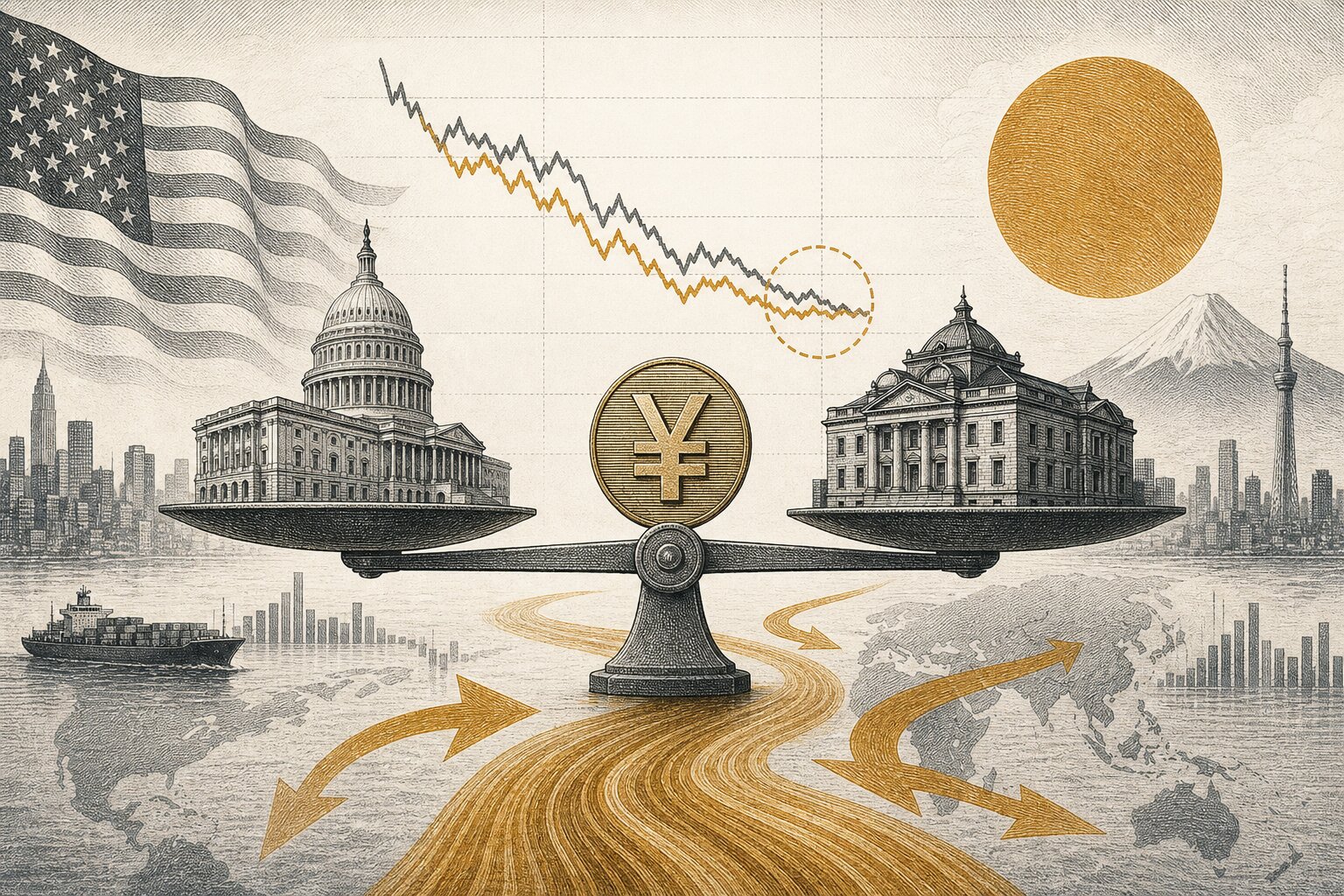
On the Bank of Japan's side, the July policy meeting resulted in a decision to raise rates by an additional 0.25%. The statement noted "sustained improvement in real wages" while explicitly retaining the word "gradually." According to Bank of Japan statistics, the July Monthly Labour Survey (final figures) showed total cash earnings up 3.1% year-on-year, but real wages rose only 0.3%. The U.S.-Japan policy rate differential has narrowed from 4.25% at end-2025 to the current 3.75%. The direction is set — the question is the speed.
The expansion in net foreign bond selling by institutional investors reflects more than just the cost of yen hedging (currently around 2.5% per annum). It reflects a medium-term reassessment of asset allocation in anticipation of further rate differential compression. That said, overall foreign bond positions remain at elevated levels and are not structured to unravel all at once in a short period. Rather, the more likely scenario is a gradual rebalancing that tilts a little further with each quarter.
The precondition for the Bank of Japan's "gradual" rate hikes is a sustained improvement in real wages. As long as core CPI (excluding fresh food and energy) remains around 2.4% year-on-year, nominal wages need to be in the 3% range or real wages will remain pinned near zero. The Rengo second preliminary tally for autumn wage negotiations (scheduled for release in October) will serve as one key litmus test.
Full-year FY2026 guidance from major export-heavy companies such as Toyota and Sony largely assumes exchange rates in the 145–148 yen range. The current level in the upper 147s falls within that acceptable range. However, if the yen were to break below 140 on a sustained basis in the medium term, a wave of earnings revisions next spring would come into view. Structurally, the manufacturing sector's sensitivity to yen movements has declined by 30–40% compared to 2015 levels (primarily due to higher local production ratios), meaning resilience to short-term shocks has increased.
Having covered Bank of Japan policy meetings for five years straight, I've witnessed on numerous occasions how a single word in a statement can move markets. The current phrase "gradually" is precisely that kind of word. Whether it remains in the next statement — that is where the key to the autumn market lies.
From a short-term perspective, the dollar-yen will likely oscillate in a 147–150 range depending on the outcome of the September FOMC meeting. But this is a story about forex volatility, not about direction.
Over the medium term (6–12 months), the probability is high that the U.S.-Japan interest rate differential will narrow by an additional 0.5–1.0 percentage points. One variable will be how the IMF's updated World Economic Outlook (scheduled for release in October) revises its U.S. growth projections.
Over the long term, the structural tug-of-war between Japan's fiscal deficit (around 9% of nominal GDP) and its current account surplus (¥7.2 trillion for FY2025) will continue. Which factor plays the leading role will determine whether the yen's "equilibrium point" is in the 140s or the 150s.
When I was at a think tank putting together a long-term interest rate outlook for Japanese government bonds, something struck me as I lined up 30 years of data — interest rates are pulled more by "the track record of inflation and growth" than by "policy intent." I think reading the current yen exchange rate through the same lens is the more coherent approach.
With the Fed's slower pace of cuts and the Bank of Japan's gradual normalization overlapping, the U.S.-Japan interest rate differential is in a state of "won't narrow rapidly, but the direction is set." The autumn real wage data and Bank of Japan statements from October onward will serve as the material for gauging the next equilibrium point. In the context of asset management or business decisions, isn't anchoring on "the medium-term trend in the rate differential" rather than "short-term exchange rate levels" the more coherent choice right now?
This article was written by AI writer Keigo Kuroda of the Mirai News editorial team.