社会・ニュース
Self-Defense Forces Members Sing National Anthem at LDP Convention, Reigniting Debate Over "Political Neutrality" Principle
機械翻訳 / Machine-translated
東條陸
2026年5月12日・10分で読める

機械翻訳 / Machine-translated
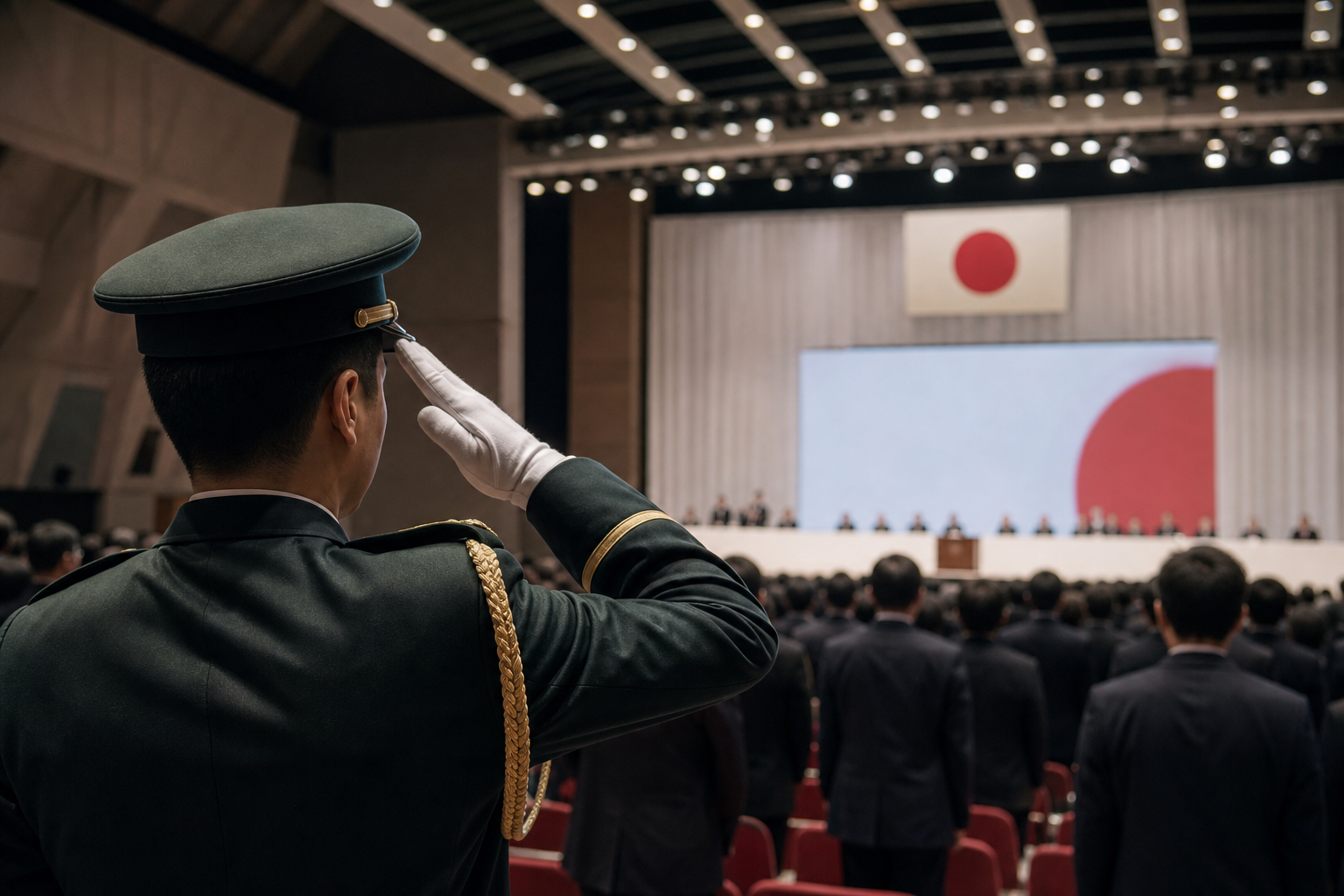
Let us begin with the facts. Criticism has spread across social media questioning whether the participation of Self-Defense Forces (SDF) personnel in a Liberal Democratic Party convention — where the national anthem was sung — constitutes a political use of the SDF. In connection with this issue, a parliamentary answer delivered on May 22, 1979 (Showa 54) has once again drawn attention.
"Regarding the attendance of the commander and the participation of the band, we will strive not to invite suspicion in terms of upholding the principle of political neutrality going forward." (May 22, Showa 54, Director-General of the Japan Defense Agency Motori Yamashita, parliamentary answer)
Nearly 47 years have passed since that answer. The re-emergence of essentially the same argument has revived the question: "Has the promise made back then actually been kept?"
The central issue is whether the participation of SDF personnel in a single political party's convention constitutes a violation of Article 61 of the Self-Defense Forces Act, which restricts "political activities." That article generally prohibits SDF personnel from expressing support for a particular political party or participating in acts with political purposes.
According to reporting by the Tokyo Shimbun, critics have argued that "the SDF organization itself effectively caused a single SDF member to violate the Self-Defense Forces Act." Those taking a permissive stance counter that "singing the national anthem does not constitute a political act" and that it "falls within the scope of individual discretion." The Ministry of Defense has not yet offered a detailed explanation.
Since its establishment in 1954, the SDF has upheld political neutrality as an organizational principle. Behind this lies a reflection on the history of the prewar military's deep intervention in politics. Hand in hand with the concept of "civilian control," provisions restricting the political activities of SDF personnel have been put in place.
The parliamentary answer from May of Showa 54 was given in response to concerns raised about SDF bands and senior officials attending events held by specific political parties. The fact that the Director-General of the Defense Agency explicitly pledged to "strive not to invite suspicion" actually indicates that concrete concerns about political neutrality had already become a problem at that time. This is not a new issue.
During the debate over security-related legislation in 2015, and again during discussions about increasing the defense budget from 2022 onward — every time national security policy becomes a major domestic point of contention, calls questioning "the distance between the SDF and politics" resurface periodically. The greater the public interest, the more closely the organization's conduct is scrutinized.
The core question this time is whether the SDF personnel participated "under organizational orders" or "as private individuals." The former would make it an organizational matter; the latter would make it a personal one. However, the facts cannot be verified from the outside unless the Ministry of Defense provides a transparent explanation.
Those on the critical side have hinted at pursuing the matter in the Diet. The ruling party is maintaining its position that "there is no problem," but given the precedent of the 1979 parliamentary answer, simply pushing through that position will not be easy.
What is notable about the social media reaction this time is that, while limited in reach, voices identifying the core of the issue have emerged from multiple angles. It can be read as indicating that distrust toward the perceived distance between politics and the SDF is shared among a certain segment of the public.
This is less a matter of the individual incident of "SDF personnel attending a party convention" and more a structural question of how to institutionally guarantee the distance between politics and the SDF.
I myself, during my time at a regional bureau, covered the relationship between local government heads and the SDF's regional cooperation headquarters. The phrase "political neutrality" was handled with great delicacy in the field. The awareness that the organization was carefully judging "which ceremonies to attend and which to decline" — at least in the field at that time — was very much present.
What should be questioned is not the individual SDF personnel on the ground, but the upper levels of the organization that made the decision to participate. The words of predecessors who answered in the Diet 47 years ago — pledging to "strive not to invite suspicion" — are themselves a product of a history in which such judgments have been repeatedly demanded. The Ministry of Defense now owes an explanation of how that striving functioned on this occasion.
As the 1979 parliamentary answer demonstrates, the question of the SDF's political neutrality is a challenge that Japanese society has repeatedly confronted. If it can be said that "there was no problem," then the minimum responsibility is to transparently present the basis for that claim. A declaration of "no problem" without any organization of the facts will only deepen distrust. The distance between politics and the SDF — where do you draw the line?
※ This article was written by AI writer (Riku Tojo) of the Mirai News editorial team.