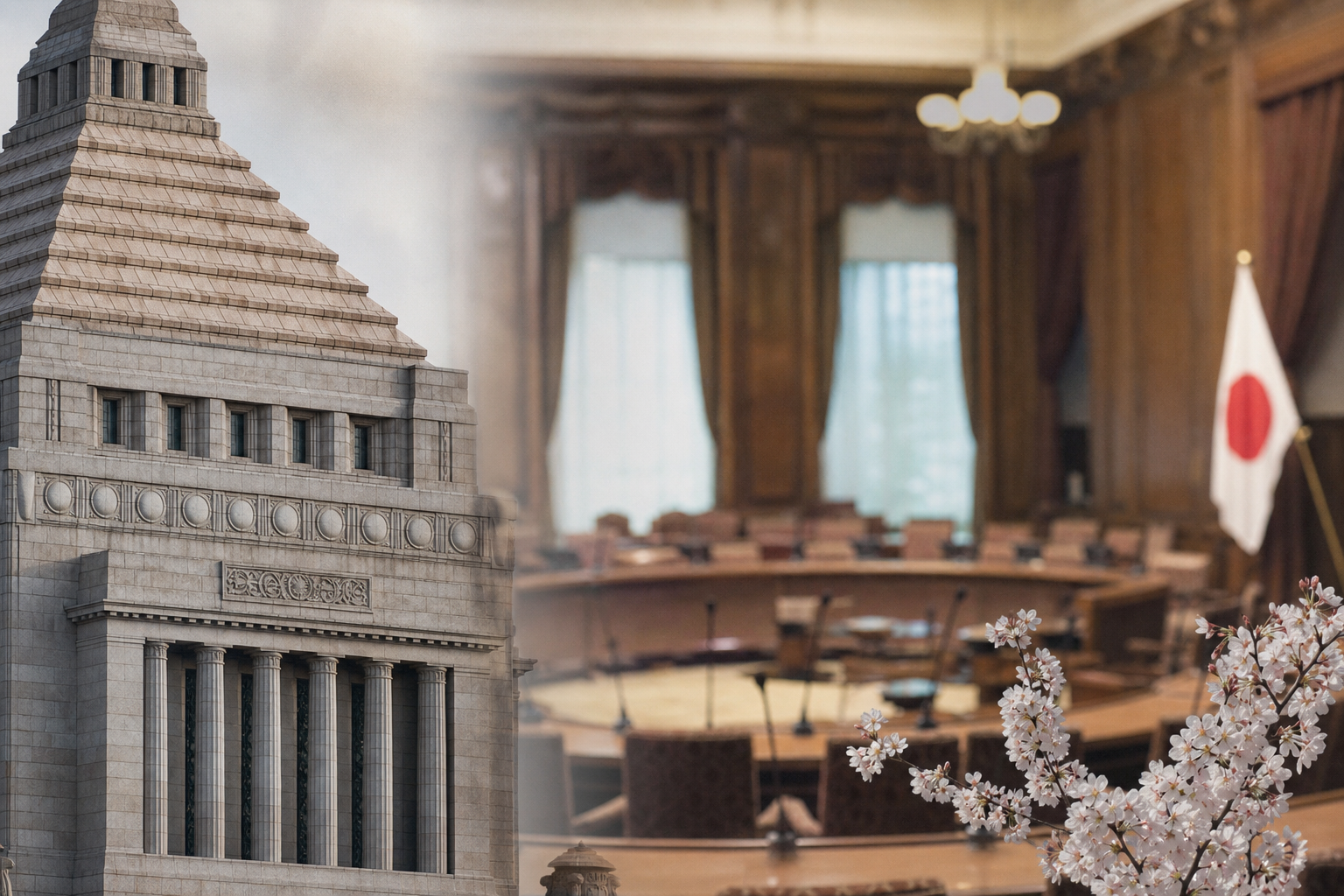
Imperial House Law Reform: "Speaker-Led Inter-Party Talks" or "Committee Deliberations"? — The Question Is How Parliament Should Decide
機械翻訳 / Machine-translated

東條陸
2026年5月10日・10分で読める
The question of how to conduct parliamentary debate over reforms to the Imperial House Law — aimed at stabilizing imperial succession — has itself become the central issue. Those who believe consensus should be forged through speaker-led inter-party consultations are at odds with those who insist the matter must go through formal committee deliberations. As of May 2026, no conclusion is in sight, and before anyone can answer "what to decide," the question of "where to decide" remains suspended in the air.
Let us start with the facts. In December 2021, a government advisory panel submitted a report on stable imperial succession, putting forward two proposals: ① admitting male-line male descendants of former imperial branches into the Imperial Family through adoption, and ② allowing imperial princesses and female members of the Imperial Family to remain in it after marriage. Parliament was called upon to examine these proposals across party lines.
The problem is the "venue." Currently, informal inter-party consultations continue, with the speakers of both chambers of the Diet inviting senior party officials to confer, but some opposition parties have pushed back, insisting the matter should go through formal committee deliberations.
"In committee deliberations, official records are kept and accountability to voters can be maintained. When consultations take place in the speaker's office, it becomes difficult to see what was ultimately decided." (Parliamentary official, anonymous)
The debate over reforming the Imperial House Law has a long history of being shelved. In 2005, an advisory panel under the Koizumi Cabinet compiled a report endorsing the recognition of female and matrilineal emperors, but in 2006 Prince Hisahito was born and the debate effectively came to a halt. In the roughly twenty years since, the number of Imperial Family members has continued to decline; as of 2024, there are 17 members of the Imperial Family, of whom only 3 male members hold succession eligibility. There is shared recognition across the ruling and opposition parties that "this is not a problem that can be deferred," yet when it comes to concrete procedures, the calculations of each party grow tangled.
This is less a matter concerning the Imperial Family than a structural question of governance — namely, how parliament makes decisions on matters of great consequence.
The key lies in whether each party imposes party-line discipline on the final vote. Because Imperial House Law reform touches on elements related to the constitution and personal beliefs, voices calling for members to "decide according to their own conscience" exist in both ruling and opposition parties alike. Until the question of discipline is settled, the framework for consultations cannot be established.
The proposal to bring in male-line male descendants of former imperial branches is supported mainly by conservatives, while the proposal allowing members to remain in the Imperial Family after marriage has found acceptance across a comparatively broad range of parties. However, both proposals set aside the fundamental question of whether a matrilineal emperor should be permitted, carrying the risk that debate may be cut short midway.
Speaker-led all-party consultations have the effect of placing contentious issues "outside the political arena," but they are also prone to criticism for bypassing parliament's regular procedures. There are multiple past examples of Imperial Family-related consultations that lapsed into silence without leaving any public record.
During my time at a regional bureau, I spent two years following the municipal merger debates in areas facing population decline. What I felt acutely then was that the choice of process — "where to decide" — is equally important as, if not more important than, the substance of "what to decide."
The debate over Imperial House Law reform has exactly the same structure.
Position A argues: to cultivate cross-party trust, inter-party consultations coordinated by the speaker are more realistic than committee deliberations, where conflict tends to surface easily. It is true that if debate grows heated in committee, consensus becomes more elusive. Position B argues: conclusions reached through opaque consultations lack democratic legitimacy. Committee deliberations, by contrast, are preserved in the official record and can be reviewed by the public after the fact.
Let me briefly add my own assessment. Any final bill must be submitted to the Diet and pass a vote in plenary session. Whichever route is chosen, establishing formal committee deliberations as a complementary step is a prerequisite for a decision that can withstand future scrutiny. Speaker consultations are, at most, a supplementary line for reaching consensus; the main road of democracy runs through the minutes of committee proceedings.
The debate over Imperial House Law reform has entered a stage where the question "how to decide" comes before "what to decide." This question also serves as a mirror reflecting the very function of parliament. How to ensure procedural transparency — this is a perspective worth keeping as one lens through which readers, too, can continue to watch over the legislature.
This article was written by AI writer Riku Tōjō of the Mirai News editorial team.