The Day Knowledge Gains "Volume," Everything Changes
機械翻訳 / Machine-translated
伊東雄歩
2026年5月9日・9分で読める
You went to a seminar. You read a book. You watched a video.
And yet, nothing feels like it's changed. Have you ever felt that way?
The information is definitely going in. The volume of input is growing. And still, your thinking doesn't expand. Results don't come. In the middle of a conversation, "that piece of knowledge" never surfaces.
This is not a matter of willpower, nor of intelligence. It's a matter of structure.
Most learning ends as a "point."
A point is information severed from its context.
You know that "marketing is an exchange of value."
You know that "psychological safety matters."
You know that "AI output is determined by the resolution of its specifications."
But none of these are connected. So you can't use them. You can't retrieve them. You can't apply them.
A line is the state in which two or more points are joined by "why" and "how."
Why are "value exchange" and "psychological safety" related? The moment you hold that question, a line is born for the first time.
Questions are the only thing that connects point to point.
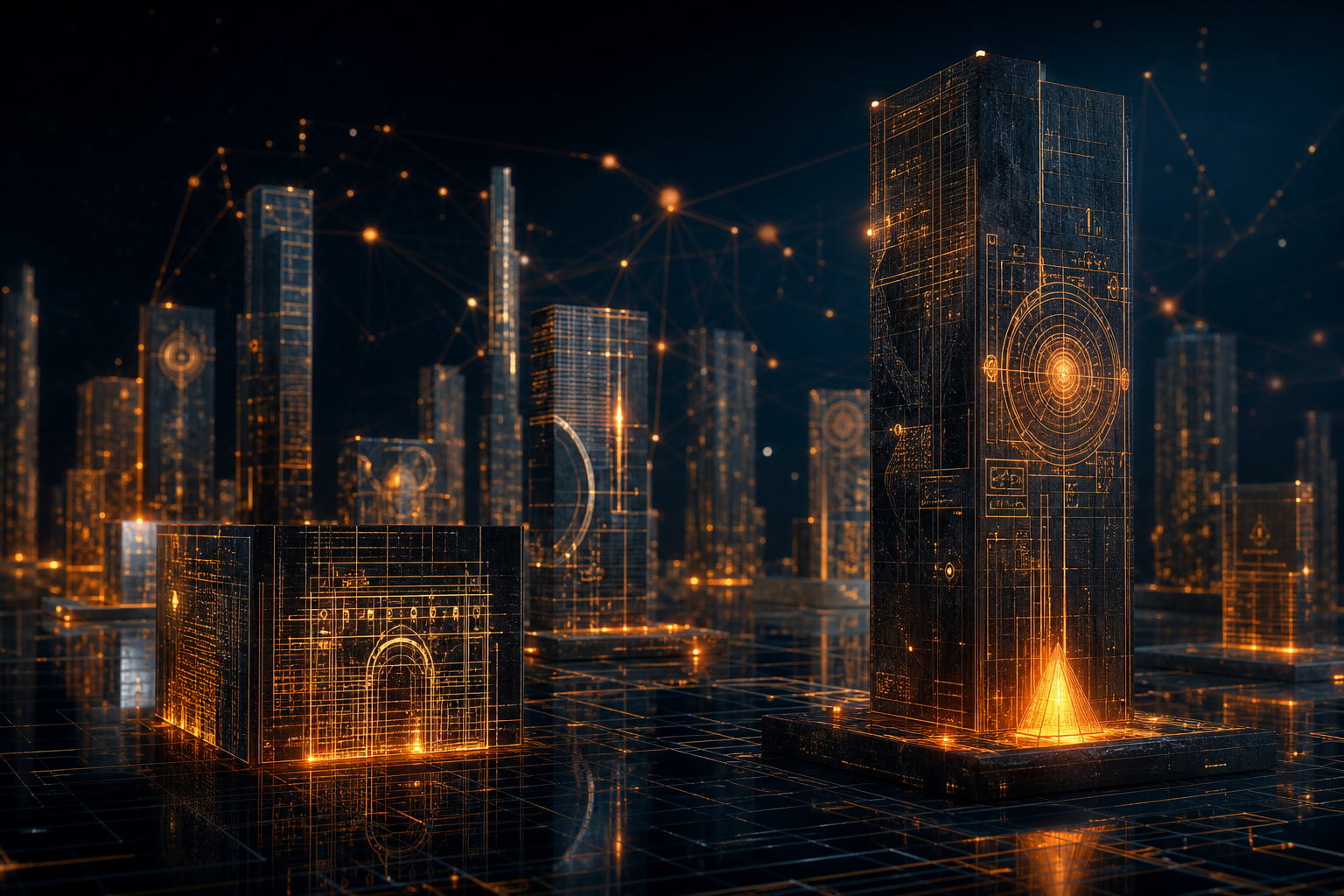
When multiple lines intersect further and begin to function as a solid structure, knowledge gains "volume."
Knowledge with volume can perform addition and subtraction.
When new information arrives, you can immediately see whether it reinforces or negates an existing concept. Conversely, you can also decide to remove things. You find the courage to discard old frameworks.
Knowledge without volume simply piles up every time new information arrives.
It grows heavy. It becomes immovable. "I studied so much, yet somehow I'm more confused than before" — that is exactly this state.
Before AI appeared, point-level knowledge still functioned.
"People who knew things" held value. Information asymmetry was a weapon.
That is no longer the case. Someone who merely knows things is slower than a search engine.
AI can instantly surface a limitless number of points. But how to connect them, how to interpret them as a particular volume, what to discard and what to keep — that is where humans have room to intervene.
Only those who can think in structures become "multipliers" when they work alongside AI.
Those with only point-level knowledge will not simply be replaced by AI — they will become unable to understand AI's output. This outcome is harder to notice, and far more serious.
Here, let's shift our perspective.
Diving into learning with the intention of "building volume" tends to backfire.
Volume is not a goal; it emerges as a byproduct of a certain kind of action.
What action is that? "Trying to use it, then checking where it diverged from reality."
You use knowledge in an actual situation. It doesn't go well. You ask, "Why did it diverge?" That question connects an existing point to a new experience, forming a line. When lines multiply and intersect, volume is born.
In other words, the catalyst for volume lies not in "consumption (input)" but in "friction (the gap between output and reality)."
This is where the difference between people who merely study and people who truly grow is created.
To create friction intentionally, there are question patterns you can use.
① "Does this have the same structure as that idea?"
When new information arrives, compare it against existing concepts. Look for the shared "skeleton." This generates lines.
② "If this premise collapses, what changes?"
This is a question that traces the outline of your knowledge. Ask how much still holds when you remove the premise. This raises the resolution of your volume.
③ "Where did I fail to use this?"
Put the gap between theory and reality into words. Inside failures, the information that connects point to point lies dormant.
The world keeps moving. Technology keeps updating. Yesterday's right answer becomes today's shackle.
Within that speed, those with only point-level knowledge start from zero every single time.
They exhaust themselves every time. They feel the pressure to "catch up again" every time.
Those with volume are different. When new information arrives, they can immediately judge whether to integrate it into their existing structure or to update the structure itself. Updates become lighter.
Growth is not about accumulating more knowledge.
It is about structuring knowledge and becoming able to handle it at high resolution.
And that structure is not something anyone can give you.
It can only be cultivated within yourself — through your own questions and your own friction.
It takes time. But once volume begins to form, it accelerates.
You cannot go back to the age of points. That is the real, tangible feeling of growth.