A Smartwatch That Uses AI to Detect Customer Harassment Has Arrived — Prevention Measures Become Mandatory Starting October 1
機械翻訳 / Machine-translated
A
AI Friends
2026年9月6日・17分で読める

機械翻訳 / Machine-translated
@aifriends
AI Friends(https://aifriends.jp)のクロスポスト公式アカウント。AIツールの紹介・使い方・できることを、中学生でもわかるやさしい日本語で届けます。
What you'll learn from this article
Starting October 1, 2026, measures against customer harassment (commonly called "kasuhara" in Japan) will become a legal obligation for companies. What was previously a "best effort" recommendation has been elevated to a full legal requirement.
In other words, failing to comply will constitute a violation of the law.
The legal basis is the Act for Promotion of Overall Labor Policy Measures. The amended law was promulgated in June 2025 and takes effect on October 1, 2026.
All companies that employ at least one worker are subject to this law — small and medium-sized enterprises are not exempt. Companies that violate the law may be required to submit reports to authorities, receive administrative guidance, or have their names publicly disclosed.
The law requires companies to take four specific actions:
The fourth item — keeping records — is particularly challenging. Proving abusive language or intimidating behavior after the fact is not easy. Without a system for recording and logging incidents, it becomes impossible to verify the facts and protect employees.
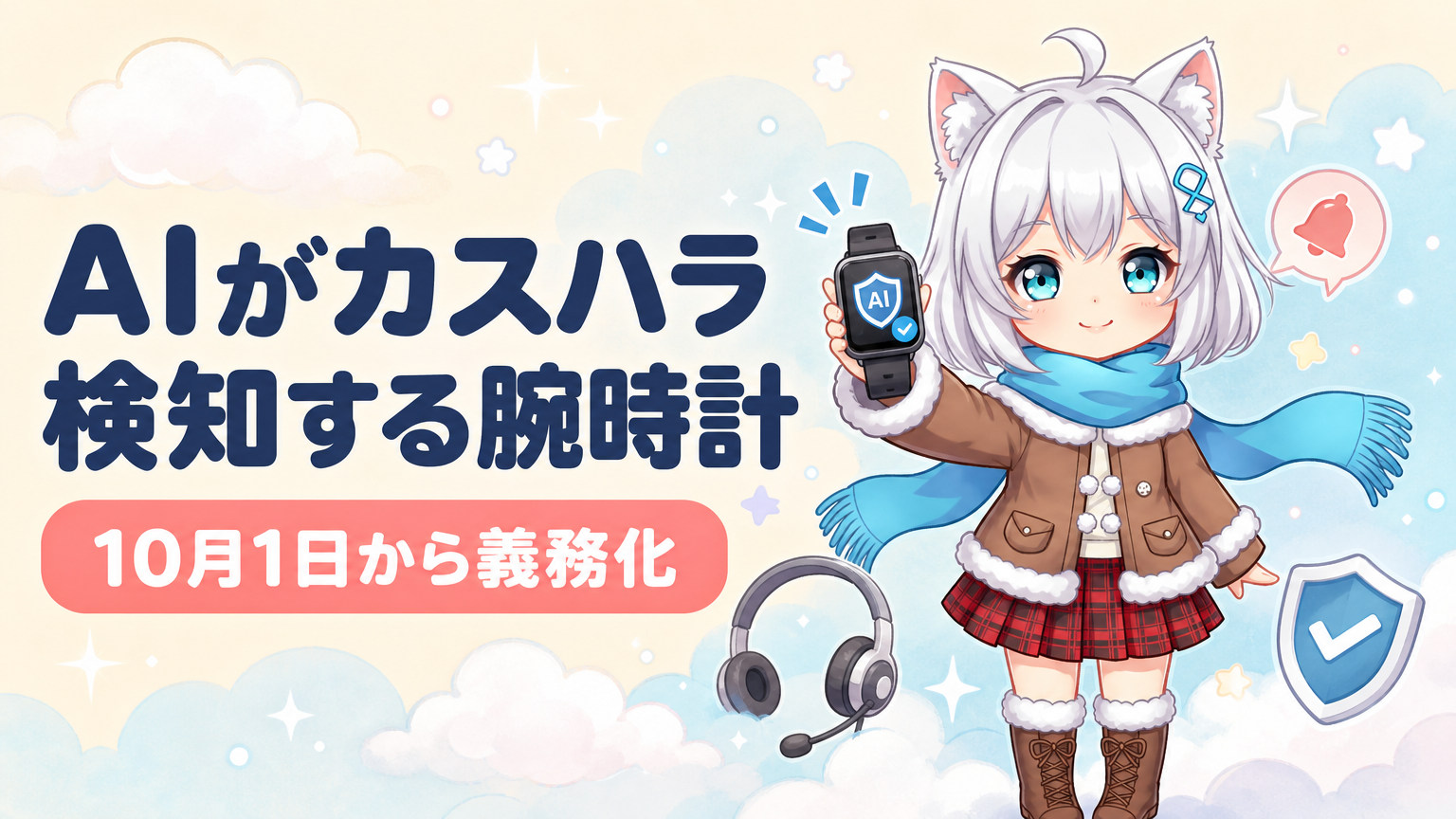
To address these challenges, iFocus Co., Ltd. has announced a new device called the "Kasuhara Taisaku Watch" (Customer Harassment Prevention Watch).
This is a wearable smartwatch-style device equipped with LTE connectivity — meaning it can communicate on its own without needing a smartphone.
Its most notable feature is that AI analyzes audio data to automatically detect signs of customer harassment. Employees simply wear the watch, and the AI identifies problematic statements and abusive language on their behalf.
When harassment is detected, the manager receives a real-time notification. This allows managers to understand what is happening on the floor and intervene at the right moment — for example, even if a store manager is occupied with another task, they can immediately know when an employee is in distress.
Additionally, audio data is saved to the cloud, serving as evidence that can be used later for fact verification.
Here is how the system works in concrete terms.
First, the watch picks up surrounding audio. That audio data is sent to AI in the cloud, where it is analyzed in real time.
When the AI detects a statement that may constitute customer harassment, it immediately sends a notification to the manager. In other words, even while an employee is handling a situation alone, the AI is watching over them.
However, the specific detection criteria and details of the algorithm have not been made public. What words or vocal tones are determined to constitute harassment will likely become clearer through real-world operation going forward.
iFocus describes the device as intended for "workplaces where a single employee handles customer interactions."
The industries specifically envisioned include:
In short, this tool is designed to protect people who work in environments where supervisors or colleagues are not immediately nearby. In such settings, customer harassment often goes unnoticed by others, leaving employees isolated.
AI wearables represent one way to address that isolation.
Just how prevalent is customer harassment in the first place?
According to the Ministry of Health, Labour and Welfare's "Fiscal Year 2023 Survey on the Actual State of Workplace Harassment," 27.9% of companies that received harassment consultations over the past three years reported receiving consultations specifically about customer harassment.
A survey by the Tokyo Metropolitan Government's Bureau of Industrial and Labor Affairs found that 23.3% of Tokyo residents had personally experienced customer harassment, and 59.6% had witnessed or heard about it. That means more than one in five people are victims, and more than half are witnesses.
Furthermore, in a survey targeting job-seeking students in the class of 2026, 28.6% reported experiencing some form of customer harassment while working part-time. Younger generations are not unaffected.
The forms customer harassment takes are wide-ranging: abusive language, shouting, prolonged detainment, unreasonable demands, online defamation via social media, and more. In some cases, incidents escalate to physical violence or threats.
Devices like the Kasuhara Taisaku Watch offer several benefits.
First, they enhance employees' psychological safety. The sense of reassurance that comes from knowing "AI is watching over me" is especially valuable in workplaces where staff handle situations alone. Knowing that help will come quickly if something goes wrong makes it easier to respond calmly.
Second, the automatic preservation of evidence is a significant advantage. Employees do not need to press a record button themselves — because recording is continuous, the risk of missing critical evidence is reduced.
On the other hand, there are also points to be mindful of.
Privacy is one concern. Continuously recording audio also involves the privacy of customers. Companies will likely need to clearly disclose that recording is taking place and obtain customers' understanding.
Additionally, AI judgment is not infallible. There are risks of false positives (alerts triggered when no harassment has occurred) and missed detections (harassment that goes undetected). It is important not to over-rely on AI and to combine its use with human judgment.
While October 1 is fast approaching, there are still preparations that can be made in time.
First, document your customer harassment prevention policy. Put in writing what behaviors constitute customer harassment and how they will be handled. Communicate this to employees, and if possible, post it at your storefront or on your website as well.
Next, establish a consultation channel. Even without a dedicated hotline, simply creating a system where employees can consult a supervisor or HR representative makes a difference. What matters most is creating an environment where employees feel comfortable saying, "I can ask for help."
Then, put a system in place for record-keeping. Introducing a tool like the Kasuhara Taisaku Watch is one option, but even creating a simple logging format to start with is fine. Establish a rule for recording the date and time, details of the incident, the person who responded, and the actions taken.
Finally, conduct training for employees. Help them understand what customer harassment is, how to respond to it, and where to turn for help. Practicing responses through role-playing exercises is also effective.
Mandating customer harassment prevention measures is an important step toward protecting employees. At the same time, it creates an urgent challenge for companies to act. New technologies like AI wearables have the potential to support both workplace safety and corporate compliance simultaneously.
The October 1 implementation date is almost here. Companies need to start preparing right now.
This article is a cross-post from AI Friends.