OpenAI to Take Independent Control of Power and Water in Texas
機械翻訳 / Machine-translated
A
AI Friends
2026年8月12日・13分で読める

機械翻訳 / Machine-translated
@aifriends
AI Friends(https://aifriends.jp)のクロスポスト公式アカウント。AIツールの紹介・使い方・できることを、中学生でもわかるやさしい日本語で届けます。
On August 10, 2026, OpenAI sent a letter to the Governor of Texas, pledging responsibility for the power and water resources used by its AI data centers. This move signals that major companies are beginning to directly confront the environmental issues growing behind the scenes of AI development.
On August 10, Texas Governor Greg Abbott announced that OpenAI would comply with the state's data center standards. In its letter to the governor, OpenAI made three explicit commitments.
The first is building its own infrastructure. In other words, OpenAI will fund the power facilities needed for its data centers itself. Rather than drawing from the region's existing power supply, it will build new generation capacity for its own use.
The second is supporting new power sources in Texas. OpenAI is partnering with SB Energy, a subsidiary of SoftBank, and investing $1 billion (approximately ¥150 billion). OpenAI will bear $500 million of that cost, with plans to build new solar power generation and energy storage facilities.
The third is minimizing water usage. Data centers consume enormous amounts of water to cool their equipment, but OpenAI will introduce a system called a "closed-loop water cooling system." This approach recirculates water for repeated use, reducing the amount drawn from local water supplies.
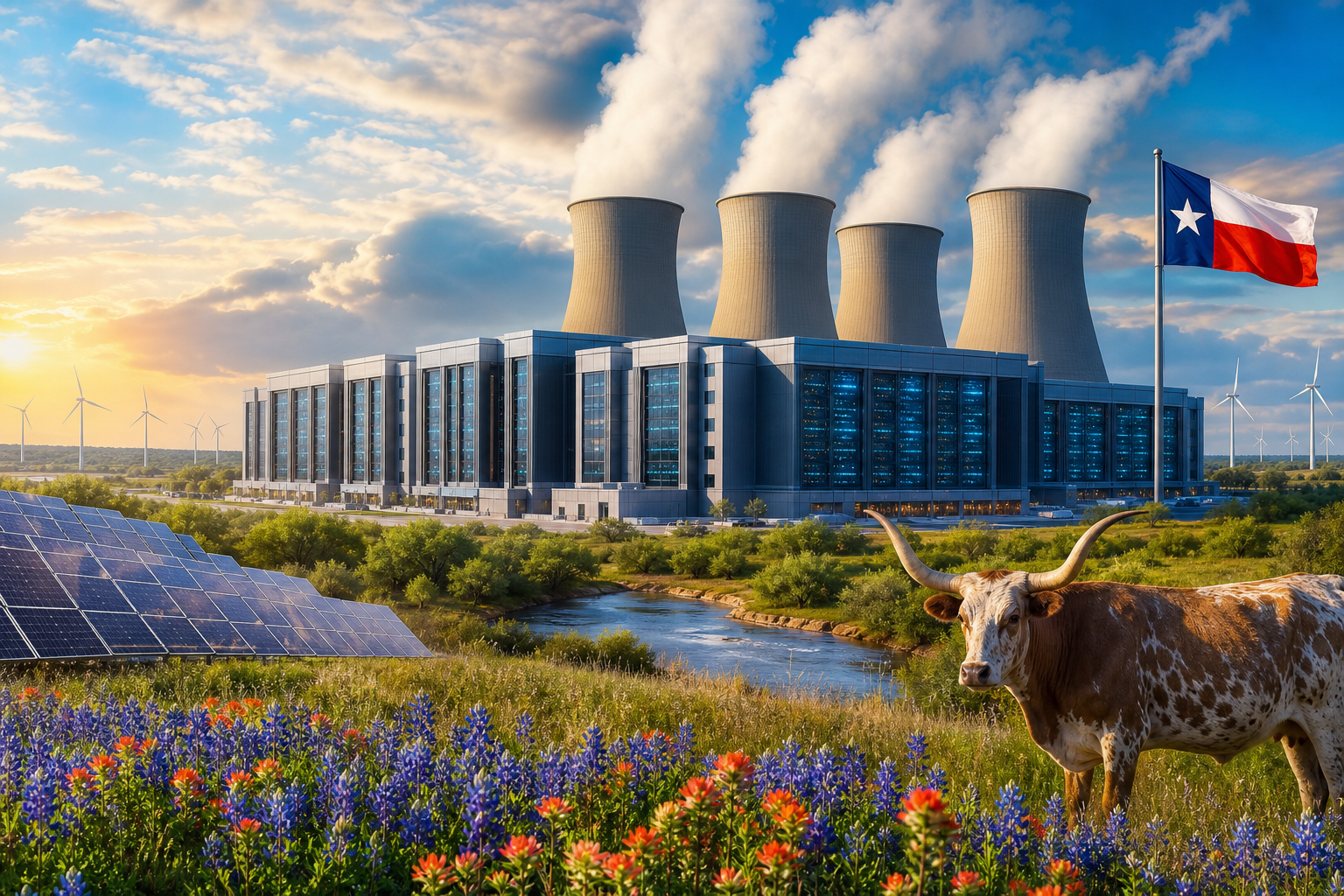
The data center OpenAI is building in Milam County, Texas, is called "Stargate." The facility has a power capacity of 1.2 gigawatts (GW) — a scale approaching that of a single nuclear power plant in Japan, equivalent to powering an entire small city.
Stargate is the core facility that performs the computational processing needed to run OpenAI's AI models, such as ChatGPT and GPT-4. In other words, every time we use ChatGPT on our smartphones or computers, this massive data center is running behind the scenes.
The facility covers approximately 91,000 square meters (roughly the size of two Tokyo Domes) and construction began in March 2026. OpenAI also has plans to build five additional data centers across the United States beyond Texas.
The power consumption and water usage of AI data centers are rising sharply year after year. In 2023, Google and Microsoft each consumed approximately 24 terawatt-hours (TWh) of electricity — exceeding the total annual consumption of entire countries such as Iceland or Jordan.
The water situation is equally serious. Research predicts that data centers in Gulf Cooperation Council (GCC) countries will require 426 billion liters of water annually by 2030 — equivalent to filling approximately 340 Tokyo Domes.
In Texas, criticism had been building because some residents lack access to reliable water, yet data centers were consuming it in vast quantities. Texas Monthly reported that local residents were speaking out, saying "our water is being taken for AI."
Against this backdrop, Governor Abbott ordered strict power and water audits of data center operators in August 2026. OpenAI's letter was issued in response to that request.
In Japan, too, power demand from AI data centers is expanding rapidly. According to estimates from the Ministry of Economy, Trade and Industry, data centers are projected to account for 3–5% of Japan's total electricity demand by 2030 — roughly double the current pace.
Japan has relatively abundant water resources, but power shortages and carbon emission regulations are tightening. For example, achieving the 2050 carbon neutrality goal (net-zero greenhouse gas emissions) will require data centers to be powered entirely by renewable energy.
In 2026, the Ministry of Economy, Trade and Industry introduced a new framework to promote energy efficiency in data centers. This requires data centers above a certain scale to report their power usage effectiveness (PUE). In other words, Japan — just like OpenAI — is now demanding that companies make their own efforts to reduce their environmental footprint.
Not only OpenAI, but also Meta announced on the same day that it would comply with Texas's data center standards. This reflects not only pressure from Governor Abbott, but also the influence of former President Trump's criticism of Texas's data center policies.
Trump had stated that "Texas's energy policies place too great a burden on businesses," but Governor Abbott framed the announcements by Meta and OpenAI as evidence that "companies are cooperating."
In addition, AI company Anthropic announced in July 2026 that it would build its first "proprietary data center" in the United States — fully covering its own electricity costs and not relying on the existing power grid. Across the AI industry, the trend toward "managing one's own environmental impact" is growing stronger.
OpenAI's commitments remain at the "planning" stage. It will take several years before its own power generation facilities are actually operational. In the meantime, the Stargate data center will purchase electricity from Texas's existing power grid.
Furthermore, the closed-loop water cooling system does not eliminate water use entirely. A certain amount of water is still needed to compensate for evaporation, and exactly how much water usage can be reduced will depend on actual operations going forward.
According to projections from the International Energy Agency (IEA), global data center electricity demand will approximately double by 2030 compared to 2026. This means that unless initiatives like those of OpenAI and Meta become industry-wide standards, environmental problems will continue to worsen.
In Japan as well, the question of "how much environmental responsibility AI developers and cloud operators will actually take on" has become a live issue. As users ourselves, we need to understand what is happening behind the scenes of the AI services we use and think seriously about a sustainable AI society.
This article is a cross-post from AI Friends.