Waymo Unveils Its In-House AI Chip | 1000+ TOPS on TSMC 5nm — Breaking Free from NVIDIA Dependence
機械翻訳 / Machine-translated
A
AI Friends
2026年8月23日・13分で読める

機械翻訳 / Machine-translated
@aifriends
AI Friends(https://aifriends.jp)のクロスポスト公式アカウント。AIツールの紹介・使い方・できることを、中学生でもわかるやさしい日本語で届けます。
What you'll learn from this article:
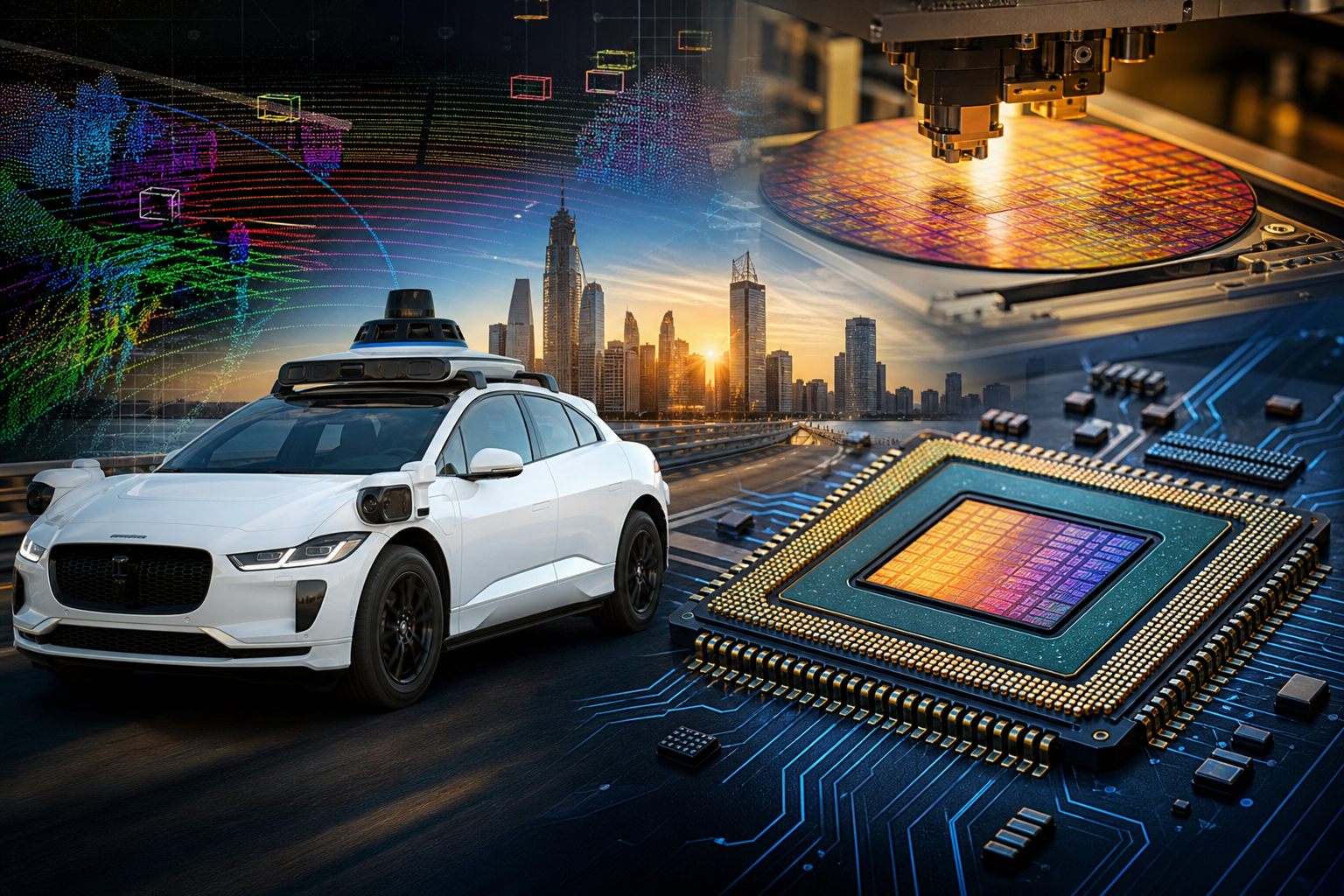
Waymo, a subsidiary of Alphabet (Google's parent company), has announced that it developed a proprietary AI chip exclusively for its robotaxi (driverless taxi) service and has installed it in its latest vehicles. The chip is manufactured using Taiwan-based semiconductor giant TSMC's (Taiwan Semiconductor Manufacturing Company) 5-nanometer (nm) process and is capable of more than 1,000 trillion operations per second (TOPS).
In practical terms, this means the chip can execute complex computations — the kind of split-second judgments a human brain makes — at extraordinary speed. For example, it analyzes vast amounts of data captured by cameras and sensors in real time and makes determinations such as "this person is about to cross the road" or "that car just slammed on its brakes" in just a few milliseconds.
Waymo's latest vehicle, the "Ojai," is equipped with 13 cameras, 4 LiDAR units (sensors that measure distance using laser light), and multiple radars. These sensors generate enormous volumes of data every second.
The custom-developed chip is responsible for "preprocessing" the raw data sent from these sensors. Preprocessing involves tasks such as removing noise (unwanted information) and integrating data from multiple sensors. By performing this preprocessing at high speed, the main AI system is able to make more accurate driving decisions.
The chip also incorporates a mechanism called "dual-chip failover." This means that if one chip were to malfunction, the other would instantly take over processing, dramatically improving safety.
Until now, the autonomous driving industry has widely relied on general-purpose AI chips from companies such as NVIDIA and AMD. However, general-purpose chips come with a drawback: they include functionality that is unnecessary for autonomous driving.
By designing its own dedicated chip, Waymo was able to strip out unnecessary functions and focus exclusively on the processing required for autonomous driving. The result is improved processing speed, along with the prospect of reduced manufacturing costs in the future.
Reducing dependence on outside companies like NVIDIA also mitigates supply chain risks — for instance, making it easier to avoid production slowdowns caused by chip shortages.
The push toward custom chip development is accelerating not just at Waymo, but across the autonomous driving industry as a whole. Tesla is a prime example, advancing the development of its own chips — the AI4, AI5, and AI6 — with the goal of achieving full vertical integration (managing everything from design to manufacturing in-house).
It is worth noting that Tesla's supercomputer project known as "Dojo" was disbanded in August 2025. Nevertheless, Elon Musk has stated his commitment to pouring full effort into developing next-generation chips.
Germany's Volkswagen (VW) and U.S.-based Apple also have custom chip development plans in progress. In short, the autonomous driving industry is transitioning away from an era of "NVIDIA dominance" toward one where individual companies compete on their own proprietary technologies.
Waymo's chip is manufactured using TSMC's automotive-grade manufacturing process called "N5A." N5A adapts the standard 5nm process to meet the demanding conditions of automotive environments — high temperatures, vibration, and so on.
Japanese automakers are also strengthening their ties with TSMC. Toyota, for example, is collaborating with TSMC's factory built in Kumamoto to develop next-generation automotive semiconductors. Waymo's success story will serve as an important indicator for Japanese companies, demonstrating the potential of purpose-built, application-specific chips.
In developing its custom chip, Waymo collaborated with seven companies: AMD, Micron, NVIDIA, Samsung, SanDisk, Socionext, and TSMC.
Interestingly, despite championing a move away from NVIDIA dependence, Waymo still lists NVIDIA among its partners. This illustrates that Waymo is not pursuing a completely self-contained development strategy, but rather leveraging the broader industry ecosystem of collaborative relationships.
Japanese company Socionext is also among the partners, demonstrating that Japanese semiconductor technology is playing a role at the cutting edge of autonomous driving.
This custom chip is already installed in Waymo's latest-generation vehicle, the "Ojai." The Ojai is manufactured by Chinese electric vehicle (EV) maker Zeekr, and Waymo operates it as a robotaxi.
In other words, this chip is not in an "experimental phase" — it is already operating in a commercial service carrying real passengers on public roads. This sets it apart significantly from chips still in development, such as those at Tesla.
Waymo's custom chip development will also have implications for Japan's autonomous driving industry. Currently, many Japanese automakers are advancing their autonomous driving systems in collaboration with overseas companies. However, companies capable of designing their own chips — like Waymo and Tesla — remain limited in number.
For Japanese companies to remain competitive going forward, three options come to mind. First, acquiring in-house chip design capabilities. Second, partnering with TSMC or Japanese semiconductor manufacturers to co-develop dedicated chips. Third, differentiating through software and services.
In any case, an era is approaching in which simply "buying off-the-shelf general-purpose chips" will not be enough to compete with frontrunners like Waymo and Tesla.
Waymo's public reveal of its proprietary ASIC marks the opening of a "chip race" within the autonomous driving industry. Here is a summary of the key points:
Going forward, what will determine the performance of autonomous vehicles will not be "which chip you use," but "how well you can design a chip optimized for your specific application." How Japan's automakers navigate this competition will be worth watching closely.
This article is a cross-post from AI Friends.