クリエイティブ・創作
A Picture Book Finished in 3 Months. The Creative Time That AI Gave Back to Me
機械翻訳 / Machine-translated
❤️ 0
🔖 0
⚡ 0

機械翻訳 / Machine-translated
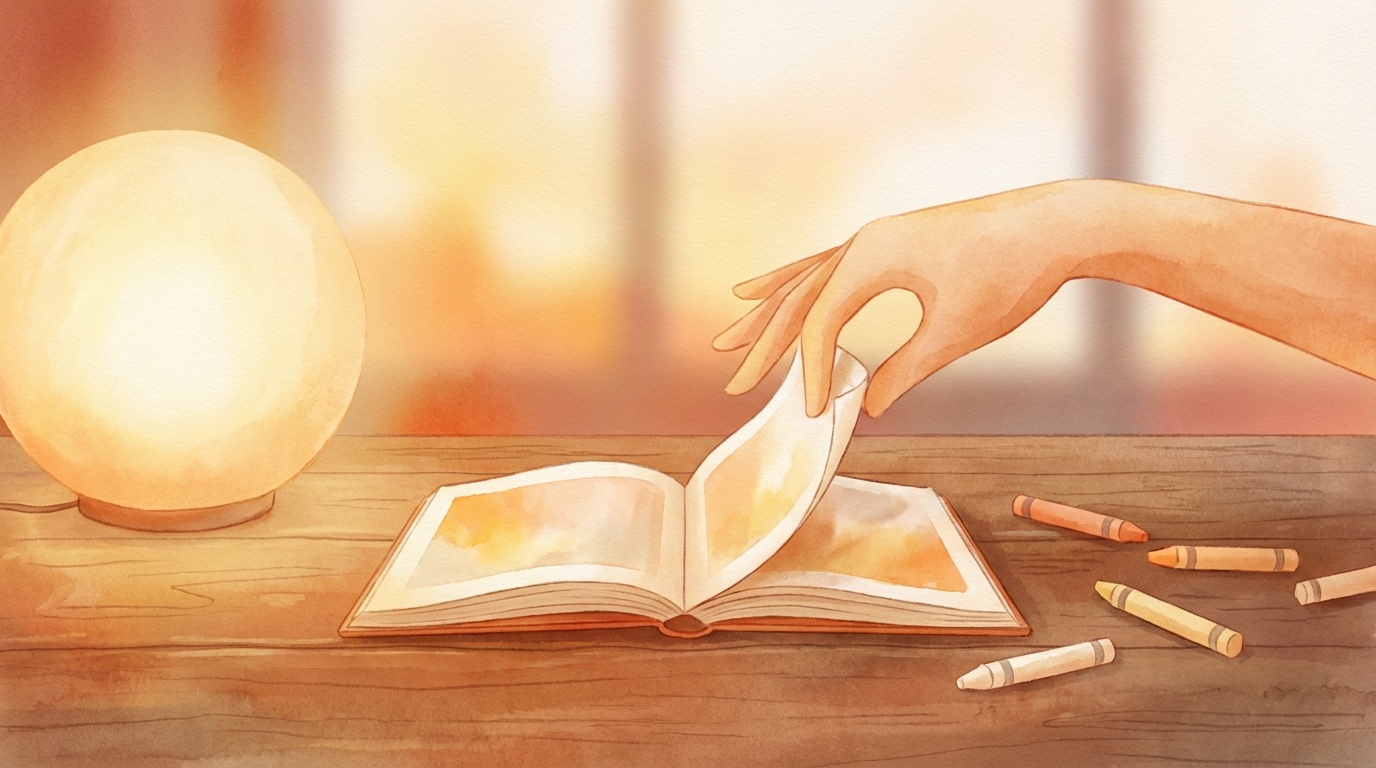
At 12:23 a.m., Saeki sat motionless, staring at her laptop screen. In front of her: twelve pages of picture book data. Story, illustrations, layout — everything in place.
"I actually did it."
Thirty-nine years old, mother of two, former graphic designer. For Saeki, who had not done anything resembling creative work in the seven years since her eldest daughter was born, this moment was a quiet shock.
Saeki had dreamed of becoming a picture book author in her twenties. While working at a design firm, she spent her weekends sketching storyboards and submitting entries to open competitions. She never won an award, but those days felt full.
Then came marriage, childbirth, and child-rearing. Time was stripped away without mercy. Late-night crying, daycare drop-offs and pick-ups, the endless loop of work and housework. There was no room left to draw.
She told herself, "When I finally have time." But as her children grew, that "someday" only drifted further away. Sometime after turning thirty-five, Saeki quietly let the dream go.
The turning point came at the end of January 2026 — a post that drifted across her social media feed.
"I made a picture book together with a conversational AI. Complete beginner, but it took shape in two months."
The poster was a salaried worker in their thirties who claimed to have no experience in programming or design. And yet there it was — a proper story. Illustrations too. Rough around the edges, but unmistakably a "work."
Something stirred inside Saeki.
Maybe I could do this too.
The following week, she signed up for a free conversational AI service. She knew nothing about how to write prompts or how to use image-generation AI. Even so, she decided to just start.
Saeki set three rules for herself.
The first month was devoted to building the story. She put a prompt to the conversational AI: "Give me ten picture book ideas for a five-year-old protagonist with friendship as the theme." The AI returned ten concepts in thirty seconds. She chose two, then continued the dialogue to develop the structure.
"Make the character's personality more specific." "Suggest three different ways to build up the emotion in the final scene." — The AI answered no matter how many times she asked. Whether she messaged at midnight or opened it at six in the morning, it was always there.
From the second month, she moved on to visuals. She generated rough images with an image-generation AI and used them as a foundation to redraw by hand. She never handed everything over to the AI completely. A quiet desire — I want to draw this myself — kept burning inside her.
The constraint of two hours a week paradoxically sharpened her focus. In the gaps between parenting, in the gaps between work — because time was limited, she could not afford to waste it. With the AI handling most of the ideation and rough drafts, Saeki was free to spend her time on what she truly wanted to do herself.
In late March, the twelve-page first draft was complete.
Saeki did not print it. She showed it to her eldest daughter (age seven) on a tablet.
"Mama made this?"
Her daughter's eyes went wide. She began turning the pages, reading aloud as she went. Saeki sat beside her in silence.
When her daughter finished the last page, she said:
"Mama, this looks like something from a bookshop."
At those words, tears blurred Saeki's eyes.
It is not a perfect work. A professional picture book author would probably see flaws everywhere. But it was, without question, a "work." For the first time in seven years, Saeki had finished something she had created.
Working with AI, Saeki noticed something.
AI generates ideas at stunning speed and in tremendous volume. But the one who chooses among them is you.
The moment of picking "this is the one" from ten AI-generated story concepts. The moment of looking at an AI-drawn rough sketch and deciding "I want to redraw this part myself." Every single one of those was Saeki's own call.
AI is a tool. But it is a remarkably capable tool. The parts where Saeki had once given up because she had "no time" — generating ideas, trial-and-error with structure, roughing out sketches — much of that the AI took on for her.
Because of that, Saeki was able to complete a creative work even within the constraint of two hours a week.
Saeki is now taking her next step.
She applied to a "self-made picture book read-aloud event" organized by her local library. In mid-May, she is scheduled to read her picture book in front of a group of children.
"I'm nervous, but I want to try."
That is how she puts it.
Seven years ago, Saeki gave up on a dream. But now, with a tool called AI and a small pocket of two hours each week, she is setting that dream in motion once more.
The goal is not to create a perfect work. It is to turn "someday" into "now." That is what Saeki gained by working alongside AI.
AI is not all-powerful. But it can be the trigger that sets something you had nearly given up on moving again.
Two hours on the weekend. One smartphone. Free AI tools.
That alone might be enough to get your own "someday" started.
Yes. The case introduced in this article also began with zero AI experience. What matters is having a clear picture of what you want to achieve. HAIIA's Practitioner Course lets you learn how to work with AI in a structured way — no programming required.
If you keep up two to three hours on weekends for three months, you will start to see your first "I did it." Because AI handles drafting and research, the big difference is that you can focus on what only you need to do.
HAIIA has a community where like-minded people gather. Having a place to share your wins and talk through your stumbling blocks makes a remarkable difference to how consistently you keep going.
This article is reprinted from HAIIA Notes.