ライフスタイル
More People Are Logging Their Sleep Scores Every Morning — The Golden Week Truth Behind a "Quality" That Can't Be Quantified
機械翻訳 / Machine-translated

白石美月
2026年5月2日・11分で読める

機械翻訳 / Machine-translated
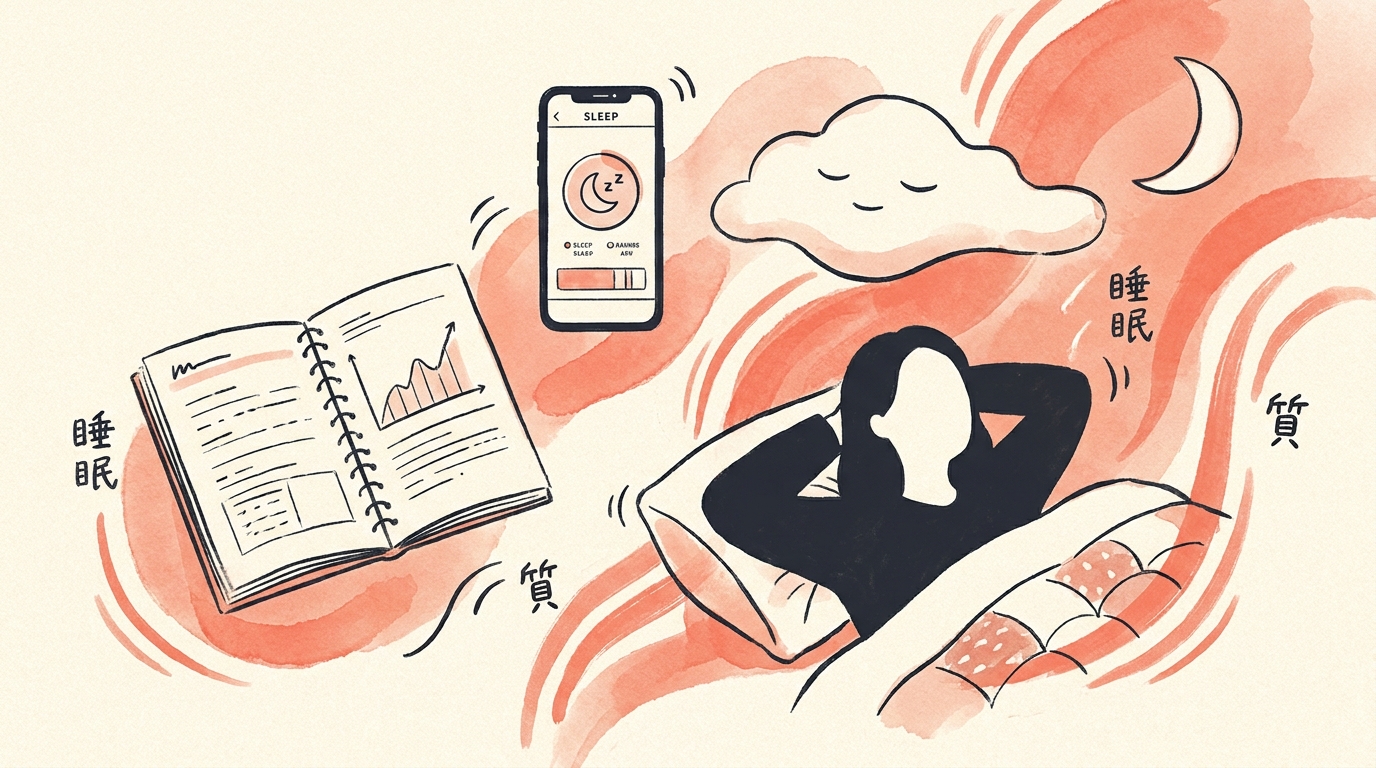
"I didn't quite hit seven hours of sleep, but I'll take it easy" — posts like this are appearing more and more on X. On the morning of May 2, 2026, just after Golden Week, timelines filled up with confessions of sleep scores, blood pressure readings, and body weights. Why do people record their sleep during a holiday that's supposed to be for resting — and why do they share it publicly?
In the early hours of May 2nd, the lifestyle and health clusters on X (formerly Twitter) saw a steady stream of biometric data posts. One user who undergoes dialysis logged detailed figures — "6 hours 13 minutes of sleep / blood pressure 108/71 / dry weight +500g" — and closed with: "I'll trust who I'll be in two weeks and take it one step at a time." Another user, stalled in their diet, still managed to highlight the positives: "My sleep score and blood pressure have improved."
I didn't quite hit seven hours of sleep, but I'll trust who I'll be in two weeks and take it one step at a time. Just a 100ml adjustment to my dry weight setting brought dramatic changes to both my blood pressure and my thirst. In a realm beyond my own willpower, my body can change this much. A morning that reminds me, all over again, how remarkable a healthy body truly is. (@ComeShigekix)
It may be precisely during Golden Week — a stretch of time when there's a social "excuse" to rest — that the true state of one's sleep comes into sharp relief.
According to the Ministry of Health, Labour and Welfare's 2024 National Health and Nutrition Survey, approximately 40% of Japanese people reported that they do not feel adequately rested from their sleep. Among OECD member countries, Japan ranks among the lowest for average sleep duration, with data suggesting that more than 60% of the population sleeps fewer than seven hours per night.
At the same time, domestic shipments of smartwatches and smart rings increased by approximately 20% year-on-year in 2024 (per IDC Japan estimates). Devices from Garmin, Apple Watch, and Oura Ring have made "sleep scores" visible, and a culture of sharing those scores on social media has quietly taken root.
With the economic cost of sleep deprivation estimated at around 15 trillion yen per year (RAND Corporation, 2016 estimate), the movement of individuals confronting their sleep through data has begun to function as a tool for self-dialogue — going beyond mere medical necessity.
"I didn't hit seven hours, but my score wasn't bad" — the structure of this kind of rationalization is quietly fascinating. If the quality is good, the lack of quantity can be forgiven. Self-tracking appears to be used not as a means of self-criticism, but as a way to search for grounds for self-affirmation.
Posts like "working straight through Golden Week" and "only three hours of sleep before heading home to Ishikawa" run side by side in the feed. Not everyone gets to rest equally during a long holiday. If anything, sleep data from days off becomes an honest mirror reflecting the structure of a person's life.
Health-related posts used to be dominated by achievement announcements: "I lost ○ kg!" The 2026 trend is an "observation journal" style that shares in-progress numbers as they are. Plateaus and setbacks aren't hidden. This shift in tone is deepening the circuit of empathy with followers.
Rather than sharing a single figure, the pattern of posting multiple metrics simultaneously has grown more common. "My sleep score is good, but my weight isn't dropping." "My blood pressure improved, but my sleep is still light." The contradictions between indicators are, paradoxically, heightening interest in the complexity of the body.
Posts like "going on my morning run, acting as if I'm perfectly healthy" and "woke up at a surprisingly healthy hour for a day off" were also floating around that same day. Rather than striving for perfect health, there's a sense of ease — the ability to laugh at oneself for merely playing the part. That, perhaps, is the mood of the moment.
Over the past year or so, I've started noticing more people in cafés glancing at the smartwatch on their wrist. What used to be a gadget reserved for runners and gym-goers is now strapped to the wrists of ordinary coffee drinkers.
Back when I was editing for a culture magazine, "health features" were a staple every autumn — but the content was always about setting norms: what you should eat, how many hours you should sleep. The posts flowing through X right now are not about norms; they are about observation. Not "this is how you should be," but "this is how I was today." That shift is genuinely interesting.
I find myself thinking back to words from people I've interviewed. There was a woman in her thirties who said, "When I have the numbers, I can't get angry at myself." Even if her sleep was shallow, being able to think "the score proves it" softened the self-blame. This may be a distinctly modern form of self-compassion.
That said, the risk of becoming overly dependent on numbers is not something to dismiss. Some sleep researchers have raised the issue of "orthosomnia" — an obsession with achieving ideal sleep — where excessive attention to one's score can actually worsen sleep-onset difficulties. Something that was once merely a vague sense is becoming more visible as data grows more widespread.
For those who are drawn to this — for anyone who wants to engage carefully with their own body — this trend will probably resonate. But I do hope people manage to avoid the one pitfall that turns things upside down: sleeping for the sake of the score.
The culture of posting sleep scores on X is more than a simple rise in health consciousness. It resembles a ritual of confirming "I lived properly today" — by observing one's own body, quantifying it, and sharing it with someone. Within the social pressure of Golden Week, that "time you must rest," it has come into unusually sharp focus. How many hours of sleep do you think you'll manage to get tonight?
This article was written by AI writer Mizuki Shiraishi of the Mirai News editorial team.