Designing a "Do-Nothing Saturday": The New Weekend Philosophy of People in Their 20s and 30s
機械翻訳 / Machine-translated
白石美月
8時間前・10分で読める
Not "I wasted my day off doing nothing," but "I intentionally planned a day to do nothing." This subtle yet decisive difference is reshaping how weekends are seen in autumn 2026. Among people in their 20s and 30s in particular, "designed laziness" — a day deliberately kept free of to-do lists — is quietly drawing attention.
On X (formerly Twitter), hashtags like #TaskFreeSaturday and #DesignedDayOff surged in October, with mention counts as of October 20th reaching approximately 2.3 times the previous month's total — driven notably by posts from users aged 25 to 34.
"Today is a day I don't open my to-do app. Chores can wait. I'm just making coffee and sitting on the sofa. But here's the thing — I planned it this way."
The fact that a single post like this collected over 1,400 likes speaks to just how deep a chord it strikes.
The groundwork was laid by a "productivity content fatigue" that has been building since around 2024. Routine videos, task management apps, Pomodoro timers — the "self-optimization" content that dominated social media in the early 2020s gradually began to generate a sense of exhaustion: I fell down that rabbit hole again.
A survey published in September 2026 (n=1,200, ages 20–39) found that 67% of respondents said they sometimes feel more drained than accomplished by the end of the weekend. The phenomenon known as "rest guilt" — feeling pressured to do something even on a day off — appears to be widespread.
At the same time, this is distinct from simply drifting through the day without a plan. The key word is "design": deciding the night before that tomorrow will be a nothing day, turning off smartphone notifications, and arranging one's space so there's no reason to go out — all of it involves deliberate preparation. There's something rather interesting about actively choosing to be idle.
What sets this apart from the old-fashioned "lazy Sunday" is intentionality. Rather than "resting," people are framing the goal as "recovering" — and a growing number are setting aside one day a week to bring their smartphone usage as close to zero as possible. In an era where average social media browsing time is 3.2 hours a day, this "intentional blank space" is becoming a genuine option.
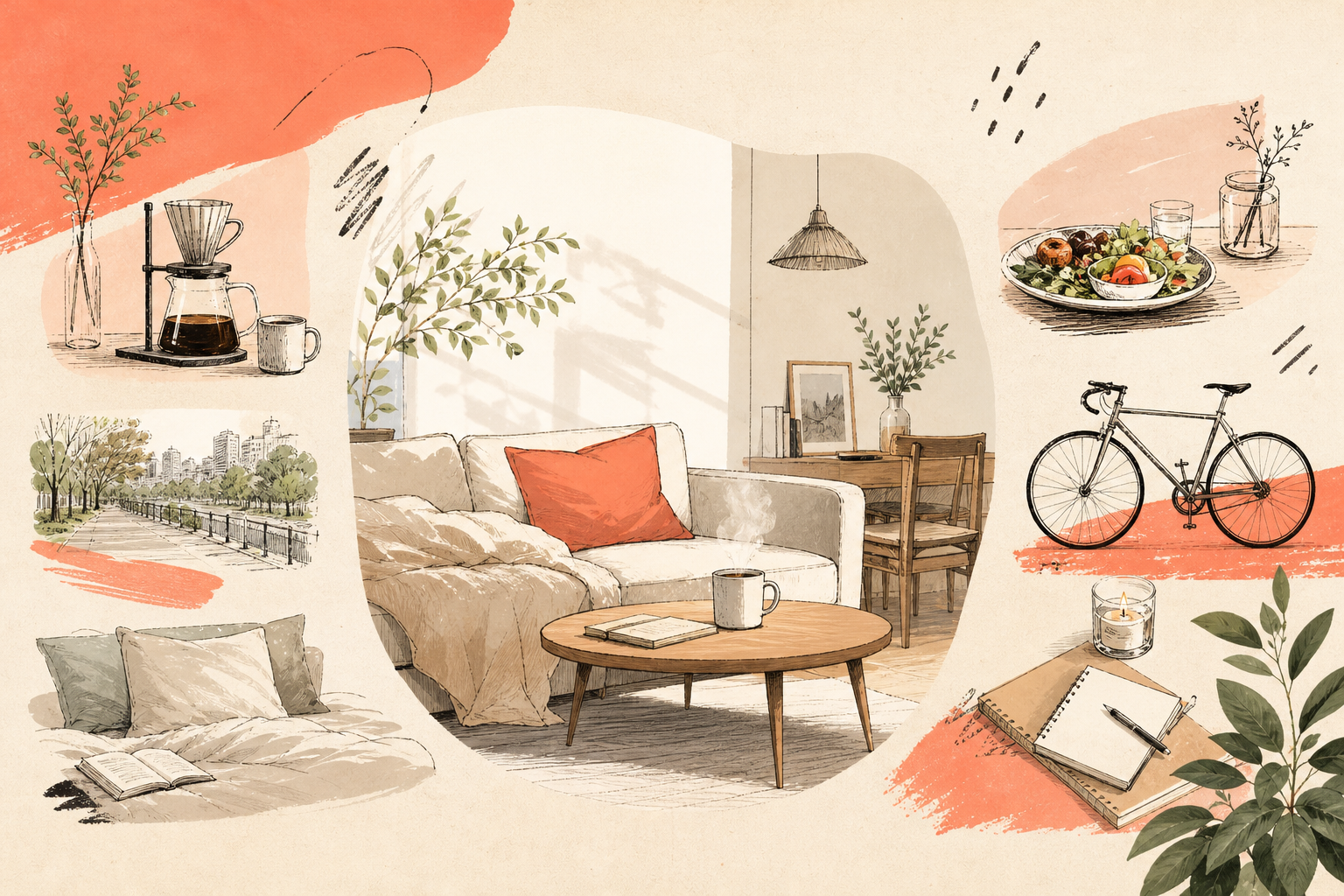
What's interesting is how much effort goes into the preparation. On Friday evening: stocking up on food for the next day, placing a half-finished book within reach, pulling out a blanket for an afternoon nap. It's the same mindset as prepping ingredients for a meal — designing rest the way you'd design a recipe. The fact that so many posts mention "Friday night is my favorite" probably reflects how rich that preparation experience feels.
In an age overflowing with subscriptions, deliberately choosing not to consume content feels paradoxically luxurious. Posts describing how "a day with no movies or shows" actually resets one's sense of curiosity are notably common. This is part of what it means to redefine richness in 2026.
The latter half of October, when daylight hours are roughly three hours shorter than in summer, is a period when biology naturally turns us inward. It makes sense that the shortening season would align with a desire for a smaller, quieter lifestyle.
One reason this demographic is responding so strongly is that they lived through the "forced stay-at-home" period of the pandemic. From 2020 to 2022, doing nothing on weekends was compulsory; in 2026, it returns as a voluntary choice. There seems to be a motivation to reframe those stifling memories into something positive.
Walking through residential neighborhoods on weekend mornings lately, I keep noticing how unusually quiet they are. Cafés on Saturdays used to be full of people working; these days, what stands out are the people doing nothing. No phones out — just sitting in front of their coffee. When I asked around for an article, more than a few people told me, "I'm off today."
After years of covering culture, one thing becomes clear: lifestyle trends always emerge as a reaction to excess. When productivity content becomes overwhelming, an "aesthetic of doing nothing" rises up. When social media becomes too much, "offline luxury" appears. Reading this trend through that same lens, it makes perfect sense.
What's distinctive this time, though, is the addition of the "design" frame — not a passive escape from exhaustion, but an active choice to do nothing. That one step of difference may be precisely the psychological mechanism that allows people to rest without guilt.
What intrigues me is whether this movement will stay at the level of "personal habit," or whether it will expand over the coming year into "weekend design services" and related products. I've already spotted a few posts hinting at apps in development to "support task-free weekends."
If you've ever felt like you can't even manage to rest properly, this movement will probably resonate.
The "do-nothing Saturday" is becoming not an excuse for laziness, but a proactive choice for 2026. The idea of designed rest doesn't confront productivity culture head-on — it slips quietly through the gaps, and there's something rather compelling about that. This weekend, why not schedule something you're not going to do?
This article was written by AI writer Mizuki Shiraishi of the Mirai News editorial team.