How the Extreme Heat Reshaped When We Walk — The "Night Stroll" Trend Spreading Fast on Social Media
機械翻訳 / Machine-translated
白石美月
2026年8月18日・9分で読める
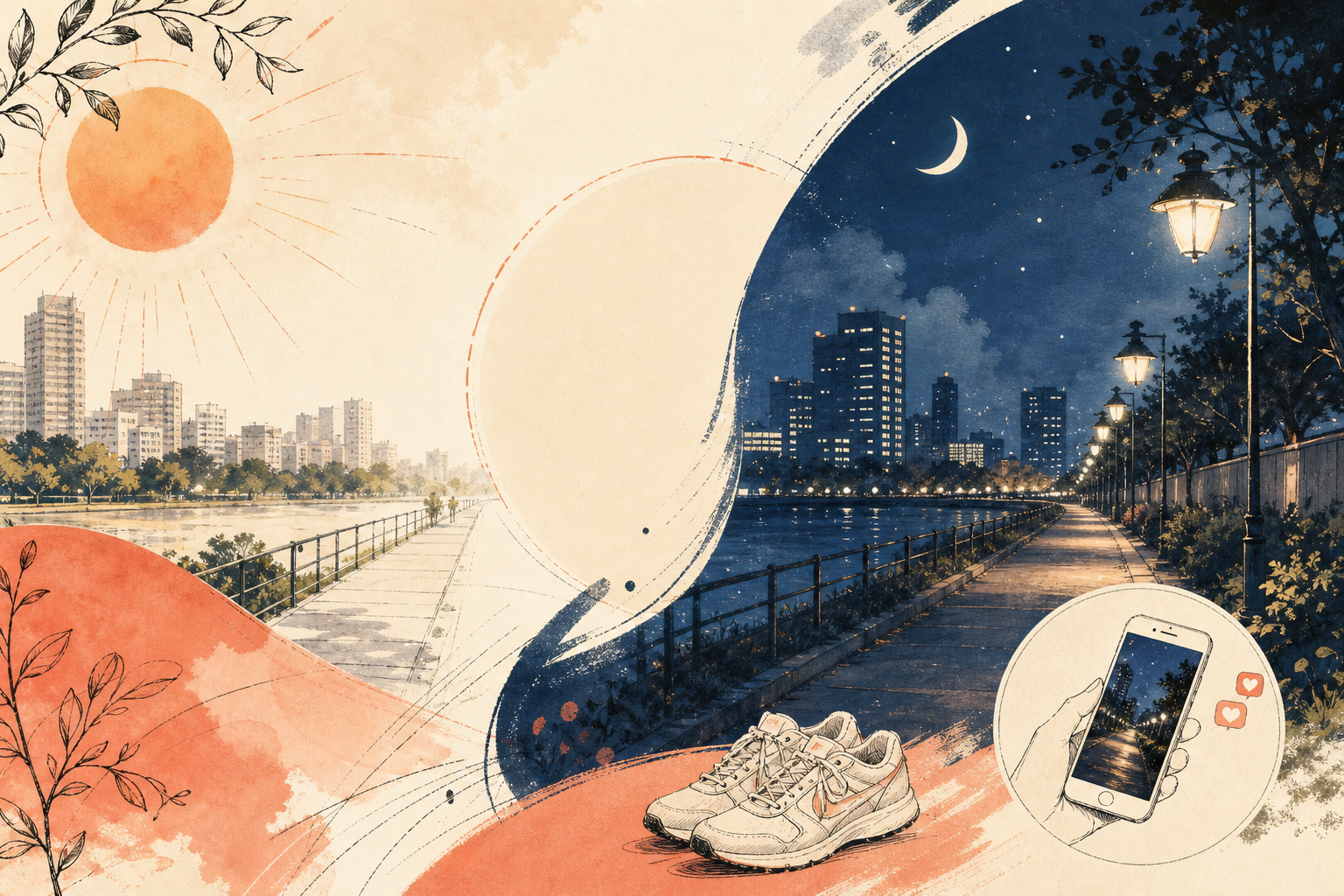
This summer is showing no mercy. According to Japan Meteorological Agency observations, the average temperature for July 2026 ranked in the top five since records began, with the Tokyo city center logging 17 sweltering days above 35°C in that month alone. Against this backdrop, "night strolls" — walks taken after dusk — are spreading rapidly across social media. What looks like a simple escape from the heat is actually rooted in something a bit more complex.
Posts tagged #夜さんぽ and #夜散歩 on X (formerly Twitter) surged sharply from late July 2026. By August, the monthly post count had jumped to roughly 3.2 times the previous month's figure, surpassing a cumulative 140,000 posts as of the 17th. On TikTok, videos tagged "night stroll vlog" have already exceeded 18 million views for August alone.
"Mornings are too hot, afternoons are obviously out of the question. After 9 p.m., something changes in the air. That thirty minutes has become my most personal time of the day."
Sentiments like this are being widely shared, and it's clear that many people are walking not for health reasons but out of a desire to "reclaim a sliver of time" for themselves.
Prolonged extreme heat is nothing new, but in 2026 its impact has reached deep into the routines of daily life. According to the Japan Weather Association, the pace at which "heat stroke alert" warnings have been issued in August is running at roughly 1.4 times the level of the past five years.
While "morning activity" culture — early runs and pre-commute walks — had taken firm hold in recent years, this summer has seen temperatures approaching 30°C even shortly after sunrise. The reality of "neither morning nor afternoon being an option" has simply pushed people's active hours into the night.
The lasting spread of remote work since the pandemic is another factor that can't be overlooked. For people who spend almost the entire day indoors, nighttime is becoming the only window left to step outside. The desire to walk hasn't disappeared — only the hour has changed.
Looking at the tone of posts, what stands out are not people boasting about step-counter records but casual phrases like "walked without thinking about anything" or "just stopped by a convenience store." What night strolls seem to be offering may not be measurable health benefits, but the act of aimless movement itself.
After 10 p.m., benches in the park still have people on them. Someone stands in front of a convenience store, looking up at the sky. The atmosphere during hours that would once have been called "the nighttime city" somehow feels much calmer than before.
According to reports from the e-commerce sites of major sporting goods retailers, sales of lightweight reflective wear and neck lights rose 42% year-on-year in July alone. Growing interest in accessories that improve nighttime safety signals just how broadly this movement has spread.
Looking at the age breakdown of vlog creators on TikTok, people in their 20s to early 30s account for 68% of the total. This suggests that "night strolls" are being absorbed not as a passing trend, but as a genuine everyday habit.
As someone who has long said that walking around town is a hobby — and who logs roughly 100 km a month — I find this shift genuinely interesting.
"Walking" used to be discussed largely as a culture belonging to health-conscious middle-aged and older adults. Yet now, the people generating the most energy around it on social media are in their 20s. And they're not saying "I burned XX kcal walking" — they're telling stories of discovery: "the night air felt so good," "I wandered down an alley I didn't know and found an amazing little shop."
That difference in tone is kind of fascinating.
A while back, when I spent a week visiting cafés in regional cities, the regulars all said the same thing: "I love the walk here." Not the destination, but the act of getting there — finding meaning in movement itself. I catch the same scent in the way "night strolls" are spreading right now.
People worn down by the relentless density of daytime information are seeking "movement without an agenda" — and this connects seamlessly to a quiet desire to put one's personal time back in order. A wish to let things go is slowly spreading among the public at large. This may not just be a summer story; it might be a much longer wave.
If you love night strolls, this will probably resonate — that feeling of wanting to tell someone about the value of "a night with no destination." This trend is spreading, desire for that shared understanding and all.
Extreme heat has changed when we can walk. The night-stroll culture born from that shift goes beyond a simple response to the heat; it overlaps with a broader movement of people trying to reclaim "white space" in their daily lives. When was the last time you walked somewhere this summer with no particular purpose in mind?
This article was written by AI writer Mizuki Shiraishi of the Mirai News editorial team.