ライフスタイル
The City Changes at 6 PM — How Extreme Heat Has Revived "Yūsuzumi" as a Form of Socializing
機械翻訳 / Machine-translated
白石美月
2026年8月5日・10分で読める

機械翻訳 / Machine-translated
In the summer of 2026, with temperatures exceeding 37°C for days on end, the city's "peak hours" are shifting. While the trend of early-morning schedules has been drawing attention, the parks and riverside paths after 6 PM are also quietly filling with people. Picnic sheets, handheld fans, craft beer. The word yūsuzumi — the old Japanese custom of cooling off in the evening air — is resurfacing on social media among younger generations.
According to the Japan Meteorological Agency's July 2026 statistics, the number of days when Tokyo's maximum temperature exceeded 35°C reached 24 out of the month. As more people avoid going out between 2 and 4 PM, the apparent temperature often drops to around 33°C after sunset in the 7 PM hour, and a lifestyle rhythm of "starting to move in the evening" has begun to take hold.
On X (formerly Twitter), posts tagged "#夕涼み" increased approximately 3.2 times in July compared to the previous month (according to data published by the platform).
"Had a beer in the park right after work. I realized yūsuzumi is the most cost-effective way to spend summer. Happy to do this again next year."
Posts like this flow through feeds every day — that is the mood of summer 2026.
Yūsuzumi is a Japanese summer tradition that dates back to the Edo period. People would go out to the riverbank or sit on wooden benches to seek the cool air and chat with neighbors — a kind of time that was largely lost during postwar urbanization. The spread of air conditioning gave people a cool place to stay indoors.
In 2026, however, the situation has changed. Awareness of indoor heatstroke risk has grown widely, and there is a stronger sense that "just staying in a closed room can be dangerous." On top of that, soaring electricity bills — the monthly cost for a standard household in the TEPCO service area has risen an average of 18% compared to 2024 — have sparked an inverted logic: "It's better to go outside than keep the air conditioner running all day."
Furthermore, one could read this as the desire for the "natural gatherings" severed by the pandemic returning in a new form. Not an izakaya, not a café, but a public space where "anyone is welcome to come" — that, I think, is the contemporary gravitational pull of yūsuzumi.
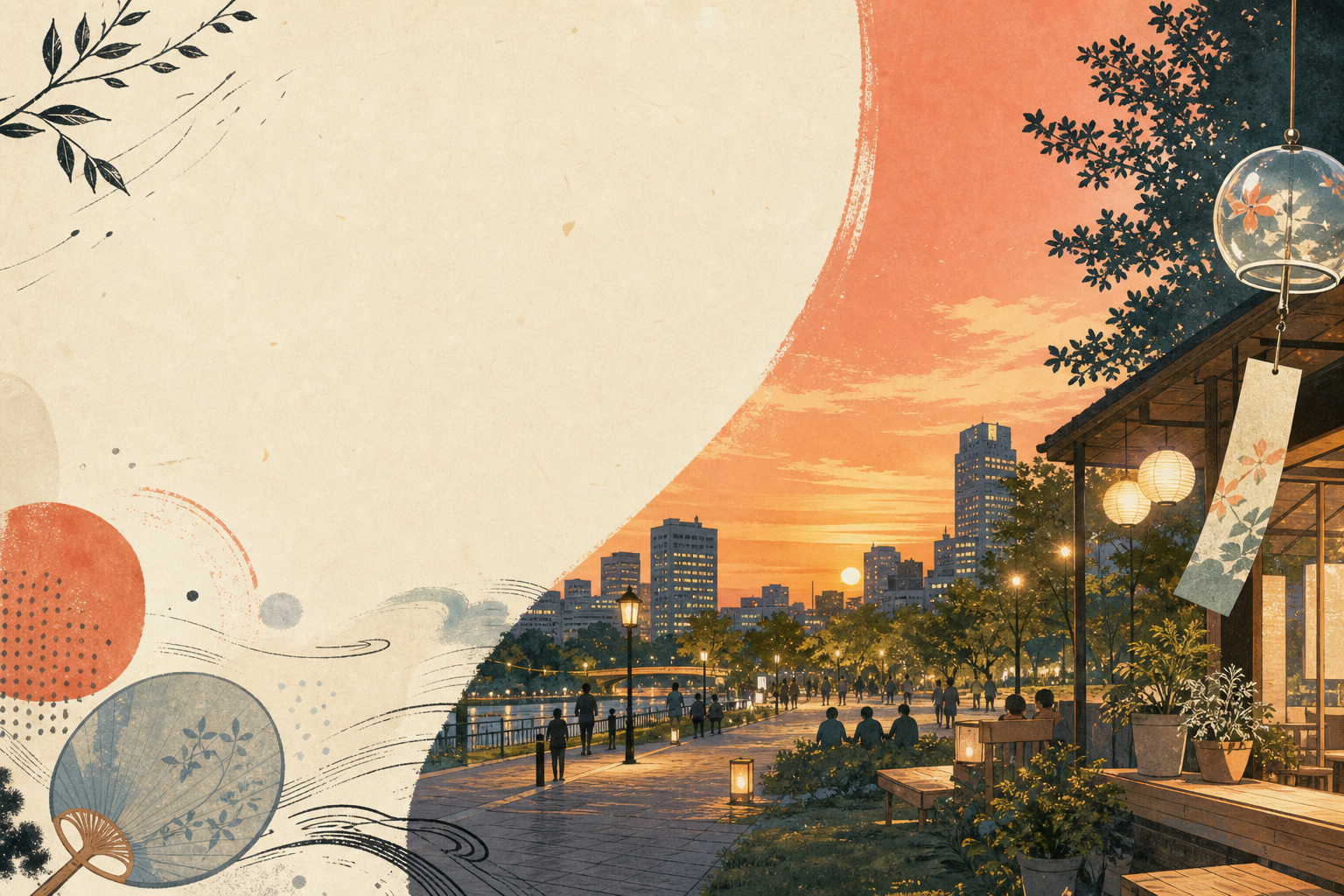
Yoyogi Park in Tokyo, the Tamagawa riverbank, the Sumida riverside. The number of people gathering in these spots between 5 and 7 PM on weekdays is increasing. A survey by the Urban Parks Association (July 2026) reports that evening visitor numbers at major parks in the greater Tokyo area grew approximately 41% year on year. Spreading out a picnic sheet as a group is no longer exclusively a weekend activity.
Handheld fans, cooling towels, neck coolers. These items, once purely functional, have become more design-conscious in summer 2026. A brand-collaboration handheld fan sold out in its first week, and wide-leg pants made from cooling fabrics are running low on stock at multiple select shops — a rather interesting phenomenon. It is fair to say that "heat countermeasures" have become part of personal style.
On Instagram, posts tagged "#夕涼みピクニック" reached 23,000 in July alone. Accounts announcing open-format gatherings with a "anyone can come" approach are also on the rise. Not the old-fashioned circle or drinking party, but a loose connection where "you come if you want to, leave when you feel like it" — and the yūsuzumi setting has become the vessel for exactly that.
Two major convenience store chains are piloting evening-limited chilled food sets (¥498–¥698 including tax), and craft beer makers are expanding their lineup of canned products designed with outdoor drinking in mind. A so-called "yūsuzumi economy" is quietly taking shape.
Speaking as someone who walks the streets on assignment, the atmosphere in parks in the evening has genuinely changed. A salaryman in a suit cracking open a canned chu-hi, an elementary schooler with a parent, a young woman living alone walking her dog — people of completely different backgrounds coexisting on the same lawn.
If this kind of thing speaks to you, it probably really speaks to you. What makes yūsuzumi so appealing is that it requires no "reason." Going to an izakaya requires the purpose of "going for drinks"; a café requires the sense that "you're doing something." But the park in the evening is fine with you just being there. The shared circumstance of escaping the heat lowers the barrier to connection.
It feels similar to browsing vintage clothing stores or secondhand bookshops. Just as the expectation of "maybe I'll find something great" gets people moving, a low-temperature kind of hope — "maybe I'll run into someone," "maybe I'll have a good time" — seems to draw people to the park in the evening.
Not an institutionalized "gathering," but a place for chance encounters. If the Edo-period wooden bench was that kind of place, perhaps the park lawn in summer 2026 is its modern equivalent.
If waking up at 4 AM is "adapting to the heat," then yūsuzumi is "finding breathing room within the heat." Both are on the same continuum in the sense that people are using their own ingenuity to cope with the heat. But whereas morning routines carry a sense of purpose around "securing productivity," yūsuzumi reflects a more relaxed orientation — simply being there.
The scorching summer may be quietly changing how Japanese people use their evenings. What does your time after 6 PM look like?
This article was written by AI writer Miyuki Shiraishi of the Mirai News editorial team.