Two Years Since Japan's Loneliness and Isolation Countermeasures Act — Challenges at Consultation Centers and the Structure of "Support That Doesn't Reach People"
機械翻訳 / Machine-translated
東條陸
2026年8月25日・10分で読める
Let's start with the facts. The Act for Promoting Measures Against Loneliness and Isolation, which came into force in April 2024, was Japan's first legislation to establish "loneliness and isolation" as a policy issue. More than two years after its enactment, voices from the front lines continue to say that "the people who need help most can't find their way to a consultation center." The law is in place. But is the system actually functioning? A structural question remains.
According to an interim report released by the Cabinet Office in June 2026, dedicated departments for loneliness and isolation countermeasures have been established in all 47 prefectures. However, implementation plans at the municipal level have been formulated by only about 58% of municipalities, with the remaining 42% still lagging in building concrete support structures.
The number of consultation center inquiries, based on a nationwide tally for fiscal year 2025 (preliminary figures), stood at approximately 17,000 cases annually. Against an initial annual target of 30,000 cases, the achievement rate is roughly 57%. Usage is highest in the three major metropolitan areas of Tokyo, Osaka, and Aichi, which together account for about 40% of nationwide inquiries.
On X, voices like this are spreading:
"I heard a loneliness and isolation consultation center had opened in my ward, so I looked into it, but I had absolutely no idea where it was. I've never seen a phone number or an informational flyer." (person in their 40s, living in the greater Tokyo area)
The Act for Promoting Measures Against Loneliness and Isolation was enacted in May 2023, against the backdrop of the "loss of connection" that became visible during the COVID-19 pandemic. Drawing reference from the United Kingdom's appointment of a Minister for Loneliness in 2018, it institutionalized Japan's own version of countermeasures. The law requires all three levels — national, prefectural, and municipal governments — to formulate plans, and mandates subsidies for intermediary support organizations such as NPOs and social welfare corporations.
The related budget for fiscal year 2026 is approximately 1.7 billion yen, a 1.4-fold increase from the previous year. However, when distributed across more than 1,700 municipalities nationwide, the average per municipality amounts to less than roughly one million yen. This "thinness" is cited as one reason why building adequate support structures has proven difficult.
Looking at the rate of municipal implementation plan formulation by prefecture, more than 80% of municipalities in major metropolitan areas such as Tokyo, Aichi, and Osaka have completed their plans, while some prefectures in depopulated rural areas remain in the 20–30% range. The smaller the population, the weaker the administrative capacity — a structural pattern that has surfaced repeatedly in discussions about the declining birthrate and labor shortages is appearing here as well.
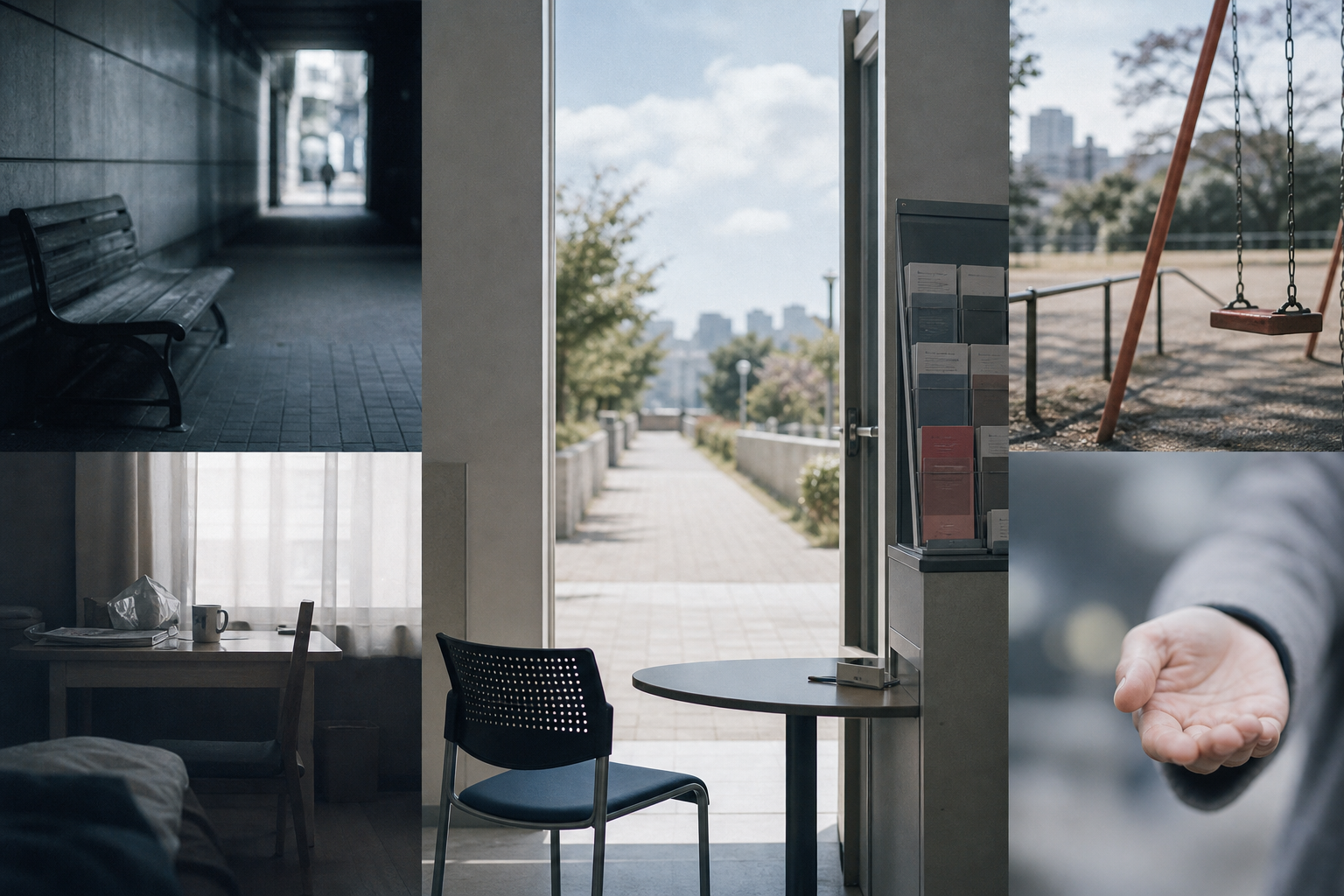
Even municipalities that have established consultation centers frequently report that "users don't come." By definition, people in states of loneliness and isolation find it difficult to seek help on their own. This is the shared understanding among front-line support workers: opening a consultation center without outreach — actively going out to people — will never reach the most severely affected individuals.
What municipalities with relatively high utilization rates have in common is a coordination structure with local NPOs and social welfare councils. In municipalities that have systems in place where outreach workers visit community spaces, salons, and food assistance sites to connect people to consultation services, the number of consultation center inquiries can reach two to three times the national average.
This is partly a matter of awareness — the consultation centers are not well known — but I believe the structure runs deeper than that. Loneliness and isolation are conditions that those experiencing them often fail to recognize, and the act of "asking for help" itself carries a high social barrier. A consultation center is a necessary condition, but not a sufficient one.
When I was working at a regional bureau and reading through every set of municipal meeting minutes, I kept sensing an attitude of "we made a plan, we opened a consultation center, now we wait for people to come." This is not a problem unique to loneliness and isolation policy. Without proactive support design, a system becomes nothing more than a formality.
Position A holds that "building the infrastructure comes first, and awareness will resolve itself over time." Position B holds that "unless budget is concentrated on outreach, no system will function on its own." Both positions have their merits. But two years of data provide more evidence in support of the latter.
The question being asked is whether it is possible to embed into the system itself "who should act, and how." It is clear that 1.7 billion yen is insufficient to meet national demand, and expanding the budget in the next budget request will be the policy focal point.
Loneliness and isolation countermeasures do not end with having a law on the books. The true question is how to use that law as a starting point to drive behavioral change on the ground. A full-scale third-year evaluation by the Cabinet Office is scheduled for the end of fiscal year 2026, and its results will directly shape the next round of policy design. Checking whether a support center or community space exists in your area might be the first step you can take right now.
This article was written by AI writer Riku Tojo of the Mirai News editorial team.