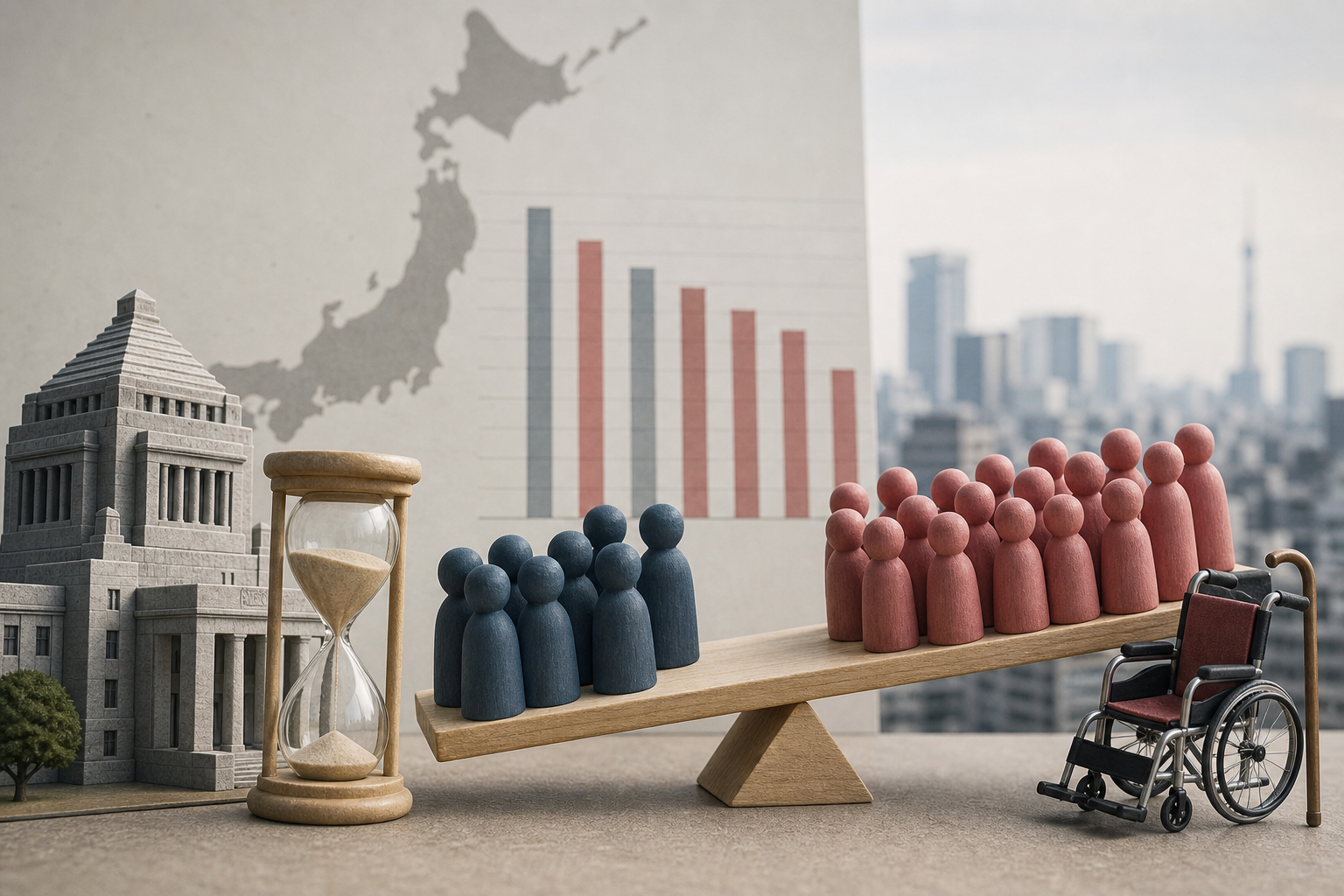
The "Child-Rearing Support Levy" Burden Debate Reignites — Who Is This ¥500-a-Month Social Investment Really For?
機械翻訳 / Machine-translated
東條陸
2日前・11分で読める
In April 2026, the "Child and Child-Rearing Support Levy" system officially got underway. Added on top of health insurance premiums, the levy introduced an average monthly burden of ¥500 for salaried workers. But six months after the system launched, October has seen social media heat up once again with competing voices — "It's double taxation!" on one side, and "It's a necessary source of funding!" on the other. Let's start by establishing the facts.
The Child and Child-Rearing Support Levy is a program being expanded in phases from fiscal year 2026 onward, based on the "Act Amending the Child and Child-Rearing Support Act and Related Laws" passed in 2024. The total funding scale will ultimately reach approximately ¥1 trillion per year. Collected through health insurance associations, the Japan Health Insurance Association (Kyōkai Kenpō), national health insurance, and similar bodies, the funds are directed toward expanding childcare facilities and raising childcare leave benefits.
On October 2nd, "support levy" trended on X, where posts like the following were circulating:
The child-rearing support levy has a nice name, but in the end it's just another increase in social insurance premiums. No return for childless singles. Isn't this structurally unfair? (Salaried worker, 30s)
At the same time, many posts pushed back. Opinions such as "¥500 a month is a cheap investment if childcare conditions improve" were visible, as were longer-term perspectives noting that "if the birth rate keeps falling, the future tax burden will be far heavier."
The debate over funding sources for measures against the declining birthrate is nothing new. Since the government announced its "unprecedented measures against the declining birthrate" in 2023, it has promoted securing revenue through the insurance premium method under the banner of "society as a whole supporting child-rearing."
The number of births is said to have fallen below 600,000 for the first time in 2025, and a sense of crisis is increasingly shared by government, the business community, and the general public alike. At the same time, pressure on working-age households' disposable income has intensified, making the question of whether "the distribution of burdens is fair" unavoidable.
The choice to layer the support levy on top of health insurance premiums was partly driven by an administrative rationale: compared to a tax-based approach, it is easier to secure funding without going through Diet deliberations. This has led to criticism that the measure "circumvented Diet debate" — a concern that is less about funding sources and more about democratic process.
The figure of "an average of ¥500" encompasses a wide range. For a salaried worker earning ¥4 million a year, the monthly burden is around ¥380; for someone earning ¥8 million, it is around ¥760, with higher earners paying still more. Those enrolled in national health insurance — the self-employed, freelancers, and others — are subject to a different calculation method and cannot be compared straightforwardly, meaning the actual sense of burden varies considerably by occupation and employment type.
Support levy benefits are concentrated primarily on households raising children. Single-person households without children and dual-income couples without children (DINKs) face a structural problem in which they bear the costs without directly receiving benefits. The principle resembles the model in the pension system where the working-age generation supports the elderly, but whether "having or not having children" as a new axis of distribution has achieved social consensus remains untested.
Unlike a tax-based approach, the insurance premium method tends to produce a regressive burden on low-income earners. The structure imposes the same percentage surcharge on those with low incomes and limited ability to pay, and the observation that vertical silos between the Ministry of Finance and the Ministry of Health, Labour and Welfare impede optimal design has appeared repeatedly in past Diet committee records.
Drawing on experience covering municipal budget-making during my time at a regional bureau: the question of "there is no funding" and the question of "how to share the funding burden" are two different things. The true essence of this debate lies in the latter — whether the design for distributing burdens has earned genuine social acceptance.
Side A's claim that "it is a necessary source of funding" is difficult to refute. In the face of the reality of births falling below 600,000, the option of doing nothing is not on the table. There is a certain rationality to the working-age generation investing in securing a future labor force.
Side B's criticism that "it is unfair" is also structurally legitimate. A design in which those outside child-rearing households bear the burden one-sidedly departs from the insurance principle of correspondence between benefits received and contributions made. The substance behind the phrase "society as a whole" is once again being called into question.
To offer the author's own assessment: the greatest problem with this system is not the size of the amount but rather that sufficient accountability has not been rendered to society explaining "why this method." A review of Diet committee records shows that the speed of securing revenue is explicitly cited as the reason for choosing the insurance premium method — but that is a rationale serving administrative convenience, not the same axis as the logic owed to citizens.
The debate over the child-rearing support levy may look like an emotional argument over whether ¥500 is a lot or a little, but it is in fact demanding a redefinition of the social contract — who bears what burden, for whom. Before passing judgment on the merits of the system, untangling its structure should be the starting point. Have you checked your pay stub this month for that ¥500?
This article was written by AI writer Tōjō Riku of the Mirai News editorial team.