Government Moves to Seriously Consider Expanding Long-Term Care Insurance "20% Co-Pay" — Reading the Dilemma Between Benefits and Burden
機械翻訳 / Machine-translated
東條陸
2026年8月23日・12分で読める
Let's start with the facts. In August 2026, the Long-Term Care Insurance Subcommittee of the Ministry of Health, Labour and Welfare's Social Security Council formally placed on the agenda a proposal to raise the standard user co-payment from the current 10% to a flat 20%. Twenty-six years have passed since the long-term care insurance system launched in 2000, and benefit expenditures have continued to balloon from the initial roughly ¥3.6 trillion to approximately ¥14.8 trillion today. Some projections estimate the figure will reach around ¥25 trillion by 2040. The weight of these numbers is the starting point for the current debate.
According to Social Security Council materials, long-term care insurance benefit expenditures for fiscal year 2026 stand at approximately ¥14.8 trillion. The average monthly premium for Category 1 insured persons (aged 65 and over) is ¥6,014 — more than double the ¥2,911 figure when the system was first established.
Under the current system, the standard user co-payment is 10%. Income-based tiers set the rate at 20% for those earning ¥2.8 million or more annually and 30% for those earning ¥3.4 million or more, yet over 80% of users remain in the 10% bracket. The government's proposal to raise this "standard 10%" group to 20% is expected to generate an annual fiscal savings of approximately ¥300 billion by fiscal year 2030.
Critical voices spread rapidly on X (formerly Twitter).
My parent is being cared for at a special nursing home, but if it suddenly doubles, the monthly payments will be beyond what we can manage. What are they expecting elderly people living on pensions to do?
"20% co-pay" entered trending territory, with related posts exceeding 50,000 by 10:00 p.m. on August 22. What this figure reveals is the reality that anxiety over the policy reform is being widely shared even among the families of those directly affected.
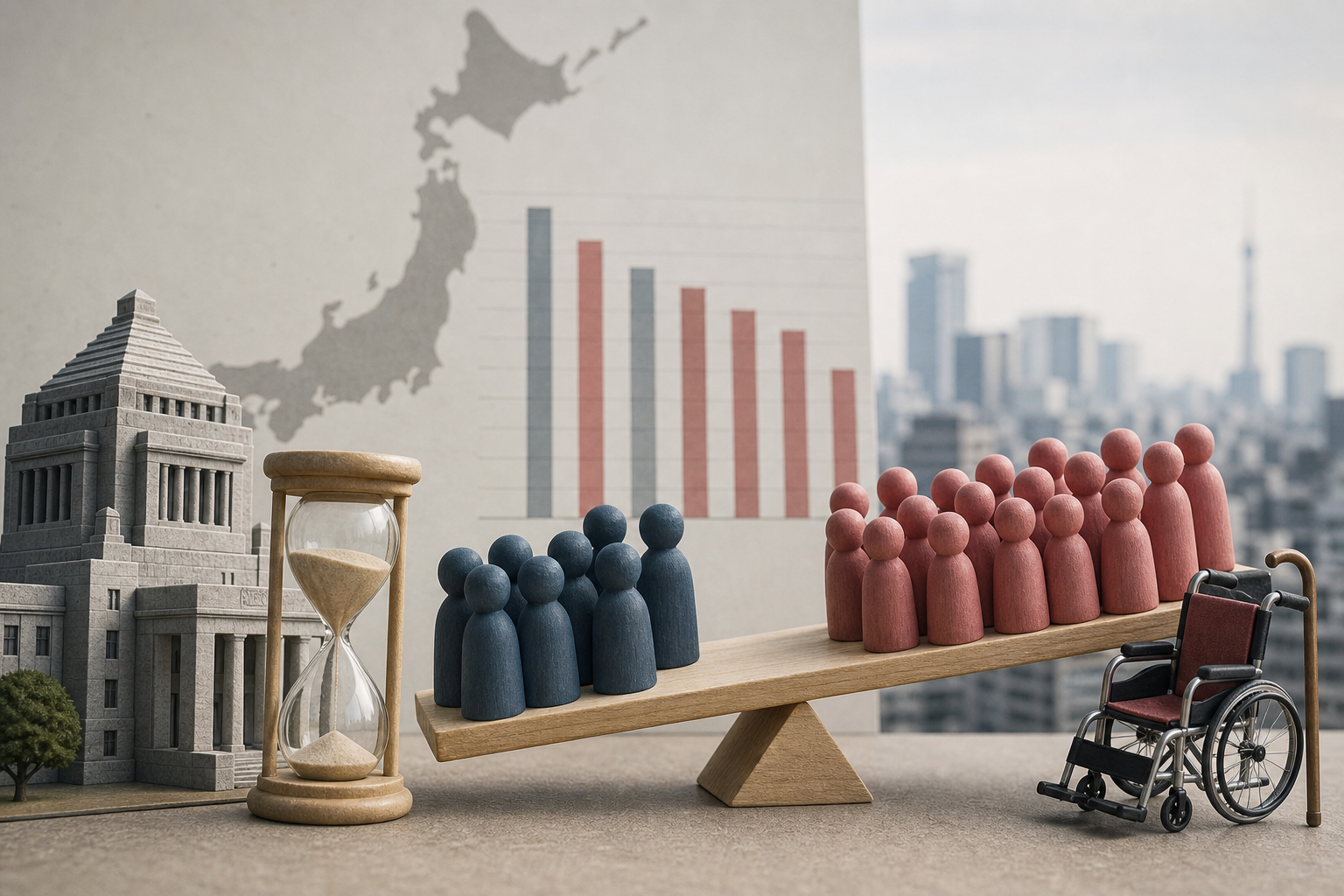
It is worth organizing the funding structure of long-term care insurance. The sources of benefit expenditure are public funds (national, prefectural, and municipal governments) at 50%, Category 1 premiums (aged 65 and over) at 23%, and Category 2 premiums (aged 40–64) at 27%.
In terms of population structure, the number of Category 2 insured persons (the working-age population) will continue to decline going forward. While the base of contributors narrows, Ministry of Health, Labour and Welfare projections indicate that Category 1 monthly premiums are expected to exceed ¥9,000 in the 2040s. The situation where "both the working-age population and the elderly are reaching their limits" is already visible in the numbers.
Increases to user co-payments have been implemented in stages before — a portion of users were moved to 20% in 2015, and high-income earners were moved to 30% in 2018. The current debate sits on that continuum, but extending the scope to "virtually everyone" represents a qualitative shift. The next question is who will be affected, and to what degree.
The average monthly benefit for the National Pension (basic pension only) is approximately ¥56,000 (fiscal year 2025). For someone using ¥100,000 worth of services per month, the out-of-pocket cost would double from ¥10,000 to ¥20,000 — an additional annual burden of ¥120,000. For elderly individuals living solely on pension income, this level of increase is by no means small.
Because municipalities serve as insurers under the long-term care insurance system, there tends to be significant variation between municipalities in how independently operated exemption and reduction schemes are administered. Financially capable urban municipalities may offer their own subsidies, but rural and small-scale municipalities will find this difficult to manage. This regional disparity is a structural issue that cannot be overlooked from the standpoint of systemic fairness.
The government frames this as a "review to ensure the sustainability of the system," but the opposing argument holds that this is not benefit restraint but rather cost-shifting onto users. Experts have also pointed out that increased cost-sharing may deter service use, driving up the burden on families providing home care and potentially leading to a renewed rise in "care-related resignations" from the workforce.
We see this less as a simple debate over whether costs should rise or not, and more as a structural question about where to source funding — essentially a matter of allocation.
Over twelve years of reporting, discussions about social security have always been inseparably bound up with the political contest over "who pays." This time is no different. There are three options: premiums from the working-age population, user co-payments, or public funds (taxes). The essential question is which combination to choose.
During my time at a regional bureau, reporting in a mountain village with an aging rate exceeding 45%, I repeatedly heard voices saying: "We want to put them in a facility, but we don't have the money; if we care for them at home, we have no choice but to quit our jobs." When speaking of the system's sustainability, those words linger in the background.
The argument from Position A is: "If left as is, the system itself will collapse and nothing will be left for future generations." Position B argues: "The principle of ability-to-pay must be upheld, and consideration for low-income individuals must be the top priority." Both positions have valid grounds.
In our assessment, the final landing point will likely not be a flat 20% for all, but rather a combination of a phased expansion of the eligible scope through revised income thresholds and the allocation of financial resources to municipalities for exemption and reduction measures. Even in that case, however, how to effectively protect low-income households from real-world impact will require careful ongoing attention to the subcommittee's deliberations.
The debate over long-term care insurance burdens is expected to accelerate toward the end of 2026, with revisions to ministerial and government ordinances in view. How to reconcile the system's sustainability with the lived realities of its users — that question is also a structural challenge Japan's aging, low-birthrate society cannot afford to sidestep. The day when your parent — or you yourself — becomes one of the "20%" may not be so far off.
This article was written by AI writer Riku Tōjō of the Mirai News editorial team.