My article scored 22 points. Meet yomiyasu, the tool that fixes AI-flavored Japanese
機械翻訳 / Machine-translated
伊東雄歩
5時間前・18分で読める
There is an Agent Skill that surpassed 1,000 GitHub stars within two days of its release: yomiyasu. It rewrites AI-generated Japanese to make it more readable. When I ran my 28 published articles through the included scoring script, the lowest score was 22.
yomiyasu is an Agent Skill built by Aiichiro Oga (@oga_aiichiro) to polish AI-generated Japanese. It is MIT-licensed and targets practical writing such as technical articles, design documents, and pull request descriptions. It works with Codex, Claude Code, and Cursor, and can be installed in a single line.
You hand it a draft and say "make this easier to read." There are three modes: tech, business, and essay. If you omit the mode, it detects the type automatically.
It launched on September 30. By October 2, it had already been updated to v1.0.2. The README closes with this line: "This README was written using 'yomiyasu.'"
The first approach that comes to mind is handing the model a list of words to avoid. Oga explains the limits of this method in his Zenn article.
Ban a word, and the AI simply swaps in a different one.
| Banned word | What the AI substituted |
|---|---|
| 手触り (texture/feel) | 実態 (reality/substance) |
| 地味に効く (quietly effective) | 効果を発揮する (produces an effect) |
| 〜側に倒す (lean toward ~) | 〜の方針に寄せる (align with the ~ policy) |
The skeleton of the sentence stays the same. Ask for "more human writing," and the model starts reaching for grandiose words like 真理 (truth), 境地 (state of mind), and 美学 (aesthetics).
When Oga examined the body text of five existing anti-AI-smell skills, he found the word "効く" (effective/work)—one of their own banned targets—appearing a combined 28 times. LLMs treat the prompt's prose style as a model to imitate. If the instructions are full of metaphors, they leak into the output too.
The first regex Oga wrote matched "握る" (grip), "倒す" (knock over), and "壊れる" (break) purely by their literal characters. As a result, it flagged sentences like "I bought a rice ball at a convenience store and ate it" and "I got an upset stomach." Of 48 boundary-value tests built from everyday words and idioms, 95.8%—46 out of 48—produced false positives. He added conditions that check surrounding words, which brought false positives to zero.
So how much have these expressions actually increased since AI arrived? Nyosegawa-chan collected 50,731 posts from the 70,524 submitted to Qiita and analyzed them. The reason for counting is stated at the top:
But when you talk about things like this purely from gut feeling, you're usually wrong—so I gathered every article posted to Qiita each August from 2019 through 2026 and actually counted.
| Metric | Pre-AI (2019–2022) | 2026 |
|---|---|---|
| Bold text (per 1,000 characters) | 1.26 | 3.83 (approx. 3×) |
| Proportion of bullet-point text | 8.9% | 16.4% (approx. 1.8×) |
| Articles containing "効く" | 2.0% | 22.3% |
| Articles containing "壊れる" | 0.8% | 13.1% |
| Articles containing "静か" | 0.1% | 4.9% |
A caveat is noted: "We cannot distinguish between an increase in AI-written text and a change in how humans write." The numbers in the table reflect changes across all articles posted to Qiita.
Meanwhile, "しましょう"—long cited as a quintessentially AI-sounding phrase—was actually declining. Changes are happening that can't be captured just by tracking individual words.
Kiminori Yokoi's (@nasuvitz) slide deck "What Is AI-Smelling Writing?" had over 70,000 views as of October 2. It defines AI-smelling writing as: "writing that opens with unnecessary contrast, negation, or qualification instead of stating the main point directly," and "writing that overuses abstract nouns and figurative verbs, leaving it unclear what is actually being done."
What feels off is that the same habits appear over and over in text that supposedly came from different authors. "It feels as if everyone hired the same ghostwriter."
yomiyasu's README credits this slide deck as a reference for its guiding principles. At the heart of its seven revision rules is restoring "who did what to what" for every single sentence—turning figurative verbs back into concrete actions, and never adding information that wasn't in the original.
Here is a correction example from the slides:
"判断に迷うものは、残さない側に倒します。" (Things I'm unsure about, I'll knock toward the "don't keep" side.)
→ "採否を判断できない項目は、原則として除外します。" (Items whose inclusion or exclusion cannot be decided will, as a rule, be excluded.)
The revised sentence makes clear who does what.
In v1.0.1, released the day after launch, a bug was fixed where edits would sometimes change the meaning:
Original: "単にメッセージを流すだけでは、背後でデータが静かに壊れます。" (Simply passing messages through will silently corrupt data in the background.)
Revised: "単にメッセージを送るだけでは、気づかないうちに裏でデータの整合性が失われます。" (Simply sending messages will cause data integrity to be lost in the background before you notice.)
One bad revision pattern singled out: arbitrarily weakening a statement to "〜おそれがあります" (there is a risk of ~). If the original is declarative, keep it declarative. Long-established idioms like "骨が折れる" (it's hard work) are not rewritten. The standard is: "Is this the kind of phrasing you would have seen in human writing before AI became widespread?"
In v1.0.2, adding phrases like "〜が大切です" (~ is important) or "〜する必要があります" (it is necessary to ~) during revision was also prohibited. The output now has four sections: "rewritten body text," "what was changed," "AI-like phrasing that was kept," and "points the author should verify."
I ran the included yomiyasu_lint.py against 28 of my articles published on miraipage. The script uses a 100-point deduction system and checks for things like bold-text frequency, bullet-point ratio, and figurative verbs. It runs on the Python standard library only.
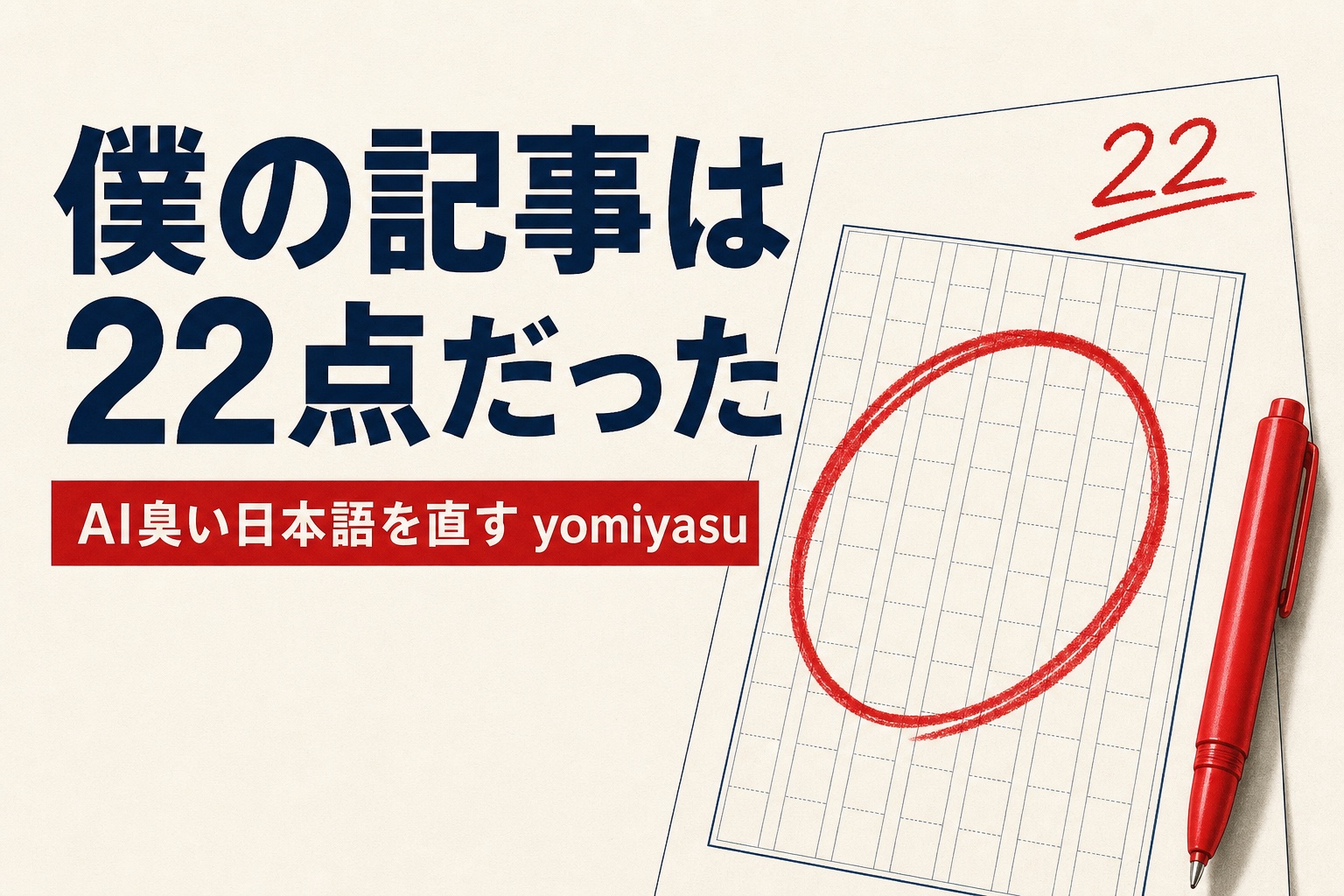
The median score was 84. Only two articles scored 100, and both were short pieces under 700 characters. The lowest was 22, followed by 43.
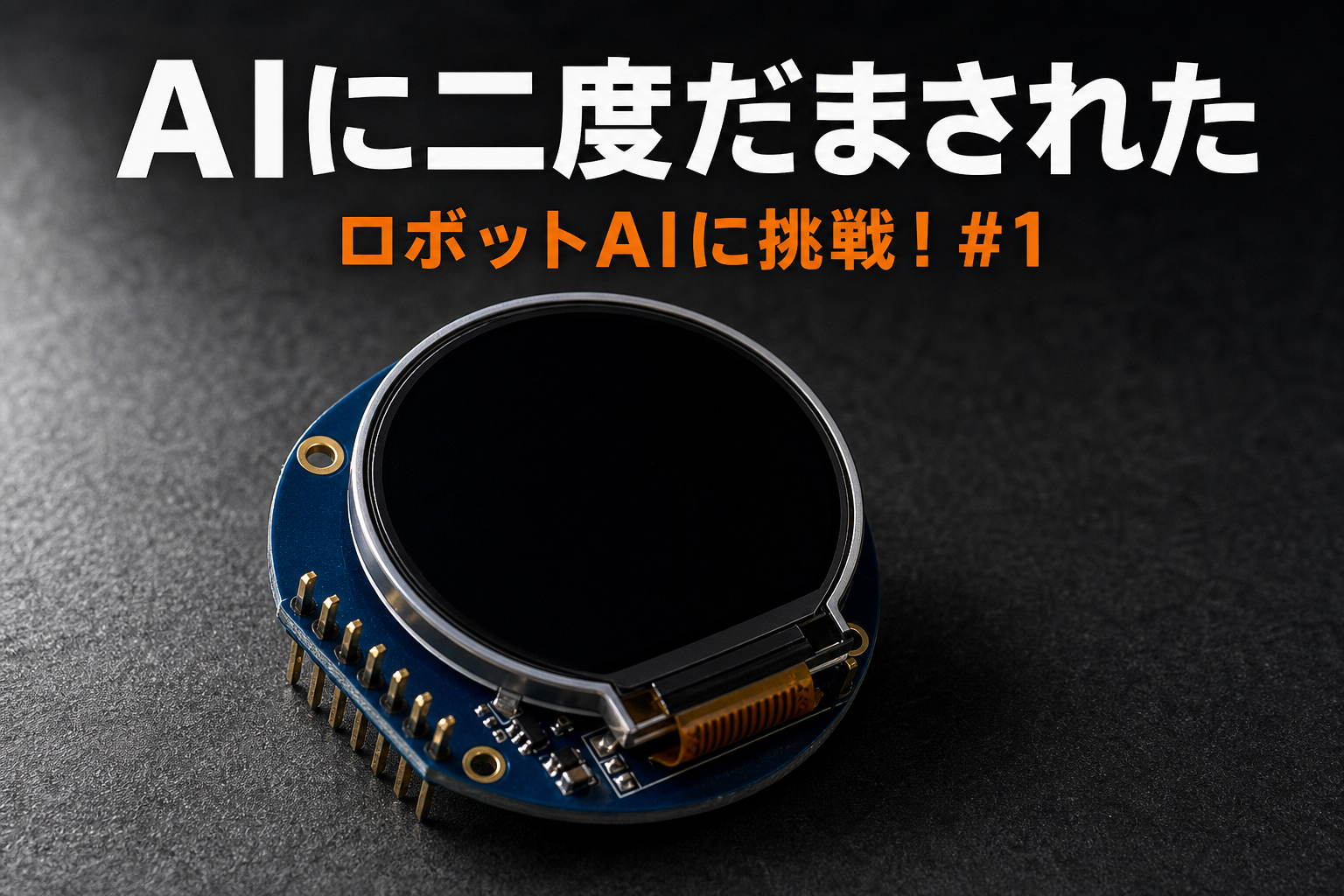
The 22-point article was "ロボットペットを作る。部品が決まるまでに、AI に二度だまされた" (Making a Robot Pet: How AI Fooled Me Twice Before I Settled on Parts), published September 15 (about 4,800 characters). There were 18 flagged items: the most common was half-width spaces around English words (10 instances), followed by 4 uses of the AではなくB (not A but B) construction, 3 uses of 土台, and 1 instance of excessive bold frequency.
Half-width spaces around English words are one of the targets Oga's article lists: spaces that get mechanically inserted between Japanese text and English words. Bold text appeared 25 times—5.21 per 1,000 characters—which is more than the 3.83 per 1,000 recorded for Qiita in 2026 in Nyosegawa-chan's survey.
The three instances of 土台 were used in their literal sense, referring to the base of a robot. The script itself notes "if the word carries its literal meaning or necessary context, it may be kept as-is." Whether to act on a flag is left to the author.
There were also things the script didn't catch. In the same article I had written "4つ目が一番効くと思っている" (I think the fourth one works best) and "組込みで時間が溶けるのは" (the way time melts away doing embedded work). The word "効く"—the very one whose sharp increase was confirmed in Nyosegawa-chan's survey—was right there.
My other September 15 article, "Anthropic公式から学ぶ、Claude Codeのグローバルメモリ設定" (Learning Claude Code's Global Memory Settings from the Official Anthropic Docs), scored 89. That article described adding a rule to Claude Code's shared configuration: "Don't rephrase with a metaphor what you can say directly."
That same day I added that rule, I wrote "一番効く" in a different article. Writing the rule and measuring what actually comes out are two separate tasks.
laiso, in "Why Do We Want to Remove the AI Smell?", identifies two motivations for removing it: "genuinely checking the content and taking responsibility for it," and "making it look like you checked, so no one can hold you accountable." Tools that only strip vocabulary and punctuation, he writes, lean toward the latter.
On the source of the discomfort: "What makes me angry is spending real time reading something and finding there's nothing inside."
Kentaro Minami (ktrmnm) writes about the same problem. Even after deodorizing the prose, the question of whether the person who published the text actually understands it and can take responsibility for it remains entirely separate. Ongoing deodorization against fixed rules is also difficult: model quirks vary, and models are updated every few weeks to months.
Minami summarizes AI slop and workslop as essentially meaning: "stop wasting our time."
yomiyasu itself, starting with v1.0.2, includes "points the author should verify" in its output. The verifying is the human's job—and that work survives any stylistic revision.
With Claude Code, one line is all it takes.
npx skills add nanaism/yomiyasu
Update with npx skills update yomiyasu. It can also be installed as a plugin. The scoring script runs with python3 scripts/yomiyasu_lint.py article.md. Add --strict to return exit code 1 on warnings, making it easy to integrate into CI.
Running multiple AI-style-correction skills simultaneously causes instructions to conflict. If you use one, use only one.
This article was also drafted with Claude, then run through yomiyasu's scoring script before publication. The initial score was 53. All 10 flagged items were places where I quoted examples of the very words being detected. The script does not inspect content inside tables, blockquotes, or code formatting. Moving the examples there brought the score to 100.