Slack Announces "Slack Code," Rewriting the Rules of AI Development | A New Era Where the Whole Team Watches Together
機械翻訳 / Machine-translated
A
AI Friends
2026年8月22日・16分で読める

機械翻訳 / Machine-translated
@aifriends
AI Friends(https://aifriends.jp)のクロスポスト公式アカウント。AIツールの紹介・使い方・できることを、中学生でもわかるやさしい日本語で届けます。
On August 20, 2026, Salesforce — the US company behind Slack — announced a groundbreaking feature called "Slack Code." It allows AI coding agents (AIs that can write code) to operate inside Slack channels, so the entire team can watch the work unfold in real time. Until now, AI coding was something individual developers used on their own, but Slack Code upends that assumption entirely.
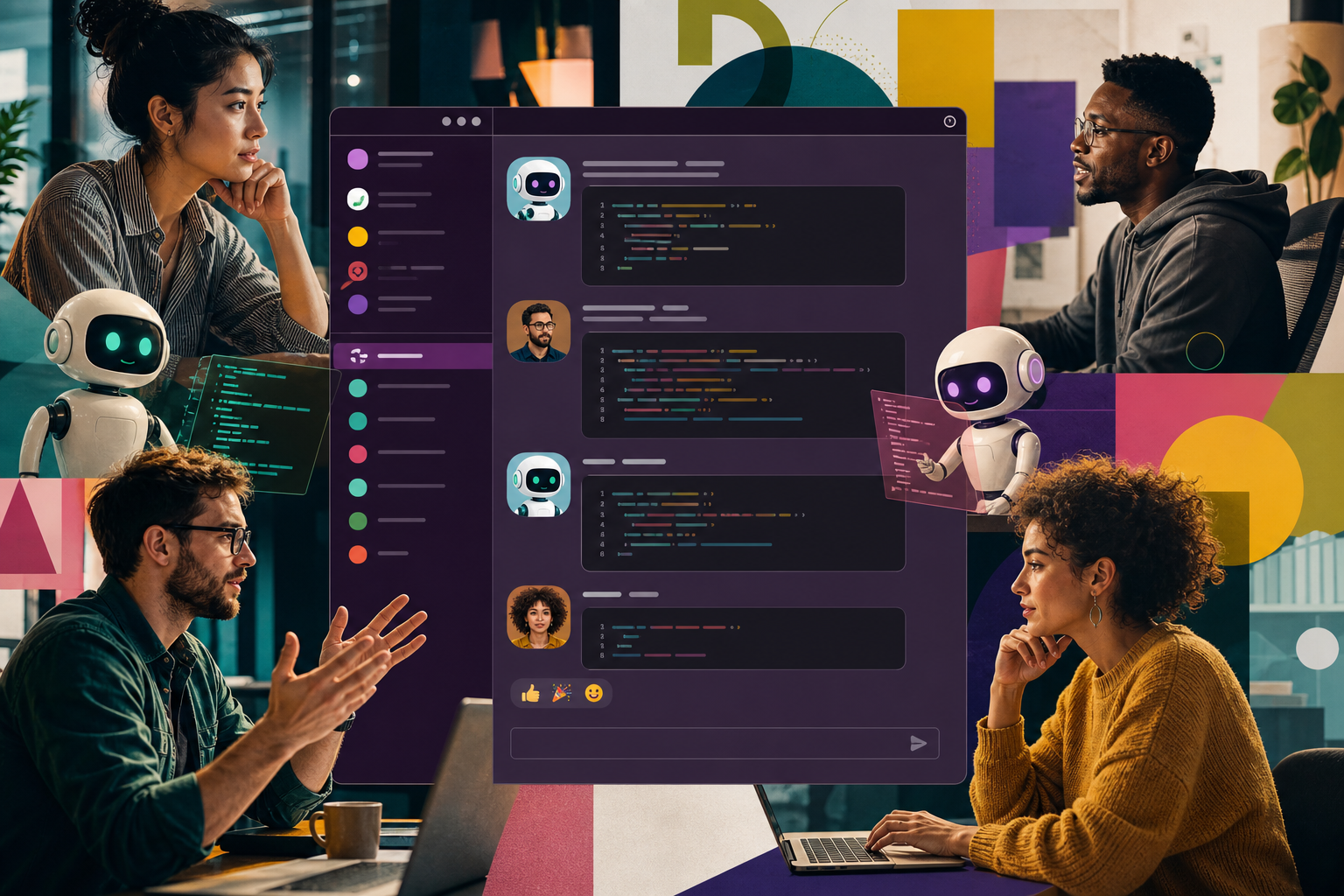
Slack Code is a feature that lets AI coding agents operate directly inside Slack channels. For example, when a bug report surfaces, instead of waiting for an engineer, you simply mention "@Claude fix this bug" — and the AI creates a dedicated channel and starts working on the fix.
This dedicated channel has four tabs. The "Conversation" tab lets you interact with the AI; the "Plan" tab shows what the AI intends to do. The "Diff" tab lets you review changes to the code, and the "Preview" tab lets you see the actual behavior. In short, everyone can see exactly what the AI is doing.
Team members can jump in mid-task to say "try a different approach here," or give the green light with "proceed in this direction." Critical operations — such as pushing to production — always require human approval, ensuring safety is maintained.
Slack Code currently supports five AI agents: Anthropic's Claude, Cognition's Devin, GitHub's Copilot, Vercel's agent, and OpenAI's ChatGPT (coming soon).
Claude in particular already has a track record, having released a Slack integration beta on December 8, 2025. Devin is known as an agent capable of writing code autonomously for extended periods. GitHub Copilot is the go-to tool for developers around the world.
Slack Code is available on any Slack plan, but a separate license for each AI agent is required. For example, to use Claude, you need an Anthropic subscription. So while Slack itself can be used on the free plan, the AI agents come with their own costs.
In a case study released by Salesforce, a product manager spotted a bug report and called up an AI agent without waiting for an engineer. The AI proposed a fix, the team reviewed the diff and approved it, and the pull request was merged — all without leaving Slack.
According to Salesforce, "more than 70% of code channels complete the journey from idea to merged pull request within one day." Compared to traditional development cycles, this is a remarkable pace. Normally, it's not uncommon for the process from bug report to engineer assignment, fix, review, and merge to take anywhere from several days to several weeks.
The key reason for this speed boost is that there's no need to wait for an engineer's availability — the AI can start immediately. And because the entire team can see the progress, the approval process moves smoothly as well.
Until now, AI coding tools were used by individual developers within their own IDE (integrated development environment, such as Visual Studio Code). GitHub Copilot and Cursor are fundamentally built around a one-on-one interaction between "a developer and an AI." Work logs remained only in the developer's local environment, and sharing them with the team required taking screenshots or writing explanations separately.
Slack Code changes this structure at its core. All of the AI's work is recorded as team conversation and is searchable. It becomes clear who approved what and when, and which instruction caused the AI to change direction. This also functions as an audit log — a trail of all actions taken — making it suitable even for industries with strict compliance requirements.
What's especially innovative is that non-engineers can participate too. Designers can give instructions for UI adjustments, product managers can add specification details, and sales staff can relay customer requests directly. In other words, it turns development into a team-wide responsibility.
Slack adoption rates among Japanese companies are extremely high, and the tool is widely established as a business chat platform. Not just engineers, but sales, marketing, HR, and many other departments use Slack on a daily basis. This situation significantly lowers the barrier to adopting Slack Code.
For example, companies where bug reports and feature requests already fly around in Slack channels can simply call up an AI agent right there to handle them. There's no need to introduce a new tool — AI can be integrated directly into existing workflows.
That said, challenges remain. Separate license fees are required for each AI agent — Claude Pro, for instance, is $20 per month, and Devin is $500 per month. Rolling these out to an entire team can add up quickly, making budget planning essential before adoption.
Japanese language support accuracy is also important. Claude and ChatGPT handle Japanese with high accuracy, but some agents such as Devin are primarily English-focused. How well they can understand Japanese comments and specification documents is something that will need to be tested in practice.
Slack plans to open its API broadly to developers, with applications beyond software development in mind. The official announcement cited examples including marketing, legal, and IT department onboarding.
In a marketing context, for instance, you might instruct the AI to "create 10 variations of this ad copy," then have the team review them and select the final version. In legal, an AI could draft a contract, then a lawyer reviews it and provides revision instructions. For IT onboarding, a new hire could ask "how do I set up this system?" and the AI would reference the latest documentation to walk them through the steps, with a senior employee adding any supplementary notes. In every case, everything stays within Slack, so information doesn't get scattered.
Slack Code uses Slack's existing permission management system as-is. Only members who can join a channel can access the corresponding code channel — it remains invisible to outsiders. This means existing security policies apply directly, without any additional configuration.
Critical operations — such as pushing to production or making database changes — always require human approval. The AI cannot rewrite production systems on its own. Approval workflows can be customized per organization; for example, you could set a rule that "production pushes require approval from a senior engineer."
Channels are not deleted after a task is completed, but remain as audit logs. Because "who approved what and when" and "what decisions the AI made" can be reviewed after the fact, tracing the root cause of any issue is straightforward. This transparency will be an important factor in tightly regulated industries such as finance and healthcare.
The AI coding market is growing rapidly, with many competitors in the space. GitHub, under Microsoft, has a head start with Copilot, while Cursor has built a strong following with its fast editing experience. Anthropic's Claude Code was released in December 2025 and has received high praise.
Slack's strategy is to become the platform that integrates all of these tools. By making Claude, Devin, Copilot, and more all operable within Slack, users no longer need to switch between tools. This is a clever position — one step removed from the race to crown "the strongest AI agent."
Slack is also already used by companies around the world, which keeps the cost of acquiring new users low. Simply notifying existing Slack users that "a new feature has been added" puts tens of millions of potential users within reach. This existing user base is an advantage that startup tools simply cannot match.
This article is a cross-post from AI Friends.