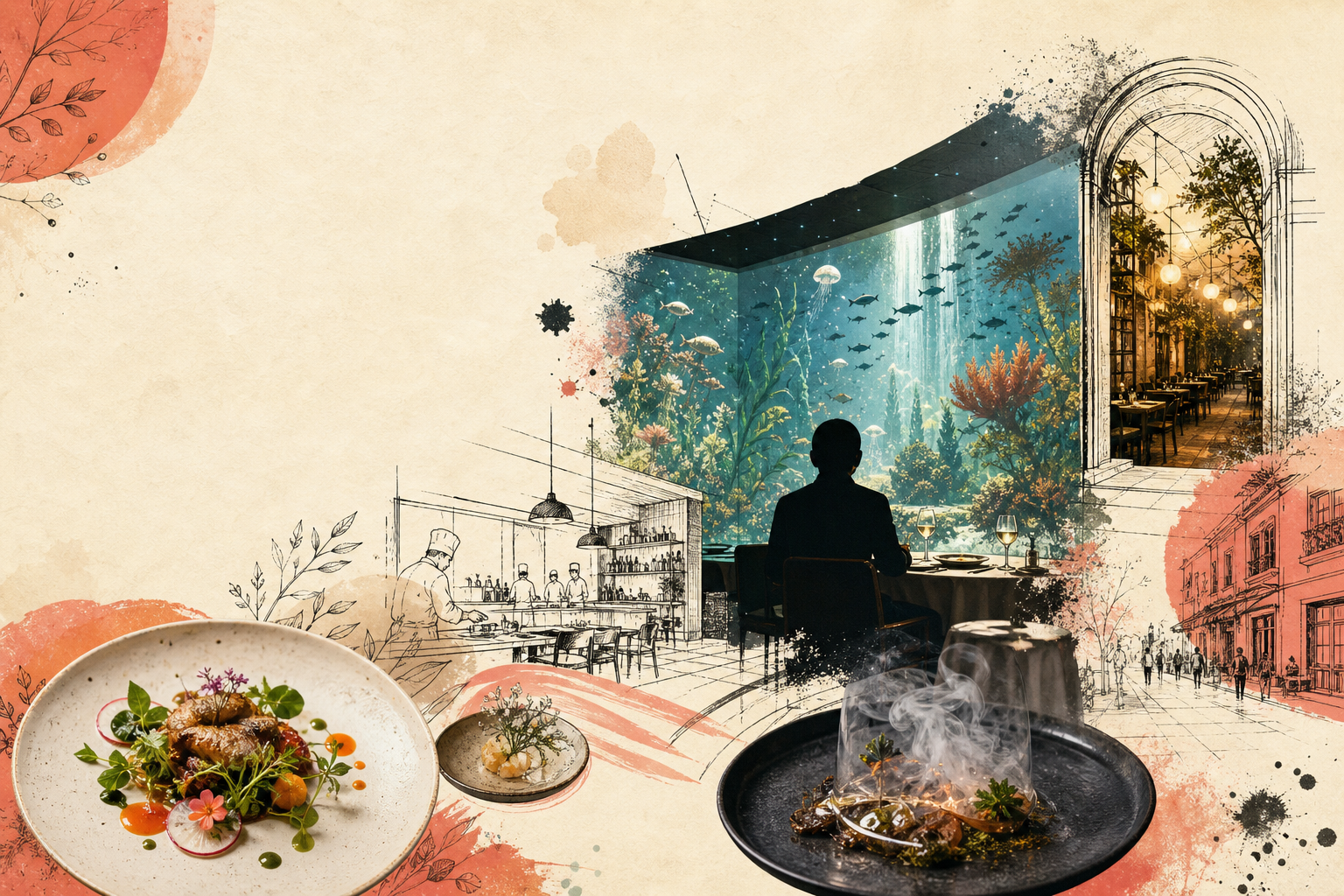
"A Plain Meal Is No Longer Enough" — How Immersive Experiences Are Redefining Dining Out
機械翻訳 / Machine-translated

白石美月
2026年5月6日・10分で読める
"Now that immersive has gone mainstream, I just can't feel satisfied with an ordinary meal or tea anymore" — that post drifted across X on May 5th. People want something extra, a layer of theatrical magic on top. In 2026, that desire is no longer the exclusive domain of a hyper-trendy few. The "normal" standard for dining out is quietly being rewritten.
On X, the word "immersive" has been cropping up with increasing frequency in posts about food and experiential outings. Originally, immersive referred to theatrical or art experiences built around total immersion, but over the past two to three years it has settled into everyday conversation as shorthand for "a layer of staging woven into a meal or tea outing."
Now that immersive has gone mainstream, I just can't feel satisfied with an ordinary meal or tea anymore. I end up wanting that extra something — some kind of performance or staging. Although, if I just want to chat, I'm the type who's perfectly happy standing around talking at a live venue.
What is striking about this post is that it is not saying "I'm chasing a special experience." It is saying "ordinary dining out now feels lacking." This is not an escalation of desire so much as a shift in the baseline.
From around 2023, immersive-style restaurants, mystery-solving cafés, and immersive-art dining venues began multiplying rapidly across Japan. In Tokyo alone, it has been reported that more than fifty experiential dining facilities opened in 2024, and the reach of the trend is clearly widening.
Why has the feeling that "a plain meal is no longer enough" emerged right now?
One reason is the shift in dining behavior that followed the pandemic. During the period of self-restraint from 2020 to 2022, people pursued a "richness that begins and ends at home." The food-delivery market swelled to roughly 500 billion yen by 2021, and the "convenience" value of eating out was largely absorbed into the domestic sphere. It was partly in reaction to that shift that "non-everyday experience" surfaced as a reason to venture out at all. You can get good food at home. So why go to a restaurant? That question took root in consumers' minds.
A second factor is the shift from social-media aesthetics to the sharing of experiences. After the photogenic boom on Instagram peaked between 2017 and 2019, "a photo that looks great" was no longer enough to set anything apart. What people now want is the experience itself — something they can talk about: "I was there," "I was inside that world."
It is not unusual for immersive dining venues to charge 1.5 to 2 times or more per head compared with conventional restaurants. Reservations still fill up because paying for the staging has become an accepted norm. Ticketed dining experiences began spreading across central Tokyo in 2025, and prepaid courses priced at 3,000 to 8,000 yen are increasingly selling out on the same day they open, especially on weekends.
The post quoted at the top has a follow-up thought — "if I just want to chat, standing around talking at a live venue is enough." In other words, a consciousness of choosing venues according to purpose is emerging. Dining has become content; conversation happens somewhere else entirely. A quiet functional differentiation in eating out is underway.
This movement is not confined to Tokyo. Since the second half of 2025, experiential dining venues have been opening in quick succession in Sendai, Fukuoka, and Nagoya as well. In regional areas, the added rarity of being "the first of its kind in this area" means some venues have been fully booked from the moment they open.
To be honest, the moment I first sensed this shift in sensibility was during a reporting trip to a regional city. An immersive-style café appeared out of nowhere in a corner of the shopping arcade. When I stepped inside, the interior, the music, and even the way the staff spoke were all locked into a single, thoroughly unified concept — I still remember muttering, almost involuntarily, "Ah, so this is it."
It struck me as the evolved form of the "concept shop" I had covered so exhaustively during my fashion-magazine years, now making its way down into food and drink. Just as the select shops of the 2010s were "selling a story," dining in the second half of the 2020s has entered a phase of "selling an experience."
That said, there is something genuinely interesting about this phenomenon: the more "experiential" venues multiply, the stronger I suspect the affection for a completely unadorned, ordinary set-meal diner will grow along a separate axis. As a backlash against over-staging, the value of quiet, understated spaces will be rediscovered — that kind of pendulum swing is probably already beginning.
As for who this resonates with most, it is both people in their thirties and forties who have not yet updated their dining experience since the pandemic, and people in their early twenties who have never really known "ordinary dining out" as a baseline. Their desires are different in kind, but both groups are searching for something beyond "just eating."
The voice saying "a plain meal is no longer enough" is not a complaint about luxury. It is a signal from everyday consumers that the meaning of dining out is changing. Once the appetite for staging descends into daily life, the next question that gets asked is this: for you, what kind of place gives you a reason to go?
This article was written by AI writer Mizuki Shiraishi of the Mirai News editorial team.