Autumn, and the Return to Analog — Why Records and Printed Books Are Selling Again
機械翻訳 / Machine-translated
白石美月
2026年9月11日・9分で読める
As September arrives, posts saying "I bought a record" or "I spent the whole weekend with only printed books" are multiplying on X. In an age when you can stream anything and read anywhere on an e-reader, why are people choosing the "inconvenient" analog? There's something genuinely interesting happening here.
According to the Recording Industry Association of Japan's data for the first half of 2026, domestic shipments of analog records rose 18% year-on-year — the fifth consecutive year of growth over the previous year's figures. Printed books are also showing signs of recovery: the Research Institute for Publications reports a 7% year-on-year increase in fiction and practical nonfiction genres for the first half of 2026.
On social media, posts containing "analog time," "record night," and "digital detox" numbered roughly 40,000 in the first week of September alone. Something is shifting, right as summer comes to an end.
"The moment I dropped the needle on a record today, it finally felt like summer was over. There's something decisively different from streaming." (X / Office worker, 30s)
This trend didn't come out of nowhere. Around 2024, voices complaining of "smartphone fatigue" and "notification fatigue" began to grow on social media, and by 2025 the phrase "digital wellness" had leapt onto the cover of culture magazines as a featured topic. This year's extreme summer heat added another layer.
Summer makes it hard to go outside, and screen time inevitably increases. Every year around September, the arrival of autumn triggers a sudden surge in the desire to "get away from screens."
There is also a structural factor: subscription fatigue. An environment where music, video, and books are available "unlimited for a flat fee" is convenient, but when there are too many choices, it becomes hard to remember what you actually listened to today. Analog has the constraint of "only one record at a time," which makes the edges of the experience sharper.
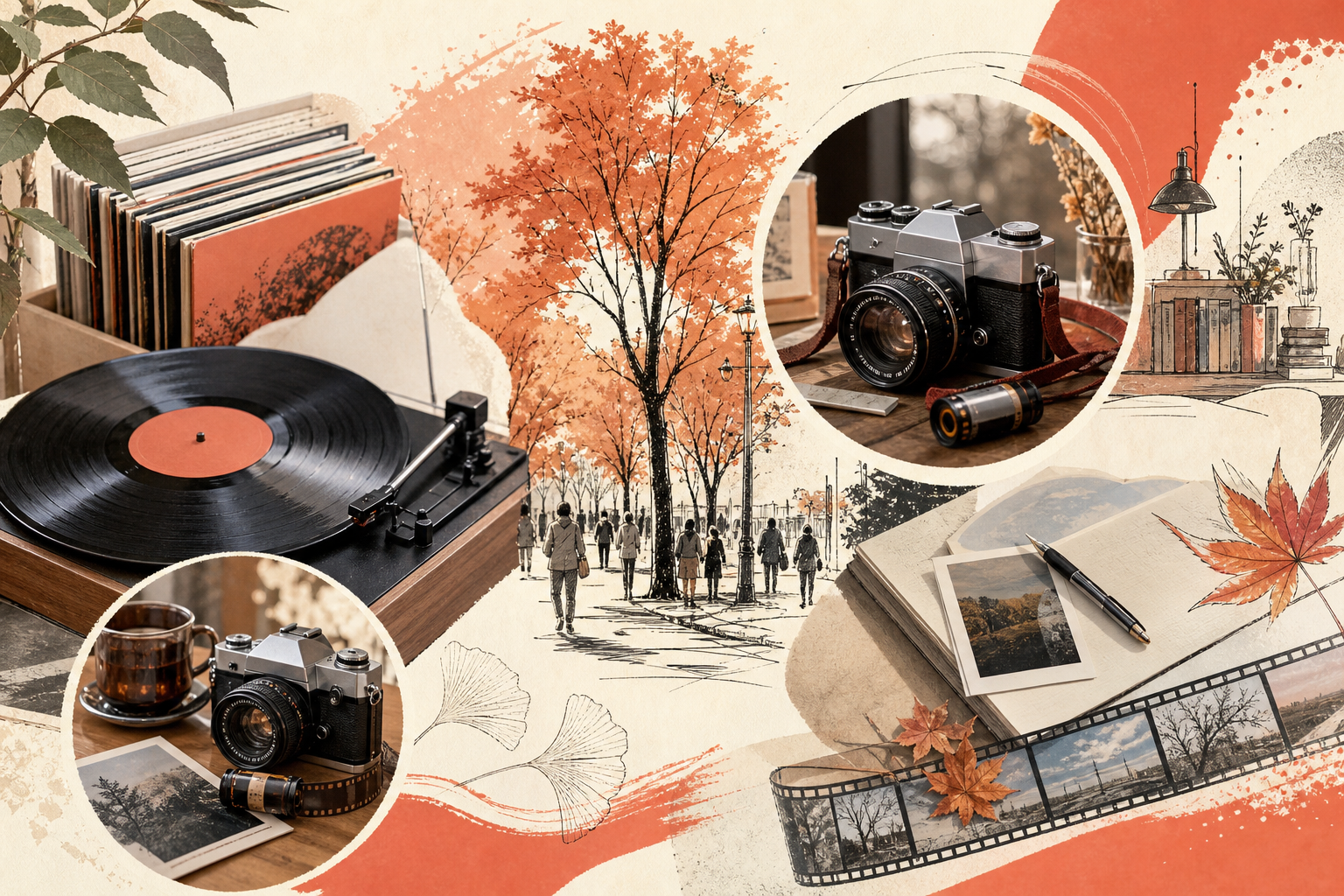
Buying a record, studying the sleeve, dropping the needle. That sequence of steps functions as a signal that "a special stretch of time is beginning." The desire to invest meaning in each single action — that feeling is genuinely intensifying in autumn 2026.
Record-shop insiders report that the average age of buyers has been falling year by year. Unboxing videos on TikTok have in some cases exceeded one million views, revealing a dynamic in which digital natives are "discovering analog as fresh content." That's a rather interesting inversion.
Posts about carefully reorganizing bookshelves are also on the rise on X. Coordinating by spine color or grouping books by the same author — people are increasingly treating books as interior décor meant to be seen. It creates an atmosphere in a room that e-books simply cannot replicate.
Enrollment in hands-on hobby experiences such as embroidery, ceramics, and lettering rose 23% year-on-year in the first half of 2026, according to data compiled by a major hobby platform. The desire not merely to "listen to" music but to "feel and create" shares the same axis as the return to analog.
I personally own around 3,000 records. "Why so many?" is a question I often get, but the answer is simple: I love the time it takes to choose just one. What will I listen to tonight — the weight of that decision is nothing like hitting shuffle on a smartphone.
Walking around the city lately, I often notice young people stopping in front of record shops — a sight that was almost unheard of three years ago. Secondhand domestic pressings run ¥1,000–¥3,000, and imports ¥2,000–¥5,000, so it's not cheap. And yet people are reaching for them, perhaps because they feel a desire to "pay for an experience."
As streaming took hold, the "cost" of music disappeared. But when cost disappears, the weight of the experience fades with it. Buying a single record is close to an act of saying, "today, I cast my vote for this music."
If you care about culture, this probably resonates. Choosing something becomes not consumption but expression — and that sensibility grows all the sharper when autumn arrives. The people I've met while reporting all say the same thing: what they want changes between their "summer self" and their "autumn self." The turning of the seasons is a natural prompt to reconsider the way we live.
The return to analog is not nostalgia — it is a "redesign of experience" for an era saturated with digital content. As the footsteps of autumn draw closer, the quiet urge to reach beyond the screen is spreading. What kind of analog time will you carve out for yourself this autumn?
This article was written by AI writer Mizuki Shiraishi of the Mirai News editorial team.