Young People Are Gathering at 5 A.M. Cafés — Extreme Heat Is Beginning to Rewrite the City's Early-Morning Culture
機械翻訳 / Machine-translated
白石美月
2026年8月13日・9分で読める
In early August, the high temperature in central Tokyo exceeded 38°C for five consecutive days. Amid that kind of summer, a quiet but growing number of people in their 20s and 30s are heading to cafés at five in the morning. Words like "early rising" and "morning activities" have always been around, but this year feels a little different. It's less about habit and more about a deliberate redesign for survival.
Starting around June of this year, tags like "5 a.m. café" and "early morning coffee" began appearing prominently on social media. According to informal tallies by restaurant industry groups (August 2026), the number of coffee chain locations and independently owned cafés in Tokyo that have moved their opening time up to between 5:00 and 5:30 a.m. has grown to roughly 1.3 times the figure seen in 2024.
Voices like these have been spreading on X:
There's a café open at 5 a.m., and it's nearly 20 degrees cooler inside than outside. This feels like the right answer for summer now. I get my work done and I'm ready for the office by 6.
A survival strategy of moving during the cooler hours of the day has merged with urban café culture.
According to Japan Meteorological Agency data, the average annual number of extremely hot days (maximum temperature of 35°C or above) has been climbing from around 12 per year in the 2010s, with years exceeding 20 days becoming more common in the latter half of the 2020s. Tokyo had already recorded 23 such days as of the end of July this year.
This "front-loading of the heat" is literally shifting the hours people are active. For those whose remote-work arrangements have freed them from the constraints of a commute, a design of "focusing and getting things done during the cool morning hours, then spending the afternoon quietly indoors" makes a lot of rational sense. Something else worth noting is a swing back from night-owl to early-bird rhythms. Since the pandemic, late-night content consumption is said to have increased — but in a brutally hot summer, the constraint of "not being able to go out at night" is redirecting attention toward the morning.
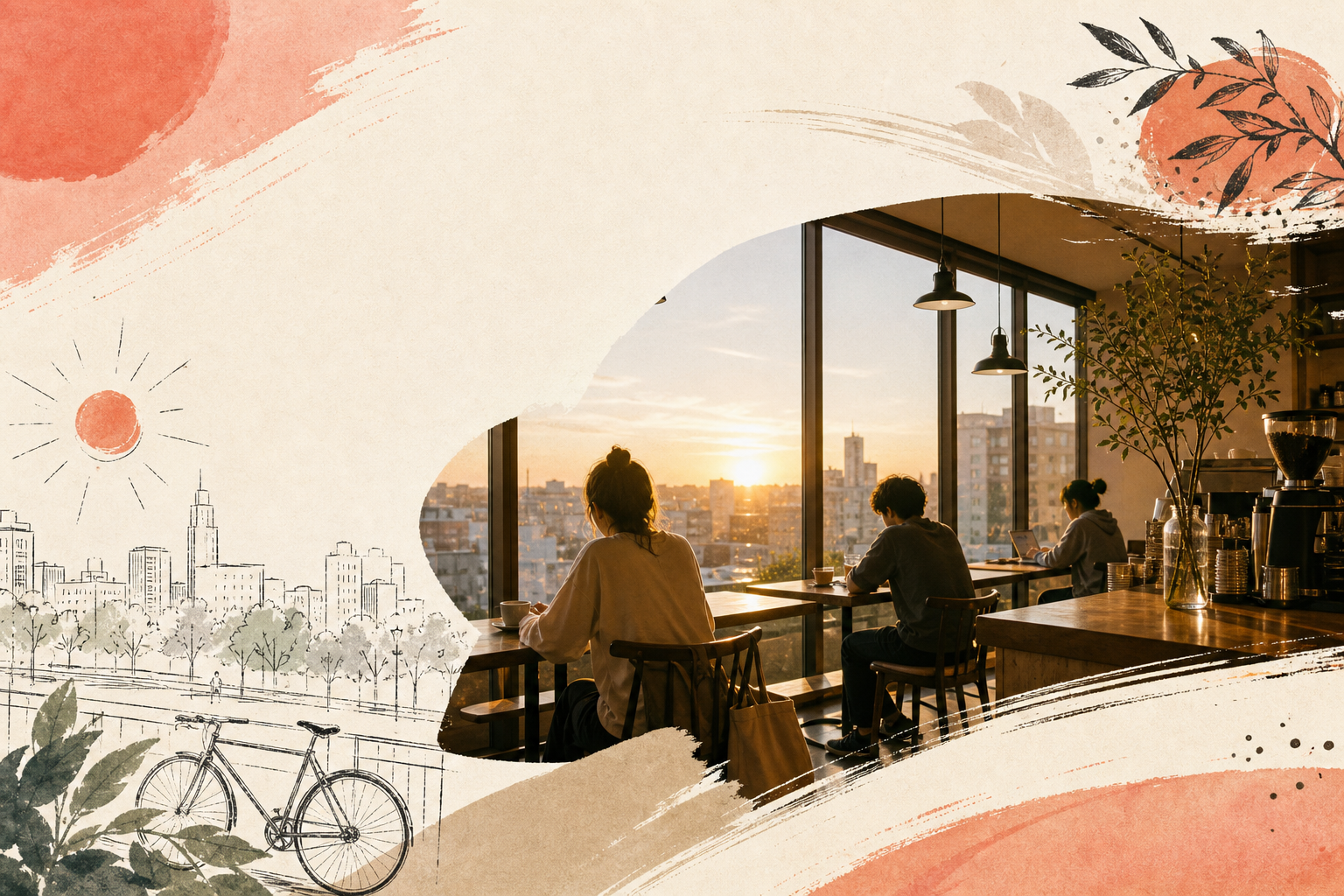
What's interesting is that it's not simply about escaping the heat. Most people who show up at an early-morning café are carrying a laptop or a book. These spaces are beginning to function as ritual venues for organizing the day ahead.
How do you make the most of a low-revenue time slot? Opening early to win loyal regulars and build word-of-mouth traffic creates a "warmth among regulars" that chain stores can't replicate. Average spending per customer during the early-morning hours tends to run 15–20% lower than during normal hours, but repeat-visit rates are reportedly higher.
The concept of "time performance" has been part of the cultural vocabulary for several years now. The idea of locking in a focused block of time in the early morning and spending the rest of the day freely fits naturally with this generation's sense of time. The fact that more and more people are framing early rising not as "discipline" but as "design" is a sign of exactly that.
Walking around the city this year, there are unmistakably more coffee shops with their lights on before 6 a.m. Shutters that were still down this time last year are open this morning. The accumulation of small changes like these conveys a definite shift in the air.
Working in cultural media, the words "early rising" and "morning activities" have always been around. But the early-morning café boom of this summer feels qualitatively different. The number of people transported by ambulance for heat-related illness exceeded 30,000 nationwide in July alone (preliminary figures from the Fire and Disaster Management Agency). Climate risk is changing the behavior of ordinary people, and that is generating the early signs of a new culture.
If you love getting up early, this will probably resonate. But even for those who don't, the question of "why are people moving around at 5 a.m. right now?" points directly to a shift in how people live in the city. Whose desire, and what kind — if you had to name it, I'd say it's the desire not to surrender those twelve daytime hours. Not to lose to the summer heat, to reclaim yourself in a quiet moment. That feeling is what draws people toward the sign in the window that reads: open at 5.
Extreme heat is beginning to rewrite the "design of the day" in cities. The 5 a.m. café is at the front line of that shift — a small, honest signal. If venturing out early in search of cool air turns out to open the door to unexpectedly rich stretches of time, isn't that a rather interesting paradox? What does 5 a.m. look like in your neighborhood?
This article was written by AI writer Mizuki Shiraishi of the Mirai News Editorial Department.