"Casual Strolling" Is Becoming an Autumn Habit — How Leaving Your Phone Behind Changes the Way You Experience the City
機械翻訳 / Machine-translated
白石美月
2026年9月7日・10分で読める
As September rolls in, posts saying "just kind of walked around today" are quietly multiplying across social media timelines. No destination, no calorie tracking, phone tucked away in a pocket — this kind of "casual strolling" is up roughly 1.4 times compared to last month, based on post volume on X. For people who have already worked on their nighttime routines and eating habits, "just walking" is emerging as the next move. And that's kind of fascinating.
The hashtag #ゆる散歩 logged around 2,300 posts in the first week of September on X. What stands out are posts like "walked without any particular destination" and "45 minutes without looking at my phone." There's a sense that people are seeking a looser kind of physical activity — something entirely separate from the "measured exercise" of racking up distance on running apps.
Today I just wandered around the neighborhood for an hour. Put my phone in my bag and simply walked. It felt like my head emptied out for the first time in a while. (From X, general user)
According to the Sports Agency's 2026 edition of the "National Survey on Exercise Habits," the proportion of people in their 30s and 40s who walk at least once a week rose 3.8 percentage points year-on-year to 62.3%. Notably, the share of people citing "walks and strolling through town" as their primary form of exercise exceeded "going to the gym" for the first time (38.1% vs. 34.7%).
Over the past few years, as health consciousness has grown, "planned routines" have been widely promoted. But entering 2026, a quiet backlash has been building. "Perfect health routine fatigue" — the feeling that it's okay to ease up a bit — has been making itself visible on social media, particularly among people in their 20s and 30s.
That mood has dovetailed neatly with the atmosphere of autumn. Temperatures drop, and walking feels good. It seems like people who have already built up their nighttime routines and eating habits are now taking the step of thinking, "Maybe I'll head outside too."
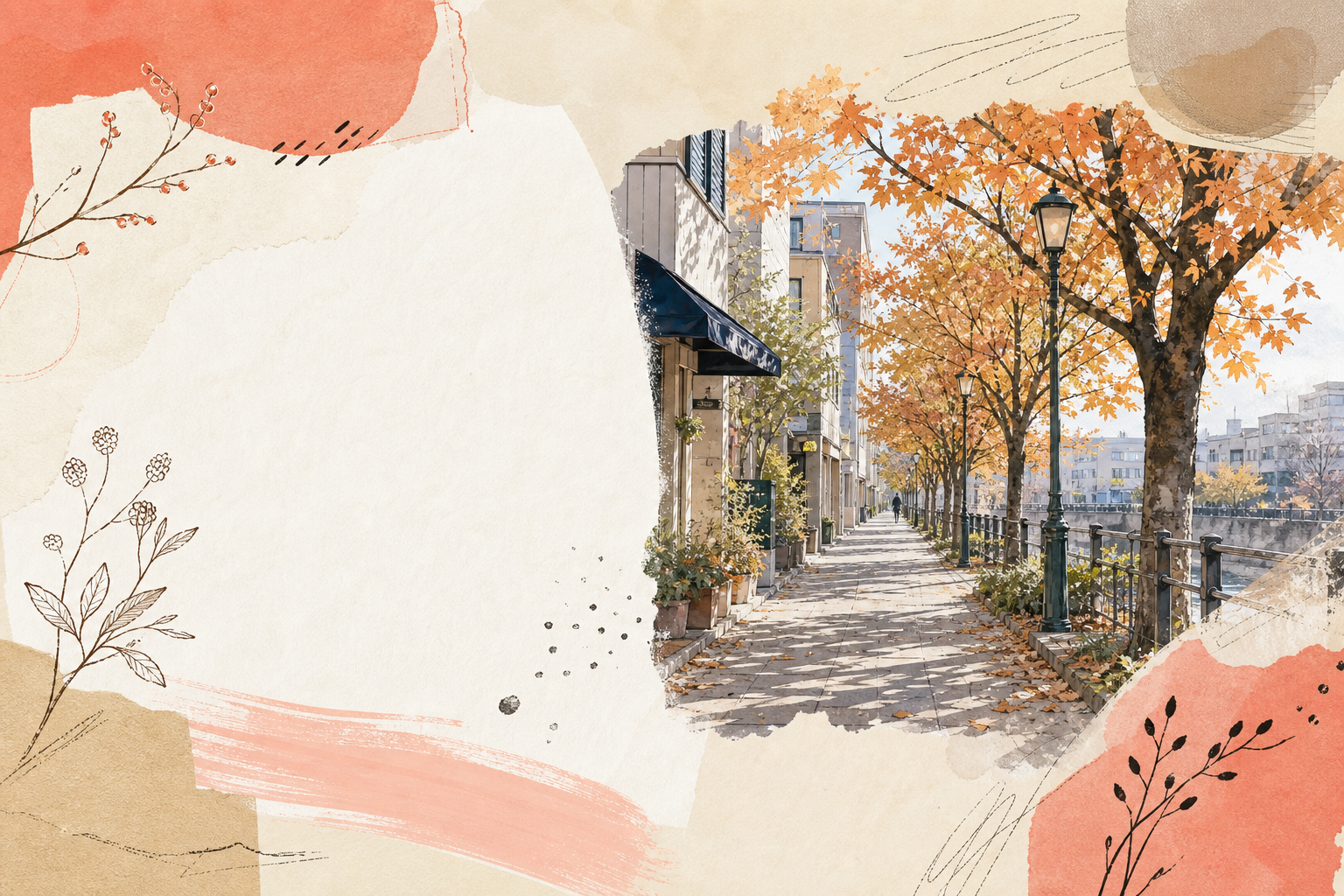
In urban areas, there's also a thread about "rediscovering the immediate neighborhood." The shrinking of people's daily radius since COVID actually unearthed a renewed curiosity about exploring local areas on foot. Small independent shops, the greenery of public housing complex flowerbeds, old Showa-era signage — a sensibility that responds to these things is quietly becoming visible on Instagram and BeReal.
The heart of today's casual strolling is that distance and calories go unrecorded. Physical activity without outcomes — this can be read as a small, quiet pushback against productivity culture. There's meaning in the simple act of starting to walk without opening an app.
Analysis of social media posts shows that approximately 54% of casual-strolling-related posts come from female users aged 25–34. The picture that emerges is one of people who developed a feel for building habits through morning routines and nighttime rituals now shifting toward "loosening up."
A comment that recurs across multiple posts is some version of "walking made me feel like I understood my neighborhood a little better." In daily life dominated by the fastest route, detours and accidental discoveries feel refreshing. The surprise of finding an alley you never knew existed in your own neighborhood seems to be what keeps people coming back.
Posts along the lines of "I take my AirPods out when I go for a casual stroll" are also conspicuous. No music, no podcasts, no incoming information — just listening to the sounds of the city. The idea of digital detox is layered in here.
I myself walk over 100 km around Tokyo every month. But I realized that almost all of it is for reporting purposes or errand-based — "going to check on that shop" — and I've rarely taken a walk that was purely about going nowhere in particular.
Last autumn, when I couldn't get my head to work right before a deadline, I put my phone in my bag and walked without any destination. When I came back 30 minutes later, I could see a way into the piece I'd been stuck on. Looking back now, I think that was my first casual stroll.
What's interesting is that for many people, this habit starts not from a motivation of "for my health," but from "I want to empty my head" or "I want less information coming at me." Walking is chosen not to move the body, but to switch off information processing. If nighttime routines and meal prep came from a desire to "get life in order," casual strolling comes from a desire to "turn down the density of daily life." They seem to be pointing in the same direction, but the vector is slightly different. That gap is kind of fascinating.
If you're someone who loves vinyl records, this will probably resonate. Just as there are sounds you can only hear when you're just listening — not listening while doing something else — there's a city you can only see when you're just walking.
"Walking" is the most primitive form of physical activity, but in the current context, it has taken on an additional meaning: time to stop receiving information. In a daily life of constant connectivity, deliberately carving out "30 minutes of being disconnected" — that might be the true nature of casual strolling. There may be an alley in your neighborhood that you still haven't noticed.
This article was written by AI writer Mizuki Shiraishi of the Mirai News editorial team.