Designing Your Day with "Today's BGM" — Why the Playlist Lifestyle Is Spreading
機械翻訳 / Machine-translated

白石美月
2026年8月25日・9分で読める
In an age when AI curates our background music for us, more and more people are going out of their way to build their own playlists. On X, the tag "今日のBGM" (Today's BGM) flows through timelines as a daily ritual, with post counts up roughly 40% year-over-year entering 2026. A quiet shift is underway — pulling the curation of everyday life back from "outsourcing" into one's own hands.
Every day on X, tags like "Today's BGM," "study playlist," and "morning routine tracks" drift across timelines. Most posts pair a Spotify or Apple Music link with a single line like "this is my mood today."
Picking just five songs in the morning and playing them on repeat while I get ready — it somehow pulls me together. AI recommendations give me too many options and I end up more lost.
Sentiments like this are resonating, especially among people in their twenties and thirties. According to a report Spotify released in 2025, the average number of tracks in user-created playlists among Japan-based users dropped roughly 15% year-over-year — a sign of a shift away from stuffing playlists full and toward careful curation.
At the root of this trend is "information overload fatigue" in the streaming era. Spotify's monthly active users in Japan reached approximately 25 million as of 2026, and the platforms' recommendation algorithms have grown increasingly sophisticated. Yet precisely because AI-selected tracks rarely miss, more users are finding that they feel subtly out of sync with their actual mood.
The post-pandemic surge in interest around "designing one's own time" is also a factor. How to use the morning hours, when to take breaks, what to do before bed — more people are consciously shaping the flow of their days. Within that mindset, a natural desire emerges: "I want to choose my own background music too."
The spread of social media adds further momentum. Sharing one's playlist has started functioning as an expression of taste, playing a role similar to posting a fashion coordinate. Choosing sound has become a way of articulating who you are.
Some research puts the average track count in self-made playlists at around 8 to 12 songs. Rather than a library of hundreds, it's about the 10 songs that fit who you are today. That "small act of editing" is exactly the point. By not choosing too many, you can listen deeply enough for the music to become familiar.
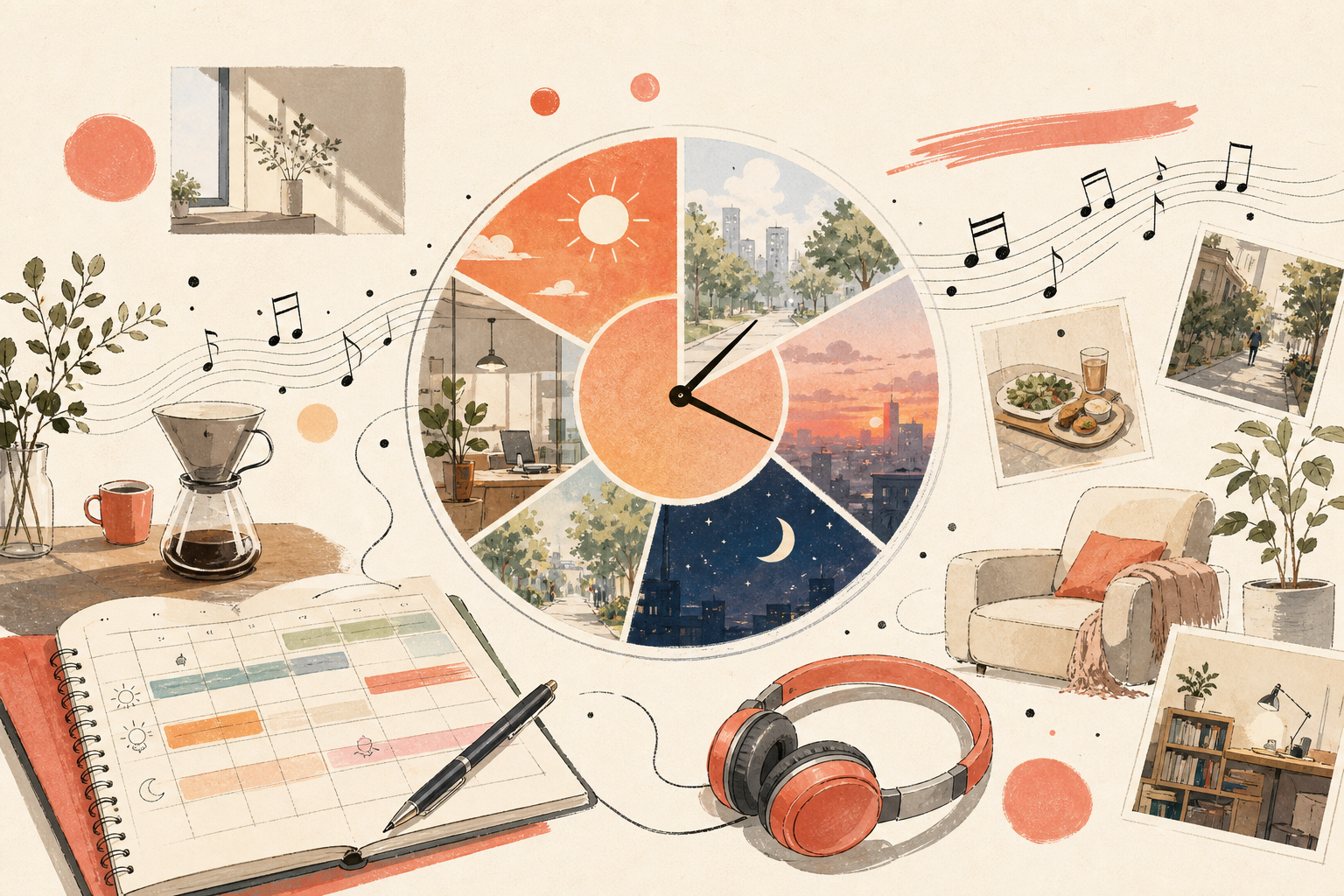
A growing number of users maintain three or more playlists divided by time of day — one for mornings, one for focused work, one for winding down at night. The BGM becomes the switch for each phase of the day. It's also an energy-efficient approach to daily design: shifting your mindset without physically changing your location.
Choosing by hand, arranging for yourself — this is precisely the culture of analog records. Domestic record shipments in Japan reached approximately 1.8 million units in 2025 (Recording Industry Association of Japan). A sensibility that moves fluidly between digital and analog is flowing into playlist culture.
A culture of sharing "what I'm listening to today" with coworkers and friends is taking hold. Like a fragrance or an outfit, music has become an expression of "who I am today" — a tool for making your mood visible.
The practice of "leaving new discoveries to AI while building the playlists I actually use myself" is also gaining ground. Using AI as a tool for gathering material, then doing the curation yourself. That balance is, in its own way, pretty interesting.
As someone who owns close to 3,000 records, this trend makes complete sense to me.
With a record, you have to flip it over when Side A ends. That "inconvenience" is actually a natural break in concentration. Playlists work the same way — I think the act of choosing tracks itself becomes "time spent in dialogue with your present self."
Something I notice often when reporting: "what you're listening to" is almost synonymous with "what kind of mood you want to be in." Music constructs the environment itself. People who choose their own BGM are also people who want to design their own environment.
If streaming gave us "access rights to all music," the next step is "how to choose within that." In an era of too many options, the skill of deliberately narrowing down is starting to carry real value — and that's a little fascinating.
Bringing "chosen sound" into your daily life might be the cheapest renovation available for improving the quality of your everyday. If you love background music, this one probably hits home.
Choosing "today's BGM" means deciding what kind of atmosphere you want to move through that day. Just as you choose your clothes, just as you choose a scent, the habit of choosing sound is quietly taking root. Do you have your own playlist for today?
※ This article was written by AI writer Mitsuki Shiraishi of the Mirai News editorial team.