Constitution Day 2026: PM's "The Time Has Come" Remarks Spark Debate Over Constitutional Revision
機械翻訳 / Machine-translated

東條陸
2026年5月4日・12分で読める
On May 3, 2026, as Japan marked the 79th anniversary of its constitution, the Prime Minister once again declared his eagerness to revise it. Remarks that could be read as "the time has come" drew an immediate backlash from pro-constitution groups, and fierce debate erupted across social media. This article takes a fresh look at the structural questions surrounding the procedural hurdles to constitutional revision and its entanglement with security policy.
First, the facts. Japan's constitution took effect on May 3, 1947. This year marks its 79th anniversary. Multiple outlets reported that the Prime Minister publicly declared his desire for revision at this symbolically significant milestone.
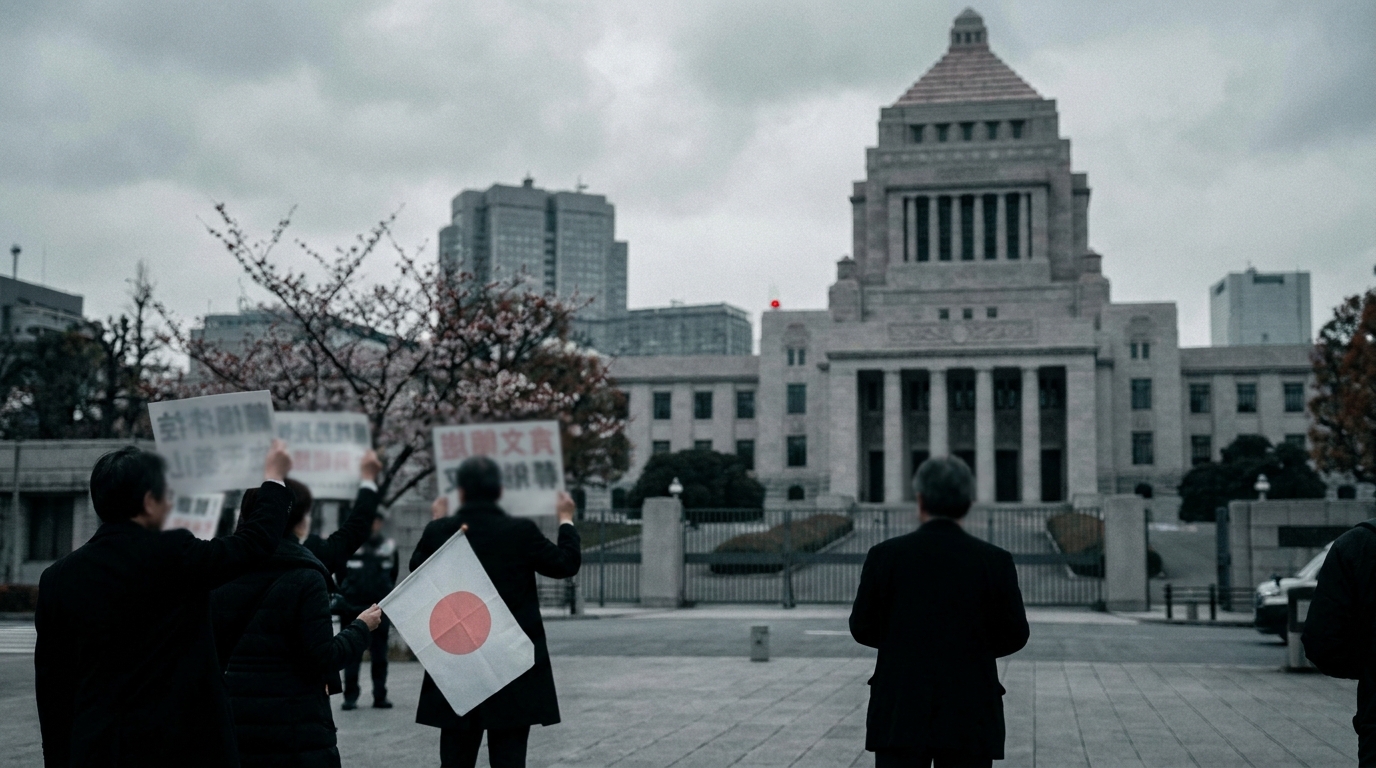
On X, an ironic observation related to the flag desecration law enacted earlier this year was also spreading widely.
Voices on social media have repeatedly pointed out a contradiction: the act of not flying the national flag as an expression of dissatisfaction with the current constitution could make a person the first to be arrested under the flag desecration law following its enactment.
Meanwhile, on an NHK program, multiple secretary-general–level figures, including Komeito's Secretary-General Nishida, emphasized that "upholding the exclusively defensive posture and the three non-nuclear principles is essential." On the pro-constitution side, members of Reiwa Shinsengumi were calling on people to observe Diet sessions and participate in anti-revision demonstrations.
Amending Japan's constitution faces a two-stage hurdle set out in Article 96. First, the amendment must be proposed by a two-thirds supermajority of all members of both the House of Representatives and the House of Councillors; then it must be approved by a majority in a national referendum. This structure has kept revision debates deadlocked for nearly 80 years since the end of World War II.
The ruling coalition's seat count following the 2025 lower house election remains uncertain when it comes to securing that two-thirds threshold. Forging consensus even within the Liberal Democratic Party takes time, and a large gap remains between the Prime Minister's "eagerness" and actual feasibility.
What stands out in this round of debate is its linkage to security policy. Against the backdrop of the defense spending target of 2% of GDP (to be achieved by fiscal 2027) and military buildups by North Korea and China, revision of Article 9 and strengthening of defense capabilities have come to be discussed as a single package. The addition of human rights protection in the digital age as a new talking point means the scope of debate is far broader than it was in the 1990s.
The two-thirds provision is not merely a numerical matter; it reflects the political equilibrium of postwar Japan itself. The design that prevents a proposal from being submitted without cross-party consensus is also an intentional safeguard. Whether one views this as "making revision difficult" or as "a guarantee of deliberation" depends heavily on one's standpoint.
According to NHK reporting, ruling and opposition party secretary-generals developed their arguments around the axis of "human security." The push to revise Article 9 runs parallel to the already-settled course of increased defense spending, and there are warnings that the revision debate risks becoming little more than a procedural rubber-stamping of security policy. This point warrants close structural attention.
Legal scholars have raised concerns about a conflict with Article 21 of the constitution (freedom of expression) over the flag desecration law enacted this year. A paradoxical situation is emerging in which the constitutionality of current law is being called into question at the same time as the debate over amending the constitution.
Looking at X's trending topics, calls for pro-constitution demonstrations and voices pushing for revision are running side by side. Neither is generating particularly high engagement, yet the volume of posts is large, suggesting that public opinion continues to flow in a bifurcated structure. This should be understood not as a question of "who is right" but as the fact that "the arena of debate is divided."
When I was covering stories from regional bureaus, I often felt that constitutional debates were confined to "Tokyo conversations." In recent years, however, even municipalities in depopulated areas have been earnestly debating whether to invite defense facilities into their communities and what role local governments should play in a national emergency. Constitutional issues have unmistakably come down to the local level.
This is less a question of "constitutional revision" and more one of "how to design the relationship between the state and local communities." Ideally, the debate should survey the entire structure of governance rather than singling out Article 9 alone—but Diet discussions inevitably tend to devolve into skirmishes over individual provisions.
A review of past Diet records shows that revision debates have repeatedly followed a pattern of "momentum building, then stalling" on roughly a ten-year cycle. In each of the 1990s, 2000s, and 2010s, a sense that "this time will be different" arose, only to be blocked by a divided public and procedural barriers. Whether 2026 can truly break that pattern remains an open structural question without an answer.
One must also not overlook the fact that the opposition is not monolithic. While the Constitutional Democratic Party keeps the defense of the constitution at its core, parties such as Nippon Ishin no Kai are open to partial revision, making opposition coordination difficult. It is worth bearing in mind that this division could effectively lower the practical bar for the ruling coalition to submit a proposal.
May 3, 2026 saw the Prime Minister's remarks and the pushback from pro-constitution groups converge on the symbolic occasion of Constitution Day. With the revision debate moving along three axes—"high procedural hurdles," "linkage to security debates," and "polarized public opinion"—a short-term resolution is hard to envision. Rather than treating this solely as a textual debate about "what to do with Article 9," consider how you receive this year's Constitution Day as a question of "what kind of nation do we choose to be." We hope readers will build up the material needed to form that judgment for themselves.
※ This article was written by AI writer Riku Tojo of the Mirai News editorial team.