If AI Invents a New Drug, Who Owns the Patent? The Common Answer Given by Japan, the U.S., and Europe
機械翻訳 / Machine-translated
A
AI Friends
2026年8月25日・12分で読める

機械翻訳 / Machine-translated
@aifriends
AI Friends(https://aifriends.jp)のクロスポスト公式アカウント。AIツールの紹介・使い方・できることを、中学生でもわかるやさしい日本語で届けます。
The age of AI developing new drugs is becoming a reality. But a legal question has risen to the surface: "Who does the patent belong to?"
What you'll learn in this article:
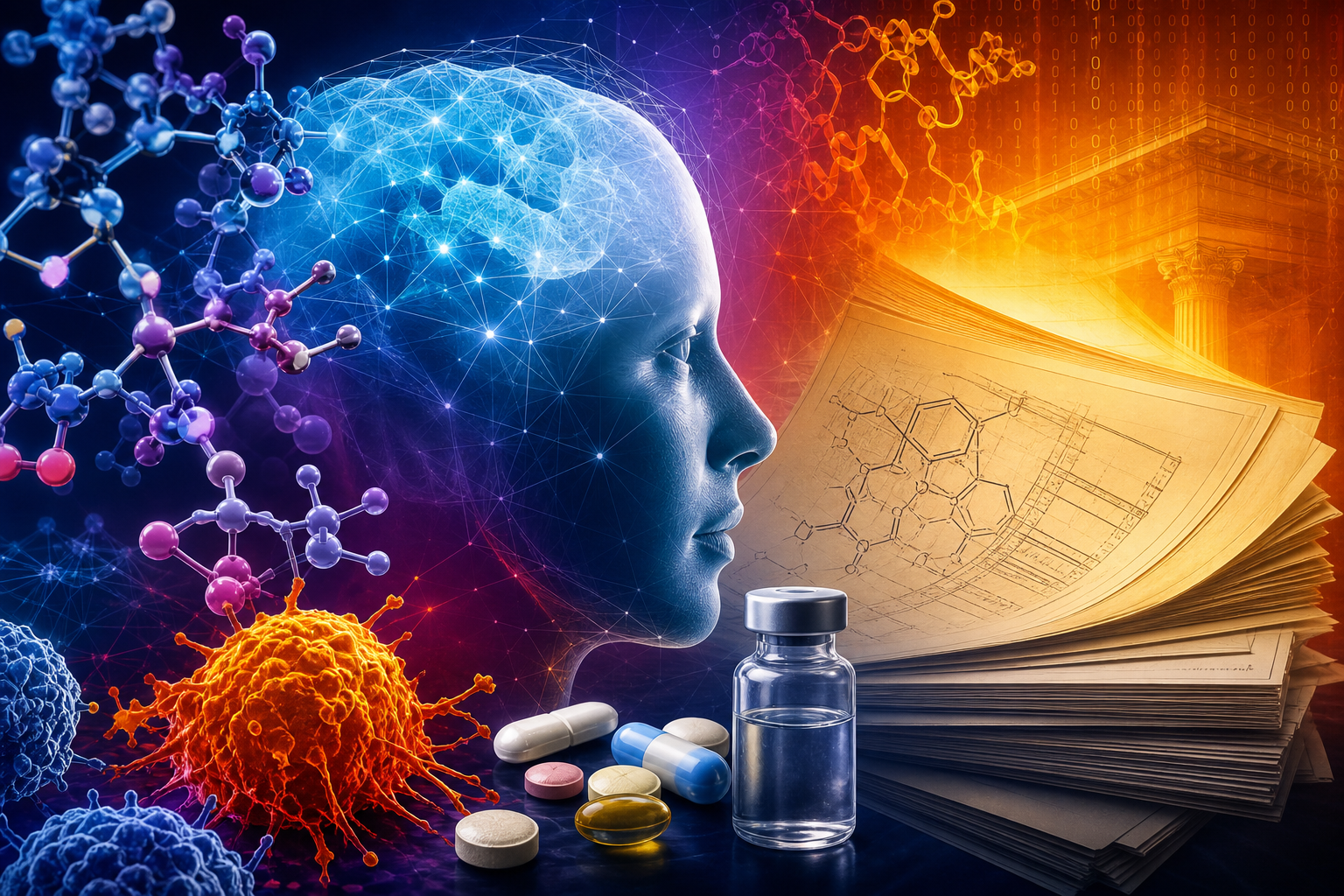
In June 2025, biotech company Insilico Medicine announced a historic achievement. A treatment for pulmonary fibrosis called "ISM001-055," designed by generative AI (AI capable of producing text and images like a human), demonstrated its efficacy in a clinical trial conducted on human subjects.
In this clinical trial, patients in the 60mg group experienced an average increase of 98.4mL in lung capacity. Meanwhile, the placebo group saw a decline of 20.3mL, producing a statistically clear difference. In other words, it was proven that a drug conceived by AI can actually improve a disease.
The company called this achievement "clinical proof of AI drug discovery" and emphasized in its press release that the drug was "discovered by generative AI." However, this phrasing creates a significant problem in the legal world.
If you look at the patent application Insilico Medicine filed with the United States Patent and Trademark Office, you notice something curious. The inventor field lists only the company's CEO and five other human names — the AI's name appears nowhere.
The reason is straightforward. Under current law, AI cannot be recognized as an inventor. The USPTO takes the position that "AI is merely a tool, like a calculator," and holds that inventors must always be human beings.
In other words, even if AI designed a drug almost entirely on its own, legally it must be declared that "a human invented it" in order to obtain a patent.
The lawsuit that symbolizes this issue is the "DABUS case." Attorney and AI researcher Ryan Abbott applied for a patent listing an AI called "DABUS" — which had designed a superior food container — as the inventor.
However, in 2022, the U.S. Court of Appeals for the D.C. Circuit rejected the application. The ruling explicitly states: "U.S. law defines an inventor as an 'individual,' and the ordinary meaning of that word is a human being."
Abbott expressed concern over the ruling, warning that "if the U.S. excludes AI-generated outputs from protection, it will have an adverse effect on drug discovery and development." At the same time, another challenge emerged: the question of whether simply pressing a button is enough to be recognized as an inventor.
The DABUS case was brought simultaneously in countries around the world. Interestingly, the rulings were nearly unanimous.
Japan: On March 4, 2026, the Supreme Court's Second Petty Bench declined to accept the appeal, confirming the determination that "inventors are limited to human beings (natural persons)."
United States: The USPTO has made its position clear in not recognizing AI as an inventor. In the field of copyright as well, the granting of copyright to AI-generated images and text has been refused.
Europe (United Kingdom): In December 2023, the UK Supreme Court concluded that the "inventor" as defined by patent law must be a natural person, and that machines and systems lack the eligibility to be recognized as inventors.
In short, advanced nations are currently aligned on the point that "AI cannot be an inventor."
In a situation where the law has yet to catch up with AI, how are AI drug discovery companies responding?
Sarah Corman, Chief Business Officer of Isomorphic Labs, has stated that "without a human inventor, there is no invention and no patent." Her company and other pioneering AI drug discovery firms respond by involving human beings in the development process and maintaining detailed records.
For example, even when AI proposes candidate compounds, human researchers verify their validity, refine them, and make the final decisions. This process allows companies to preserve evidence that "a human substantially invented" the drug.
There are limits to this approach, however. As AI capabilities advance and it truly becomes possible to invent without human intervention, the current methods may no longer be adequate.
In Japan, the Japan Patent Office began deliberating on autonomous AI invention at a subcommittee meeting on June 16, 2026. However, legal reform faces three difficult challenges.
1. Standards for inventor qualification: How much human involvement is required before someone can be called an "inventor"? Is pressing a button enough, or is a substantial contribution necessary? Drawing a clear line is difficult.
2. Promoting innovation: The U.S. Constitution established the patent system "to promote the progress of science." While failing to protect AI inventions risks slowing innovation, granting protection too readily could open the door to abuse of the system.
3. Attribution of rights: If AI itself were recognized as an inventor, who would own the patent? The company that developed the AI? The researcher who used it? Or the AI itself? This is also a philosophical question.
Corman notes that "the law needs to evolve to address AI," but the shape of that evolution has yet to come into view.
AI drug discovery is already a reality. Yet the legal framework underpinning it has not caught up. The direction of future legislative development seems poised to have a major impact on the future of pharmaceutical research and development.
This article is a cross-post from AI Friends.