ChatGPT Forging Cartoonists' Signatures? Over 15 Artists Affected
機械翻訳 / Machine-translated
A
AI Friends
4日前・17分で読める

機械翻訳 / Machine-translated
@aifriends
AI Friends(https://aifriends.jp)のクロスポスト公式アカウント。AIツールの紹介・使い方・できることを、中学生でもわかるやさしい日本語で届けます。
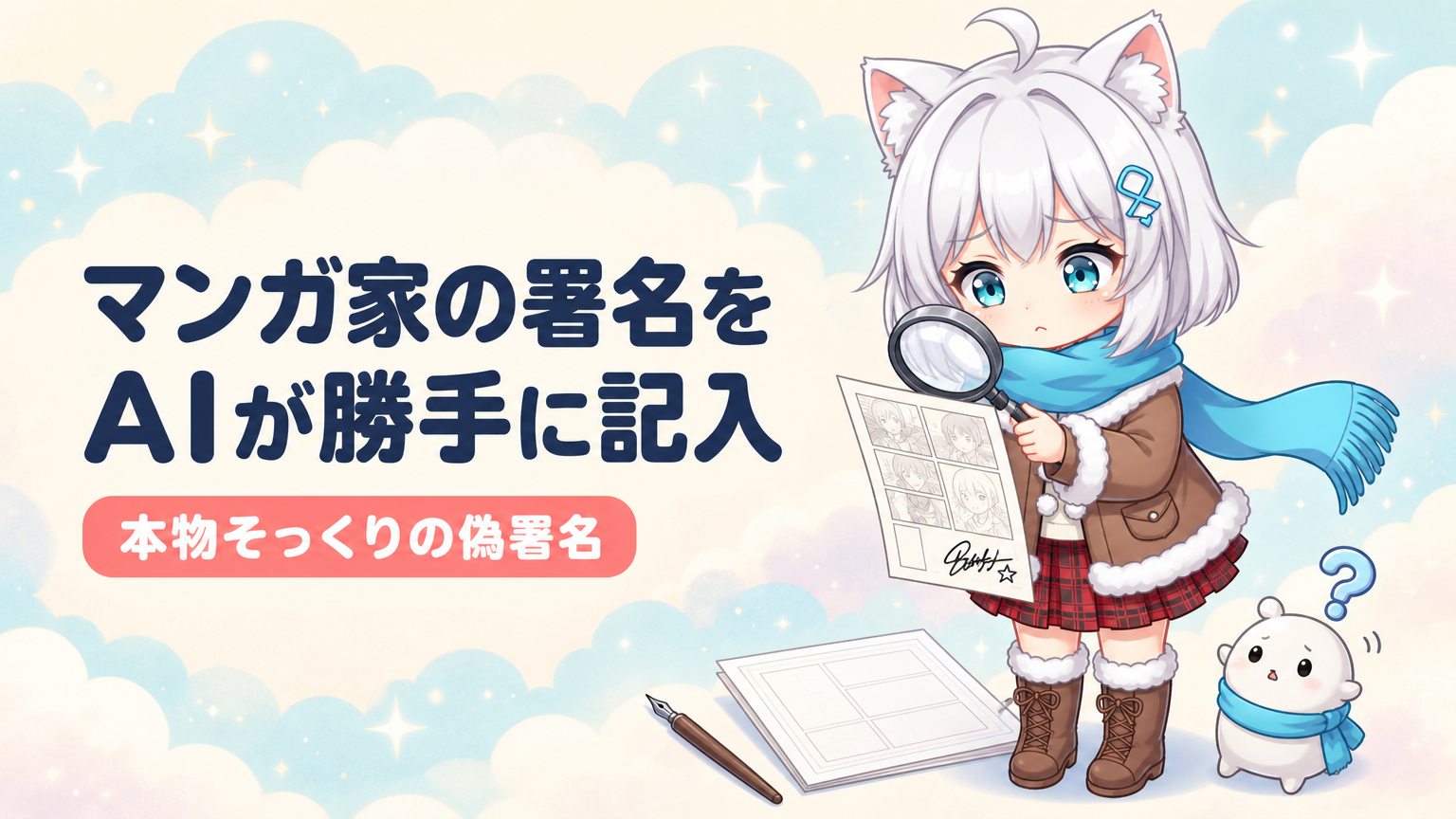
Have you ever shared a cartoon on social media thinking it was drawn by a real cartoonist? That signature might actually have been added by ChatGPT without anyone's permission. This article walks through what happened and what we should all be aware of.
On October 7, 2026, an article by GIGAZINE highlighted a troubling issue, based on reporting by Nieman Journalism Lab, a journalism institution at Harvard University.
When ChatGPT generated cartoons in the style of The New Yorker (a well-known American magazine), it was spontaneously adding the signatures of real cartoonists to the images.
It all started with a single illustration that spread in late August 2026, shortly after reports emerged that singer Dolly Parton and actor Tim Curry had passed away.
The image depicted Curry in his Rocky Horror Picture Show costume, walking arm in arm with Parton through the gates of heaven. It spread widely on X and Facebook.
In the lower right corner was the signature "BLoper" — the signature of Brendan Loper, a cartoonist who draws for The New Yorker. But the image wasn't drawn by Loper at all; it was created by ChatGPT.
The person who posted it had simply asked for "a New Yorker-style cartoon." ChatGPT had added the signature on its own.
Loper reportedly received numerous emails asking, "Is this your work?"
He had already known that his work was being used to train AI. But the forging of his signature felt like a far more personal violation. "My name is mine," he said.
A signature is proof that a person created something — it also functions as a brand. He mentioned that ChatGPT-generated cartoons bearing his name had previously turned up on Instagram and Reddit as well.
Emily Flake, who has contributed to The New Yorker since 2008, said that while the generated cartoons seemed to reflect her style, they didn't look like something she had actually drawn. Her description — "It's like meeting a distant relative" — was particularly striking.
The investigation found that ChatGPT had reproduced the signatures of more than 15 New Yorker cartoonists.
Tests produced clean-lined, satirical black-and-white cartoons. However, some of the generated cartoons had punchlines that made no sense. In some cases, fictional pen names were used as signatures.
The fact that nonexistent pen names appeared suggests that ChatGPT may be adding signatures as a kind of "decorative flourish." The underlying reason, however, was not explained in the reporting.
An OpenAI spokesperson stated that the future of creativity is human-centered, thanked the community for reporting the issue, and said they were able to address it.
After the report, prompting ChatGPT with "a New Yorker-style cartoon" began triggering a guideline warning that the output might too closely resemble third-party content.
However, it was reported that when users asked for "a cartoon-style image" without mentioning the magazine by name, real cartoonists' signatures still appeared in the results. In other words, the warning only blocked one entry point — it did not fix the underlying problem.
Condé Nast, which publishes The New Yorker, entered into a partnership with OpenAI in 2024. According to a GIGAZINE article from August 2024, the deal allows articles from publications including Vogue and Wired to be displayed within products like ChatGPT. The financial terms and duration were not disclosed.
However, a spokesperson for The New Yorker stated that the agreement does not permit cartoons to be used for AI training. The display of the magazine's logo was also reportedly not authorized under the contract.
Furthermore, the standard contracts between cartoonists and the magazine contain no AI-related clauses. The magazine holds priority publication rights, but the copyright itself remains with the individual cartoonist.
As a result, it is believed that OpenAI may have collected and trained on cartoons found online independently of its agreement with the publisher.
This is not the first time an AI has reproduced "markers" from its training data in its output.
In February 2023, stock image company Getty Images sued Stability AI. According to an article by SiliconANGLE, the company alleged that Stability AI's image generator Stable Diffusion was producing distorted versions of Getty's watermarks. Getty also claimed that more than 12 million photos had been copied without authorization.
Watermarks and signatures affect different parties. A watermark represents a company's brand, whereas a signature is the individual cartoonist's own name.
The ongoing lawsuit between The New York Times and OpenAI also centers on the relationship between AI and creators. According to a GIGAZINE article from September 2026, it came to light that a Microsoft executive had described AI data scraping as "the largest theft of labor in human history" in an internal memo — though this information came from NYT's legal filings, and the full context has not been made clear.
This issue is not someone else's problem in Japan, either. ChatGPT works in Japanese, and there is a real possibility that AI-generated images bearing Japanese cartoonists' signatures could spread online.
Imagine a serialized manga artist discovering that a cartoon bearing their name is circulating on social media. They have no memory of drawing it, yet readers are asking, "Is this a new piece?" Just having to deny it drains time and energy.
It's worth reviewing the Japanese perspective on this. According to the Agency for Cultural Affairs website, the Council for Cultural Affairs compiled a document titled "Perspectives on AI and Copyright" in March 2024. It does not carry the force of law, and relevant case law has yet to accumulate sufficiently.
Which specific laws apply to the forgery of signatures depends on the individual circumstances. If you have concerns, please consult a lawyer or the Agency for Cultural Affairs' consultation service.
There are also steps we as users can take. For example, if you come across a cartoon with a signature, don't share it immediately — first verify it through the creator's official account or the magazine's website. If you post an AI-generated image, labeling it clearly as AI-made is a good practice.
The reporting available does not explain the reason. Since cartoons typically include signatures, it's conceivable that the AI learned to treat signatures as part of the artwork itself.
No. As this case shows, ChatGPT-generated images can also include signatures. Always verify through the creator's official announcements.
Prompting ChatGPT with "New Yorker-style" now triggers a warning. However, cases were reported in which signatures still appeared even without mentioning the magazine's name.
The cases reported this time involved New Yorker cartoonists. No confirmed cases involving Japanese cartoonists were found within the scope of this reporting. That said, the underlying mechanism is the same, so caution is warranted.
If you come across a cartoon with a signature, check the creator's official announcement before sharing it.
This article is a cross-post from AI Friends.