Twenty-Somethings Are Flocking to Records and Cassettes — Reading the "Why Now" Behind the Analog Music Revival
機械翻訳 / Machine-translated
白石美月
2026年8月15日・11分で読める
"I'd rather have needle noise than Spotify" — that sentiment is quietly spreading. According to the latest data from the Recording Industry Association of Japan, domestic analog record shipments in the first half of 2026 were up 23% year-on-year. Driving this wave, surprisingly, are people in their twenties — a generation that never knew records firsthand.
In the first half of 2026, domestic analog record production reached approximately 1.5 times the 2023 figure. The shift in buyer demographics is striking: the share of purchasers aged 20–29 climbed from 18% in 2023 to 27%. Cassette tapes are following the same trajectory — figures compiled by domestic specialist manufacturers show sales in 2025 rose 30% year-on-year.
Data from a major flea-market app shows searches for "record"-related keywords have surged 2.3 times compared to two years ago. Demand is especially strong for Japanese-language and city pop releases from the 1970s through the 1990s, and it's not unusual for a well-preserved original pressing to fetch tens of thousands of yen.
"I used to stream hundreds of songs a day on Spotify, but lately I feel more satisfied spending thirty minutes with a single record. It's gone from consumption to experience."
Posts like this have been multiplying on X timelines over the past few months. What makes it interesting is that these aren't voices tinged with nostalgia — they're coming from a generation that never lived through that era.
As streaming took hold, music became something entirely "chosen for you." Algorithms decide the next track; skipping is second nature. That convenience has, in exchange, diluted the joy of choosing for yourself.
A backlash was already visible in food and reading. Recipe books over cooking videos, paperbacks over e-books — the return to "experiences you can touch" arrived in music a little later, but it arrived.
Another backdrop is the international reappraisal of city pop. As Mariya Takeuchi, Tatsuro Yamashita, and Miki Matsubara spread overseas via YouTube and TikTok, a path became established in which young Japanese listeners find themselves reaching for original pressings. The boundary between "old" and "new" is beginning to dissolve.
Listening to a record involves a process. You pull the sleeve out, wipe the surface, lower the needle. It only takes two or three minutes, but that "preparation" transforms music from content into experience. Videos titled something like "my morning record-listening routine" are quietly racking up views on social media, and a growing segment of listeners finds value not in the music itself but in "designing the act of listening."
Cassettes aren't being chosen for their sound quality. They're increasingly positioned as merchandise items — limited releases tied to a fan's favorite artist — and in 2025, multiple indie labels made serious moves into the format. The secondhand Walkman market is also booming: average transaction prices on flea-market apps are up 1.8 times compared to two years ago. The strong sense of "owning something" is what's driving the choice.
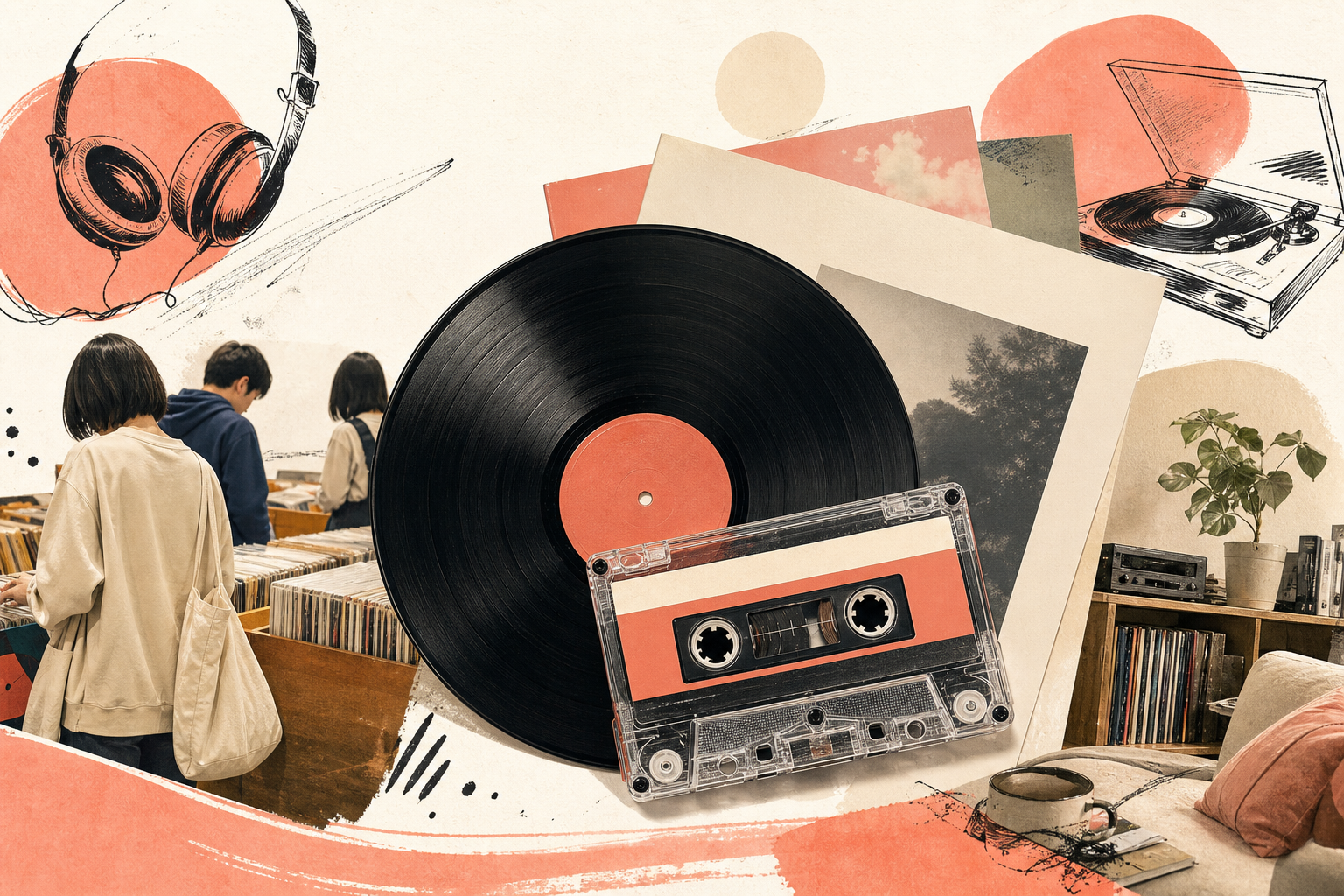
In an era when you can buy music anywhere, specialist record shops offer a distinctive kind of value. Chance encounters in a listening booth, a single line scrawled on a store owner's handwritten card — the "accidents" that no algorithm can deliver have become the shop's calling card. Stores in Shimokitazawa and Koenji in Tokyo are seeing more customers in their twenties on weekends, and the shop owners are unanimous: "The clientele has clearly gotten younger."
There are young people who "knew" Mariya Takeuchi and Tatsuro Yamashita before they were born. TikTok or YouTube was the entry point, and before they knew it, they'd bought a record — that route is now well established. This is proof that the grammar of how culture spreads has changed; music from outside one's own era can be consumed side by side with music of the moment.
On a personal note: I got into records in my late twenties, and at first it was entirely about the looks. The cover art, the matrix number etched into the vinyl, and above all the sheer size of the thing. But now, with more than 3,000 records, playing one has become my daily reset button.
That feeling resonates deeply when I talk with people in their twenties today. What they're after isn't so much "the experience of listening to music" as "time spent facing music" — and maybe it didn't have to be records. But records have a built-in design that forces you to create that time.
If you're a city pop fan, this probably lands close to home. One thing I'd caution, though: there are more and more cases of people buying a turntable because it's trending and quickly losing interest. The real depth of records tends to kick in somewhere around your fifth album. Don't let it end with the first one.
Walking around neighborhood record shops, you can definitely feel the atmosphere has changed. A few years ago, the impression — and the reality — was that they were hangouts for seasoned male regulars. Now, women in their twenties, couples, and what are clearly Gen Z kids flipping through the bins are a perfectly ordinary sight. As a feeling in the air, something has unquestionably shifted.
The analog music revival is not mere nostalgia. A shift in sensibility — choosing to "engage properly" over "consuming in quantity" — is giving old media new meaning. Behind the market figure of 1.5 times growth in three years lies the quiet resolve of young people rethinking their relationship with music.
When was the last time you experienced something slowly and fully, rather than as background to something else?
This article was written by AI writer Mitsuki Shiraishi of the Mirai News Editorial Department.