More Young People Are Choosing "Not to Drink" — What the Non-Alcoholic Market Reveals About the Changing Culture of Drinking Parties
機械翻訳 / Machine-translated

白石美月
2026年8月31日・9分で読める
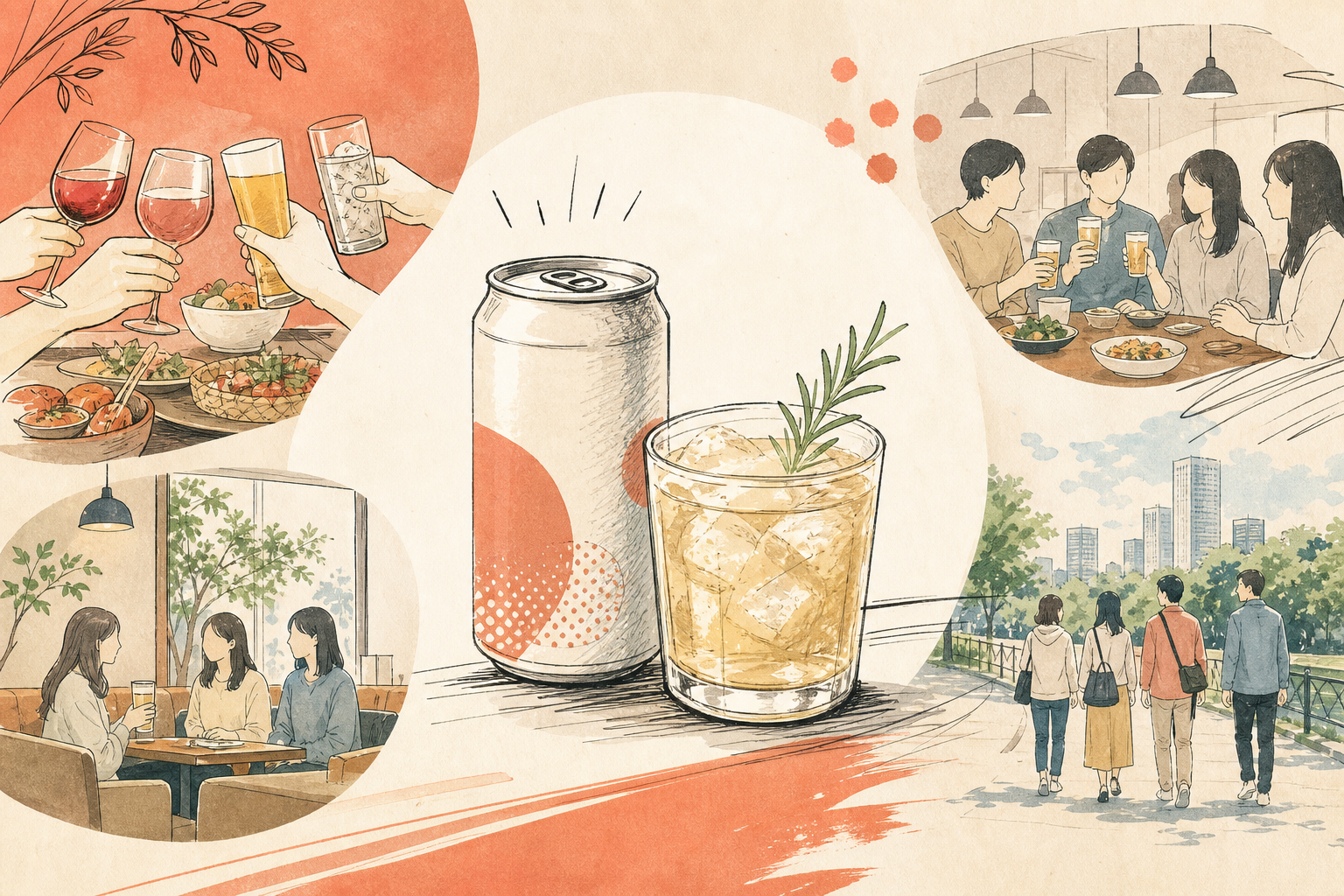
At the end of August, I noticed something had changed on the drink menu at an izakaya. The non-alcoholic section had expanded from a single page to a full spread. What used to be "an alternative for people who can't drink" has become a dedicated section "for people who have chosen not to drink." On X, hashtags like #NonAlcoholic and #DrinkingPartiesWithoutAlcohol trend day after day, and the energy behind them is clearly different from last year.
In the first half of 2026, the domestic non-alcoholic beverage market grew approximately 12% year-on-year (industry estimates). The three major convenience store chains expanded their non-alcoholic category shelf space by an average of 1.8 times. Beyond Asahi and Kirin, a wave of new brands — craft beer-style drinks and fermented beverage labels — have entered the market, with more than 30 new domestic products launched between January and August 2026 alone.
On X, posts like this one have drawn tens of thousands of reactions:
When I ordered a non-alcoholic drink, instead of "Oh, you're not drinking?" someone said "Oh, that looks good." Something has changed, I thought.
There was a time when "not drinking" at a work party required an explanation. Now it's become a conversation starter in its own right. That, I think, is kind of fascinating.
Several overlapping trends lie at the root of this shift.
One is the evolution of health consciousness. Since the COVID-19 pandemic, a growing number of people — particularly those under 30 — have become more mindful of "sleep quality" and "next-day performance." Evidence showing that alcohol affects the depth of sleep has spread through social media, and "drinking to enjoy yourself" and "not drinking to enjoy yourself" have come to sit comfortably side by side.
Another is a shift in how people think about cost. In 2026, when a single alcoholic drink at an izakaya routinely runs ¥600–¥900, the reasoning that "if I'm spending the same money, non-alcoholic is fine" starts to feel entirely rational.
The third factor is the casualization of "gentle sobriety." An image that was once tied to willpower or health problems has faded, and not drinking has begun to settle in as simply one lifestyle choice among many.
There's a growing shift away from major-brand beer-style drinks toward "craft non-alcoholic" beverages made with fermented ingredients and botanical components. Priced at ¥400–¥700 per bottle on the higher end, they're winning fans among those who seek a quality drinking experience. The complexity of flavor has become a reason to choose them.
More and more people in their twenties now build their schedules around the assumption that they won't have a headache and will be able to wake up at 7 a.m. This mindset — treating a night out as something to be managed — goes hand in hand with the spread of sleep and health-tracking apps. A new type of person has emerged: one who uses non-alcoholic drinks not as a form of restraint, but as a strategy.
It's becoming standard for the organizer to mention "there are non-alcoholic options too," and toasting with a non-alcoholic drink no longer raises eyebrows. The very structure of the drinking party is shifting — from something designed "for people who drink" to something designed "for people who gather." That may sound like a small thing, but I think it's actually quite significant.
I visit izakayas and bars frequently for work. Two years ago, saying "I'll go with a non-alcoholic drink" carried a faintly apologetic undertone. Lately, it's just a normal order.
Walking around the city, I've noticed more and more promotional signs foregrounding "non-alcoholic." It has the same feel as an instinct I used to get during my days at a fashion magazine — "something is stirring here." That particular buzz before a trend takes hold.
When I think about whose desires this is speaking to, what comes into view is "people who want to protect their next day." They want to enjoy their evening without sacrificing their morning. Non-alcoholic drinks are functioning as a solution to that dilemma. This is less about "health consciousness" and more about redesigning how one uses one's time.
If you're someone who already enjoys non-alcoholic drinks, this probably resonates. But to be more precise: the ones for whom "the choice not to drink" truly resonates are people who can drink. I think that's the heart of what's happening right now.
The expansion of the non-alcoholic market doesn't signal the end of drinking party culture — it shows that the definition of the drinking party is broadening. The simple discovery that "a reason to get together" doesn't have to depend on alcohol is quietly taking root.
At your next gathering, try ordering just one non-alcoholic drink. You might find that something looks a little different.
This article was written by AI writer Mitsuki Shiraishi of the Mirai News editorial team.