ビジネス・経済AI補助
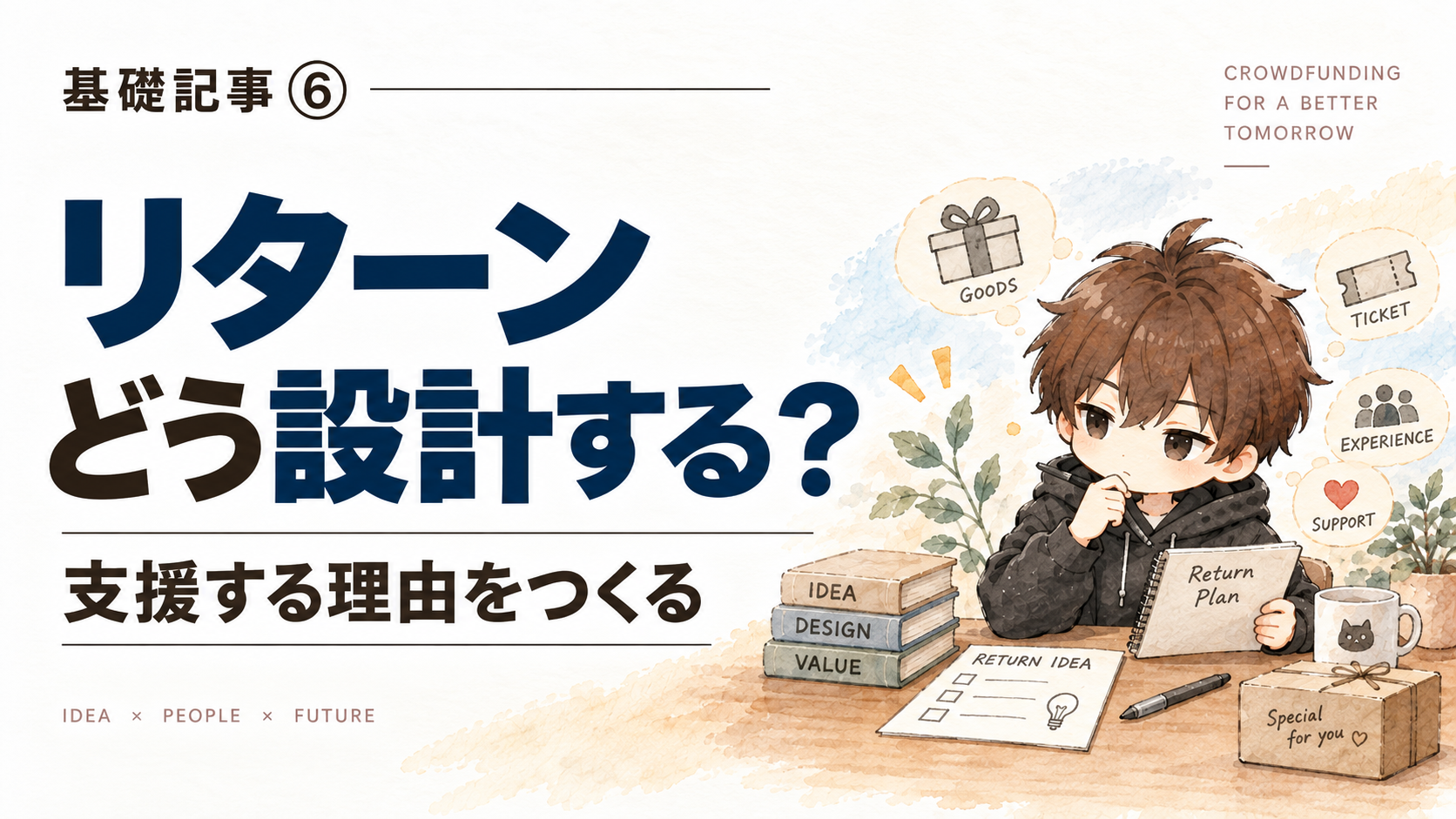
How to Design Crowdfunding Rewards | Thinking About "Returns" That Attract Support
機械翻訳 / Machine-translated
When people start a crowdfunding campaign, I often get the question:
"What should I prepare for rewards?"
Rewards, in purchase-based crowdfunding, are the products, services, or experiences you offer to supporters in exchange for their contributions at various price levels.
That said, I don't think it's a good idea to think of rewards as simply "something to give back."
That's because crowdfunding rewards are:
What gives someone who already wants to support your project a concrete reason to actually do so.
In this article, I'll share the key points I keep in mind when thinking about rewards.
When thinking about rewards, people often start with:
"What can I realistically prepare?"
Of course, they need to be things you can actually deliver.
But if that's your only lens, you end up with a list like:
Merchandise you can make.
Your own products.
A thank-you message.
— essentially a list of "things we can provide."
What I want to think about first is:
Who is going to support this project?
And then:
Why do they want to support it?
Starting from there makes it much easier to design rewards that are genuinely attractive to supporters.
People support crowdfunding campaigns for different reasons.
Some want the product.
Some simply want to cheer you on.
Some want access to exclusive experiences.
Some want to support you as a company.
Some want to be deeply involved in the project.
So you don't have to design rewards based on just one concept.
For example:
Product-based
Finished products, pre-sales, limited sets, etc.
Experience-based
Event attendance, dinners, tours, workshops, etc.
Cheering-based
Thank-you messages, activity reports — things that support the project itself.
Participation-based
Name credits, inclusion in planning meetings, involvement in the production process, etc.
Sponsor-based
Company name/logo placement, event sponsorship, etc.
The combination will vary depending on the project.
What I believe matters most is not just:
"What to sell," but "how to let people participate."
It's best not to concentrate all your rewards at a single price point.
For example:
Someone willing to support at ¥3,000.
Someone who wants the product at ¥10,000.
Someone who wants to join a special experience at ¥30,000.
A company wanting to show support at ¥100,000.
Both the amounts people can give and their reasons for giving differ.
CAMPFIRE statistics show that the average contribution is around ¥10,000, and contributions of ¥10,000 or less account for over 70% of all support. For this reason, the platform officially recommends placing your most attractive, core reward around the ¥10,000 mark.
However, this does not mean:
"Since the average is ¥10,000, set everything around ¥10,000."
What matters is that supporters can choose a way of participating that fits them — from low price points to high ones.
Another common question is: "How many rewards should I prepare?"
CAMPFIRE recommends around 10–20 types, and data shows that projects that raised over ¥2,000,000 had an average of about 12 rewards.
More recent statistics also indicate that projects launching with 10 or more rewards tend to have higher goal-achievement rates.
That said, I believe:
The goal shouldn't be to increase the number for its own sake.
If 20 similar-looking rewards are lined up, supporters will just get confused.
Instead, the more important approach is:
Creating options that match different types of supporters —
"People who want to show casual support."
"People who want the product."
"People who want to get more deeply involved."
"Companies that want to show support."
Even if you prepare multiple rewards, you don't need to expect them all to sell equally.
What I would do is decide:
Which reward do I most want people to support this time?
For example, for a new product:
A pre-sale at a slight discount from the regular price.
For a store:
Vouchers or exclusive experiences redeemable after opening.
For an event:
A bundle of admission tickets and exclusive perks.
And then I'd think through:
"If this reward sells X number of units, how close does that get me to my goal?"
Reward design is directly connected to goal-setting.
I go into detail about how to work backwards to determine your goal amount in How to Set Your Crowdfunding Goal.
Just because contributions under ¥10,000 are common doesn't mean you should only prepare low-priced rewards.
Depending on the project, you might consider rewards at:
¥50,000.
¥100,000.
¥300,000.
Or even higher.
For example:
Corporate sponsorships.
On-site services.
Private events.
Involvement in product development.
Special experiences.
One high-priced reward can be worth the same as collecting dozens of low-priced ones.
However:
Simply making the price high isn't enough.
What matters is that the person contributing that amount feels the value and has a genuine reason to participate.
In crowdfunding campaigns for new products, early-bird rewards like:
"A product normally priced at ¥10,000, available for ¥8,000"
are common.
And yes, that's a clear benefit.
But I think:
You shouldn't make "it's cheap" the sole reason to support.
Instead, think about value that only crowdfunding can offer:
Exclusive to this campaign.
You receive it before anyone else.
You get to be part of the development story.
Access to supporter-only events.
Your name is immortalized.
This way, instead of just:
"I'm buying it because it's cheap,"
the reason becomes:
"I want to support this challenge right now, so I'm in."
One thing you can't afford to overlook when designing rewards is whether you'll have any profit left.
Even for a ¥10,000 reward, there are costs such as:
Cost of goods.
Shipping.
Packaging.
Crowdfunding platform fees.
If you set prices without accounting for these, you might end up in a situation where:
You collected a lot of support, but don't have enough money left to actually execute the project.
CAMPFIRE's official guidance also advises calculating production costs, packaging, shipping, and fees together when setting prices.
Also note that reward prices must be set inclusive of shipping and consumption tax.
Something surprisingly important is asking yourself:
Can you truly deliver everything?
For example:
If you offer "one-on-one consultations for 100 people" — can you actually handle 100 clients?
If you list 50 spots for an exclusive event — can you manage the logistics?
If you sell 500 units of a product — can you manufacture and ship them all by the deadline?
In crowdfunding:
Once someone pledges, it becomes a promise.
"I didn't expect this many people to buy it" simply isn't acceptable.
I also cover reward design and other failure patterns to check before going live in 7 Common Ways Crowdfunding Campaigns Fail.
If there's a limit to how many you can fulfill, set a cap from the beginning.
Note that on CAMPFIRE, once a reward is published, you cannot change its quantity limit — so you need to decide on a realistic number before going live.
A reward name alone isn't enough for supporters to make a decision.
For a product, for example:
Size.
Contents.
Quantity.
Shipping date.
Shipping costs.
How to use it.
For an event:
Date and time.
Location.
Number of participants.
What's included.
The goal is to make it easy for supporters to concretely imagine:
"What will I actually receive after I contribute?"
CAMPFIRE statistics show that projects with reward descriptions of 200 characters or more tend to have higher goal-achievement rates.
That doesn't mean longer is always better.
What matters is writing the necessary information clearly.
To summarize, here are the 5 things I always verify when designing rewards:
① Who is going to support?
Think concretely about your supporters.
② Why will they support?
Consider reasons to support: the product, cheering you on, experiences, participation, etc.
③ What price point makes it easy to support?
Create a range from low to high.
④ Does it connect to the goal amount?
Think about your core reward and how many contributions you need.
⑤ Can you actually deliver it?
Verify costs, shipping, time, and quantity.
These are the five.
In crowdfunding, passion for the project matters.
But passion alone doesn't make someone contribute.
When someone thinks "I want to support this," you need to show them:
"Here's how you can get involved."
That's the role rewards play.
Receiving a product.
Attending an event.
Having your name included.
Becoming a sponsor.
Building something together.
The way people participate differs from person to person.
That's why I think:
Designing rewards means designing how supporters can participate.
How to present those participation methods within the flow of your overall page is explained in detail in How to Create a Crowdfunding Page That Gets Supported.
Rather than just asking:
"What should I give back?"
Try starting with:
"In what ways do I want people to participate in this project?"
・7 Common Ways Crowdfunding Campaigns Fail | Points to Check Before Going Live
If you'd like to consult about crowdfunding, please check my profile page.