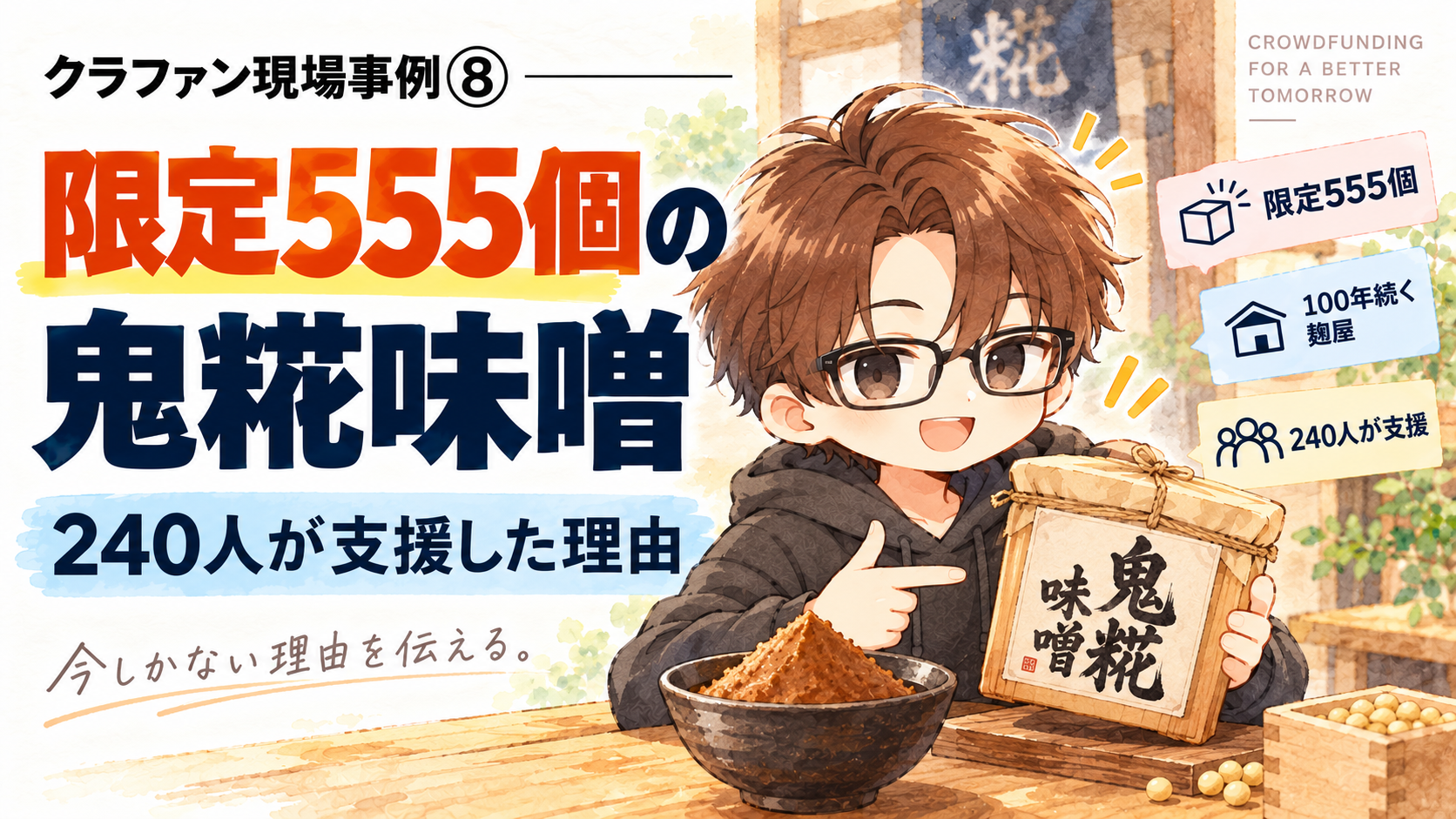
Crowdfunding Case Study ⑧ | Limited to 555 Jars of Oni-Koji Miso. How to Communicate the "Now or Never" That Drew 240 Backers
機械翻訳 / Machine-translated

When selling a product through crowdfunding,
you might think:
"If I make it limited edition, it'll sell."
But I believe that simply making something limited isn't enough.
What really matters is why the product is special — and why backing it right now is meaningful.
In this post, I'd like to introduce a miso project I supported, limited to 555 jars.
This was a crowdfunding campaign for a product called "Oni-Koji Miso," launched on CAMPFIRE in 2025.
The project creator was Azusa Kito, who works to carry koji culture into the future.
Together with Kitahara Koji Shop — a 100-year-old establishment in Nakatsugawa City, Gifu Prefecture — she developed a truly special miso.
It uses approximately 1.5 times the amount of koji compared to standard miso.
The product is also crafted with care for its ingredients: locally grown rice, heirloom soybeans, and natural salt.
And there was one more defining characteristic.
Production was capped at a limited 555 jars.
At the time of the campaign, there were no plans for general retail sales — it was introduced as a product you could only encounter through crowdfunding.
The important thing here is not to let the number steal the spotlight.
Saying "Only 555 available!" might catch some people's attention.
But that alone doesn't convey the product's value.
Why was this miso made?
What ingredients went into it?
Who made it, and with what intention?
This project was driven by the creator's desire to preserve a traditional koji culture that has been fading away.
There were also the farmers, the koji makers — all the people involved in bringing a single jar of miso to life.
Only with that context does it become possible for someone to feel:
"I want to try this for myself."
"I want to support this challenge."
In my view, the word "limited" is not something that creates value — it's one element that helps communicate the value that already exists.
This project offered more than just a single 400g jar. We also prepared sets of 2, 3, and 4 jars.
There were also sets bundled with other koji-based seasonings, as well as rewards aimed at sponsors.
Some people want to enjoy it by themselves.
Some want to share it with family.
Some want to give it as a gift to someone special.
The reasons people are drawn to a product — and the purpose behind their purchase — vary from person to person.
That's why, when designing a product crowdfunding campaign, I always think carefully about offering multiple ways to participate for a single product.
It's not about simply increasing the number of items — it's about thinking through who you want to reach, and in what form.
That's the lens I use when designing reward tiers.
The project went live on May 14, 2025.
The first goal was 1,000,000 yen.
It was reached on May 28 — just 15 days after launch.
The campaign closed on June 30.
The final results:
Total amount raised: 1,847,780 yen
Number of backers: 240
Achievement rate: 184%
I was involved in the planning, goal-setting, reward design, page production, outreach strategy, and post-launch support.
Of course, simply setting the limit at 555 jars wasn't what produced these results.
The appeal of the product itself, the creator's ongoing work, the connections with collaborators, the people who cheered the project on —
It was the combination of many different elements.
When I design a product crowdfunding campaign, I think about more than just the product's strengths. I also ask:
"Why would someone back this product now, through crowdfunding?"
There's the pleasure of waiting for something to be completed.
There's a special experience available only this time.
There's the chance to support the maker's vision and work.
There's the feeling of being part of the process through which this product comes to life.
For Oni-Koji Miso, beyond the rarity of being limited to 555 jars, there was the story of carrying a traditional koji culture forward into the future.
Of course, not every product needs to be limited in quantity.
And I don't think it's right to manufacture a sense of scarcity without genuine grounds.
What matters is finding the real value that truly exists in a product and communicating it in a way that resonates with backers.
Not just selling a product — but creating a reason to be part of this challenge, right now.
That, I believe, is where the true potential of product crowdfunding lies.
The actual project:
【Limited to 555 Jars】 The Legendary Miso "Oni-Koji Miso" | CAMPFIRE
If you'd like to consult about crowdfunding, please visit my profile page.