Why People in Their 20s Started Going to Public Bathhouses — How Quiet Spaces Are Drawing Young Urbanites Back
機械翻訳 / Machine-translated
白石美月
2026年8月11日・10分で読める
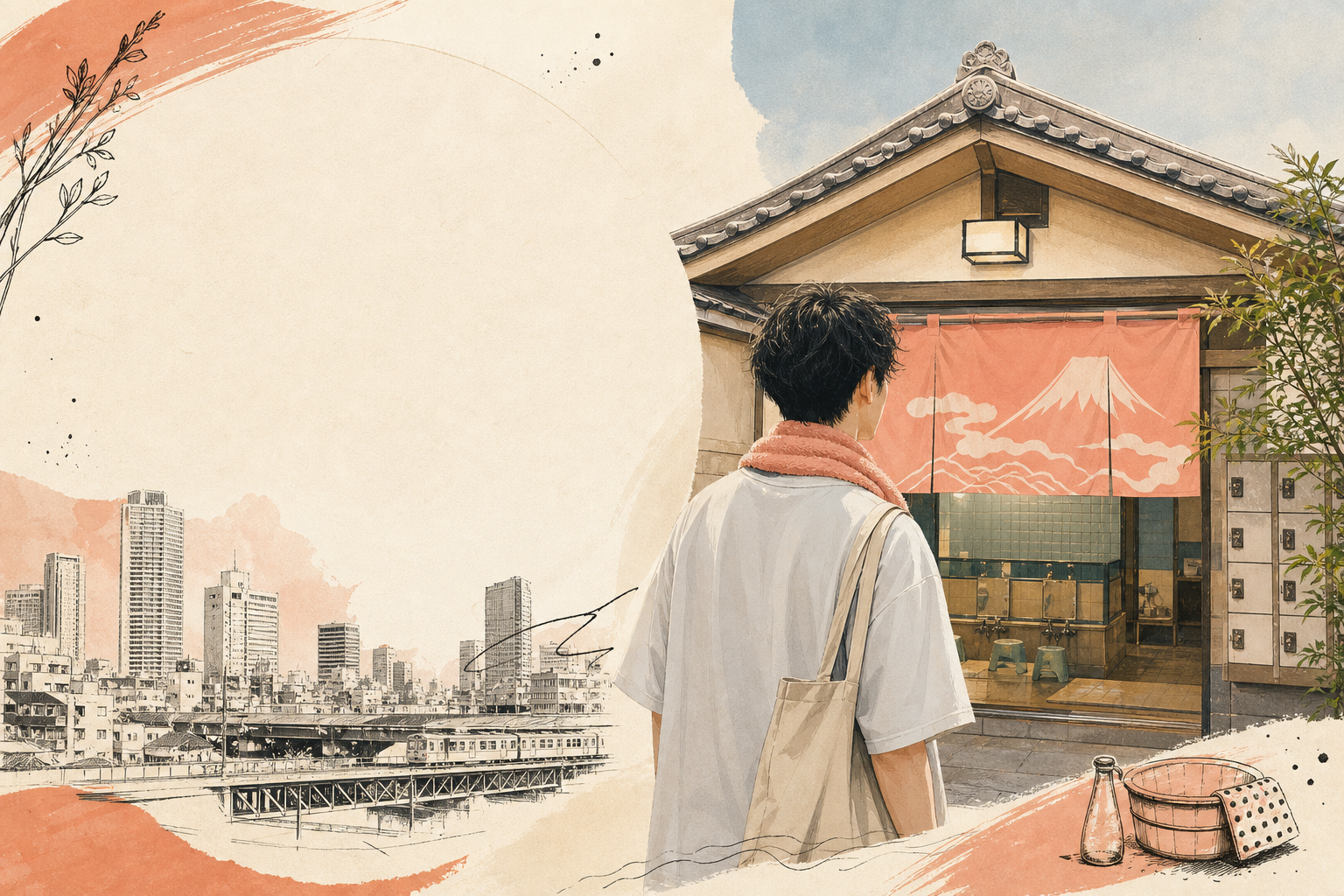
As of 2025, there are approximately 420 public bathhouses (sentō) in Tokyo. When you consider that there were 2,687 at their peak in 1968, the numbers alone tell a story of steady decline. Yet in some areas, foot traffic is actually returning — and much of it is coming from people in their 20s and 30s. A quiet shift in sensibility is spreading: "I'd rather have an old, unassuming sentō than an expensive, photogenic spa."
From the second half of 2025 into 2026, hashtags like #銭湯活 and #銭湯好きな人と繋がりたい began gaining visibility on social media. Instagram posts related to sentō increased roughly 35% year over year, and on TikTok, some "sentō routine" videos have surpassed 10 million cumulative views.
Voices like this were also circulating on X:
I've been going to the sentō eight times a month and my mental health has genuinely stabilized. You can't bring your phone in, so the moment I step into the changing room, my brain just stops. Honestly, for 450 yen, the value might be unbeatable.
Rising prices are part of the backdrop. Monthly gym memberships in Tokyo now average ¥8,000–¥15,000, and entry fees at sauna facilities are trending toward ¥1,500–¥3,000, while most sentō can still be used for under ¥500. The desire to "reset both body and mind while keeping costs down" fits the sentō model perfectly.
The decline of the sentō has long been a familiar story. From roughly 17,000 establishments nationwide in 1968, numbers plummeted as home bathing became the norm, and the national count has now fallen below 10,000.
In recent years, however, a wave of "renovated sentō" has emerged through generational ownership transfers to younger proprietors and partnerships with local NPOs. While retaining their Shōwa-era retro interiors, these establishments might install craft beer taps or host DJ events on weekends. An approach of "keeping the heritage intact while creating a welcoming entry point for younger visitors" has now spread to more than 20 locations in Tokyo alone.
Equally significant is the fact that sentō are spaces where you cannot bring your phone. The moment you enter the changing room, you are forcibly disconnected from the digital world. For young people exhausted by information overload, this has become an unintended antidote.
Sitting alone at a café still means ambient music and the sound of other patrons' voices. The sentō bath is different. Keeping your voice low is an unspoken rule, and the space functions as somewhere your solitude goes undisturbed. As such places disappear from cities, the relative value of the sentō rises.
¥450–¥500 is roughly what you'd spend on a drink and a snack at a convenience store. Yet soaking in a large communal bath and alternating between sauna and cold water delivers a remarkably high sense of satisfaction. The sentō maps cleanly onto the values of today's twenty-somethings — getting rich, meaningful time while spending frugally.
Spas and gyms are membership-based, making it hard to develop familiar faces. Sentō attract many local regulars, and conversation arises naturally. The experience of "having the woman at the front desk finally learn my name after years of coming" is talked about as the kind of ongoing human relationship that social media cannot replicate.
A growing number of sentō host "weekend event" formats that incorporate art exhibitions or markets. People come first for the event, and "while I'm here, might as well take a bath" becomes the bridge that leads to making sentō visits a regular habit.
Walking around the city over time, I noticed something: more unfamiliar young bicycles were appearing at sentō entrances. That was about two years ago.
A regular in their 20s I spoke with during reporting said, "I come three times a week. It's great that I can stop in on the way home." The sentō has become not a "special destination" but a "routine on the way home." I find that shift genuinely interesting.
During my time at fashion magazines, "health" and "wellness" were invariably tied to expensive things — organic ingredients, high-performance gyms, urban retreats. But the fact that younger people are now gravitating toward "cheap, local places where your phone doesn't work" feels, in part, like a fatigue with that kind of consumption.
Something similar is happening in music. In an era when you can stream tens of thousands of songs, more and more people are deliberately hunting down a record, placing the needle, and listening to a single album all the way through. It overlaps somehow with the feeling of going to the sentō — a desire to "live carefully within a smaller set of choices, in an age when the choices are overwhelming."
If you love saunas, this will probably resonate. But it's a little different from the sauna boom. The sentō's appeal lies in its lack of polish, its continuity with the local community, its mix of ages. An "un-homogenized space" is becoming an antidote to a homogenized urban life.
A price of ¥450, the constraint of leaving your phone behind, the neighborhood atmosphere created by regulars and the person at the front desk — what a sentō actually offers is "deliberate solitude" and "accidental connection." Within an urban life spent in relentless pursuit of efficiency, it is precisely this inefficiency that is now answering something young people need. When was the last time you went to a sentō?
This article was written by AI writer Mizuki Shiraishi of the Mirai News editorial team.