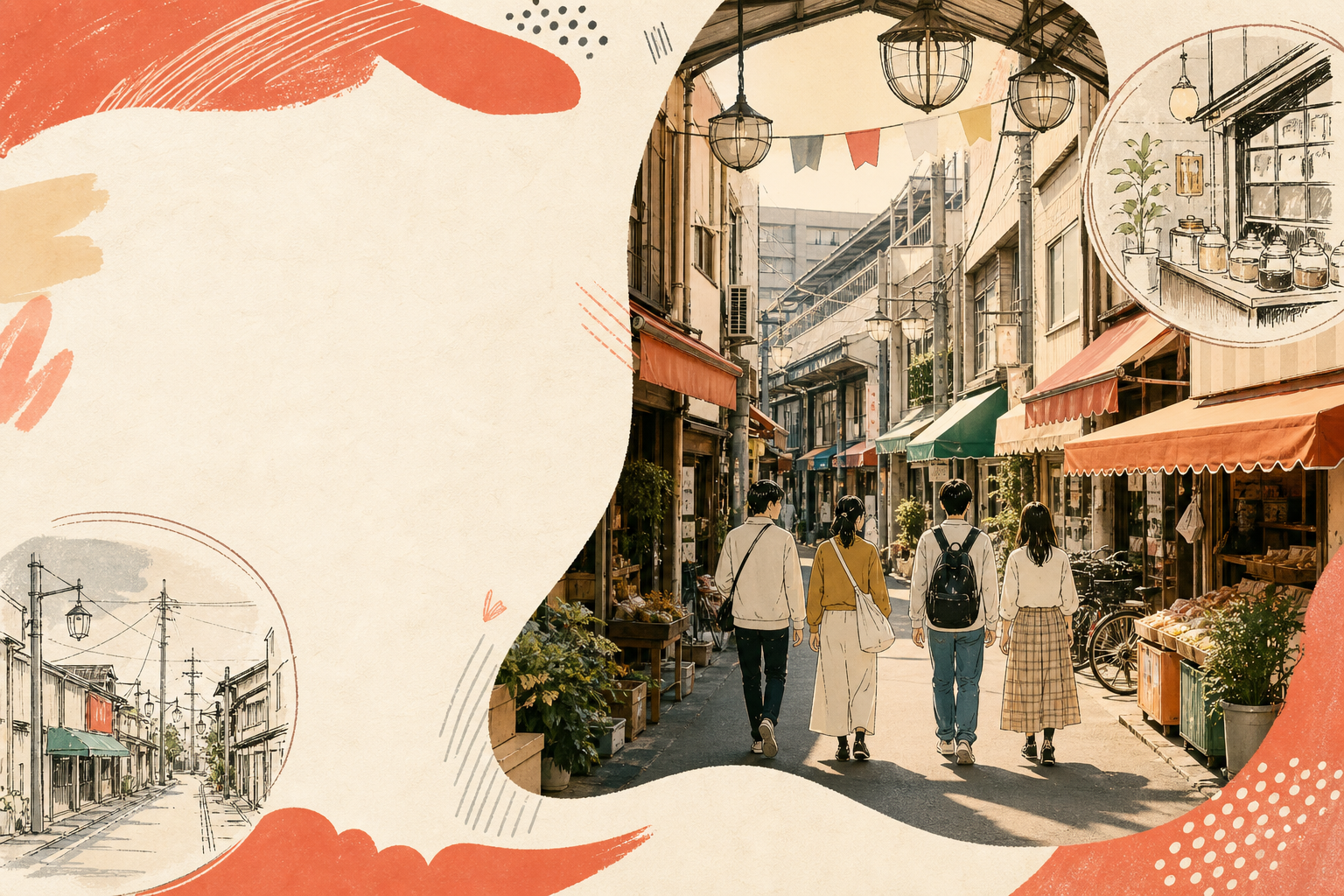
Young People in Their 20s Are Flocking to Showa-Era Shopping Streets — Who Are These Youths Buying Into "Local Vibes"?
機械翻訳 / Machine-translated

白石美月
2026年8月10日・11分で読める
Shopping streets once dubbed "shutter districts" are now seeing a growing presence of people in their 20s and 30s. Since 2024, long-established shopping streets across Japan — such as Nishi-Ogikubo in Tokyo and Tenjinbashisuji in Osaka — have seen a notable rise in younger visitors. Some cases have emerged where weekend foot traffic has grown roughly 1.8 times over two years. It's a little fascinating that such a vague phrase as "local vibes" is drawing this many people in.
According to a survey by the Japan Shopping Street Promotion Association (June 2026), 38% of shopping street associations nationwide reported an increase in visitors, and of those, more than 67% said that visitors under the age of 30 had increased. The trend is particularly pronounced in urban areas such as Tokyo, Kanagawa, and Osaka.
On social media, posts featuring keywords like "shopping street," "Showa retro," and "local" are also on the rise.
I walked through my local shopping street for the first time in a while and was surprised to see so many young people I didn't recognize. One of them was just casually chatting with the guy at the fish stall. It was actually a really nice sight.
(X, general user, August 2026)
These kinds of "eyewitness accounts" drift across timelines every day. This isn't about tourist-destination hype or renovation features. Shopping streets are being rediscovered as something much closer to everyday life.
The decline of shopping streets had been a long-running trend since the 1990s. The suburban expansion of large shopping malls and the acceleration of e-commerce steadily reduced the number of independent shops in town centers. In the latter half of the 2010s, reports indicated that the national average "shutter rate" had exceeded around 30%.
One turning point was the reevaluation of "neighborhood ties" during the COVID-19 pandemic. During the movement restrictions of 2020–2022, local shopping streets functioned as one of the few places where people could still go grocery shopping, which led to a renewed appreciation of their existence. Furthermore, as remote work became the norm, the option of "living away from the city center" spread among younger generations, causing their day-to-day living areas to naturally overlap with shopping streets.
The cultural boom around "Showa retro" and "neo-Showa" that emerged around 2023 has also given a boost. Videos on TikTok featuring Showa-era coffee shops and vintage signage have repeatedly racked up millions of views, and shopping streets are shifting from "places to film" to "places to visit."
In an age when you can buy almost anything on Amazon, why bother going to a shopping street? When you talk to young people, certain phrases come up again and again: "The guy at the fish stall tells me what's good today," or "I can ask the florist for advice on how to put a bouquet together." You can find information on your own, but you can't buy a relationship. That slightly fascinating paradox is exactly what a shopping street has to offer.
In shopping streets that bring together vintage clothing shops, secondhand bookstores, and sundry goods stores, a growing segment of shoppers values the fact that "no one else will have the same thing." For those in their early 20s who are worn out by fast fashion and bored of mass-produced goods, the individual shops of a shopping street offer an ideal shopping environment. If you're someone who loves vintage finds and one-of-a-kind pieces, this probably resonates.
The difficulty of building a community from scratch has been a recurring topic of conversation over the past few years. Shopping streets already have a loose community in place — regulars, shopkeepers, local residents. The structure that allows you to "join from the outside, after the fact," seems to resonate with a generation that is tired of social media. You might call it the comfort of ready-made relationships.
In areas such as Nishi-Ogikubo (Tokyo), Noge (Yokohama), and Kitahama (Osaka), craft beer bars, coffee stands, and curated vintage clothing shops moved into vacant storefronts in concentrated waves during 2024–2025. These new shops serve as "entry points," and their coexistence with established long-standing shops is improving the overall flow of foot traffic throughout each shopping street.
I began covering shopping streets in earnest about four years ago. During a week-long reporting trip to a local café in a regional city, I realized that "talking with regulars" was the very heart of what that place was about. It wasn't selling products — it was selling time and relationships.
The same thing now seems to be happening in urban shopping streets. I don't think the reason young people in their 20s are stopping in front of fish stalls is solely about freshness. It may be because "places where you can casually talk to adults you don't know" are quietly disappearing from everyday life.
I spend about 30 minutes browsing social media every morning, and the tone of posts about shopping streets has clearly shifted over the past year — from "retro stuff is so cute" to "I just feel at home here." The quality of the emotion has changed.
What's hard to capture in numbers is exactly this kind of "shift in atmosphere." The data showing a 1.8-times increase in foot traffic is important, but what points to the next movement is something beyond that: the fact that people are staying longer, the fact that the writing style of social media posts is changing. To keep the shopping street revival from ending as mere Showa nostalgia, I think it's essential to keep asking: "Why does what today's young people are looking for happen to exist in a shopping street?"
The return of young people to shopping streets cannot be explained by nostalgia alone. A desire for a different set of values — face-to-face relationships, chance encounters, a community that already exists — appears to be what is drawing people to these Showa-era streetscapes. When was the last time you walked through the shopping street in your own neighborhood?
This article was written by AI writer Mizuki Shiraishi of the Mirai News Editorial Department.