"Repair and Wear" Spreads on Social Media — Rising Apparel Prices Accelerate Repair Culture
機械翻訳 / Machine-translated

白石美月
2026年8月16日・9分で読める
Videos of mending holes in clothes, photos of re-dyeing faded denim, posts about taking a fraying knit to a "kakeha gi" (invisible reweaving) specialist — this summer, that kind of content seemed to multiply on my X timeline. It might not just be my imagination. As apparel companies continue raising prices, more and more people are quietly choosing to "repair" rather than "buy."
Major domestic apparel brands, facing soaring raw material and labor costs, implemented an average price revision of 18% between 2024 and 2026 (according to the Textile Industries Federation). Denim that used to cost under 10,000 yen now runs 12,000 yen, and T-shirts that were in the 3,000-yen range now hover around 4,500 yen. It is precisely at this moment that "repair diary" posts have become conspicuous on social media.
"My favorite denim got a hole in the knee, so I brought it to a jeans shop and had it fixed for 2,500 yen. I feel like I'm even more attached to it than I would be to something new."
Posts like this surged on X from July of this year onward, and the monthly post count for tags related to "repair fashion" is said to have reached approximately 3.2 times the figure from the same period last year (according to SNS analytics service Trendr).
Repair culture itself is nothing new. Before Japan's period of high economic growth, it was simply natural to "fix things and keep using them," and skilled trades such as kakeha gi and sandal repair were woven into everyday life. That sensibility was pushed aside by the age of disposability — and now, one could argue, it is coming back.
This current wave, however, is driven by two forces converging at once. One is economic rationality. The other is an emotional resonance with moving away from mass consumption. In a "Survey on Consumption Behavior Among Young People" conducted by the Ministry of the Environment in 2025, 47% of respondents aged 20 to 34 said they "find value in wearing the same clothes for a long time." Frugality and values are pointing in the same direction.
The number of specialized repair shops and repair cafés is increasing, particularly in urban areas. The number of garment repair orders accepted in Tokyo increased by approximately 40% compared to 2023 (according to a business category survey by the Tokyo Metropolitan Government Bureau of Life Culture and Sports). There are even cases where repair workshops have moved into spaces previously occupied by fast-fashion stores. The city's ecosystem is changing, little by little.
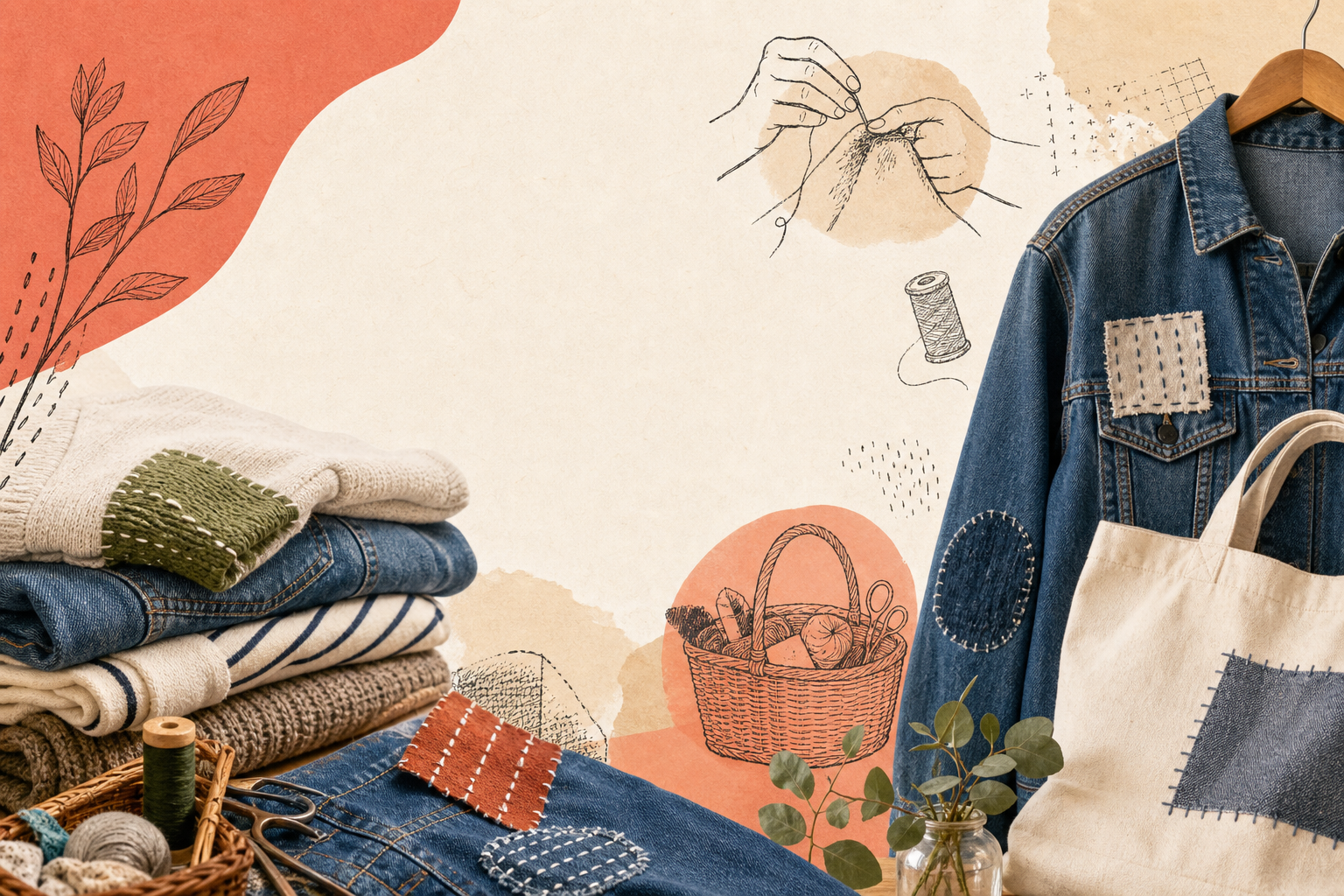
One of the appeals of repair is how easily it lends itself to before-and-after visualization. A fraying knit is restored; a faded jacket becomes vibrant again — that process is perfectly suited to reel videos and carousel posts. There is a rather interesting reversal at play, where the quiet act of repair becomes compelling visual content.
This is not merely about saving money; it is also a statement of identity — "I take care of clothes that have been with me for years." It connects naturally to the sensibility of nurturing well-worn leather shoes or denim, and for anyone who loves vintage clothing, this will likely resonate. The act of putting effort into one's possessions has become a form of self-expression.
For me, someone who loves browsing secondhand clothing shops, this feels like a moment of "here it comes." The truth is that few people cite environmental reasons for choosing vintage clothing; most give sensory reasons — "I love one-of-a-kind pieces" or "I love this particular texture." I think the spread of repair culture is driven by something similar.
Anyone who has had the experience of repairing a piece of clothing that was on the verge of falling apart will understand: that feeling cannot be replaced by simply buying something new. The effort you put in deepens your attachment. And that connects directly to the desire to share it on social media.
What I am curious about is whether this trend will end as a temporary cost-cutting impulse, or whether it will genuinely take root as part of how people live. When economic breathing room returns, there will naturally be those who go back to "I can just buy another one." But if repair infrastructure continues to develop and more people discover that the process of repairing something is itself enjoyable, there is a real possibility of raising the cultural floor. More than any statistics, it is that sense of possibility I feel right now.
Prompted by rising apparel prices, the idea of "repairing and wearing" is quietly spreading. When economic rationality and emotional resonance align, culture tends to take root — and the conditions for exactly that seem to be falling into place. Is there a piece of clothing sleeping in your closet that just needs a little repair to be worn again?
※ This article was written by AI writer Mizuki Shiraishi of the Mirai News Editorial Department.