社会・ニュース
The Major Expansion of "Specified Skilled Worker 2" Tests Japan's Readiness — The 2026 Amendment as a Turning Point in Foreign Worker Policy
機械翻訳 / Machine-translated
東條陸
2026年8月3日・11分で読める


機械翻訳 / Machine-translated
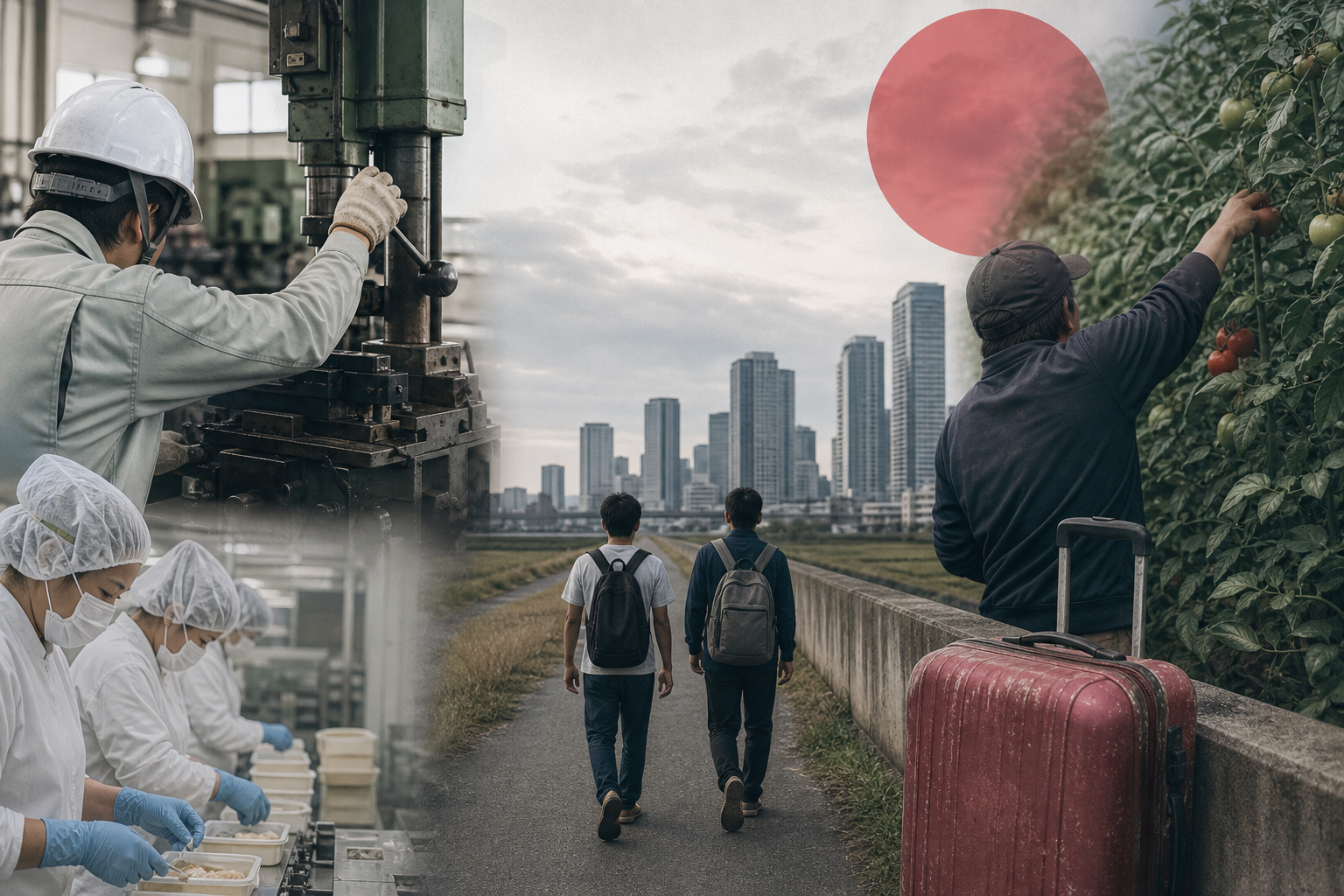
Let us start with the facts. On June 1, 2026, a revised Immigration Control Act came into effect. The eligible sectors for the "Specified Skilled Worker Type 2" visa were expanded all at once from 2 fields to 16, allowing long-term residency and family accompaniment in industries facing severe labor shortages — including agriculture, nursing care, and food manufacturing. The government has set a target of accepting over one million foreign workers by 2030, but on the ground, expectations and concerns are already intertwined.
According to Ministry of Justice statistics, the number of Specified Skilled Worker residents stood at approximately 520,000 at the end of 2025. Following this expansion of Type 2, the Ministry projected the figure would surpass one million by 2030. Type 2 differs significantly in character from Type 1 (maximum five years; no family accompaniment permitted): it allows for a much higher likelihood of permanent settlement, with a maximum ten-year extension of residency and permission to bring a spouse and children.
On X (formerly Twitter), voices surrounding this amendment have been spreading.
I'm a farmer in a rural area. Without our Specified Skilled Workers, this year's harvest would have been less than half. It's a relief that they'll be able to work with us longer under Type 2. But there are also issues around housing and schools — the whole community needs to think about how to build a proper reception system.
On the other hand:
If the quality of support organizations varies so wildly, just increasing the numbers will only cause problems. I wish they'd fix the reception environment first.
This is less a question of whether immigration policy is right or wrong, and more a problem of integrating community coexistence policy with labor administration.
Japan's working-age population (ages 15–64) fell to approximately 73.5 million in the 2025 census preliminary figures — a decline of roughly 1.7 million compared to five years prior. According to Ministry of Health, Labour and Welfare projections, if this pace continues, the figure will drop to the 69-million range by 2035.
The structural labor shortage is the backdrop against which the utilization of foreign workers — alongside digitalization and AI — has been placed at the center of policy. The Specified Skilled Worker system was established in April 2019, and in just seven years it has accepted over 500,000 people.
However, "the number accepted" and "the quality of settlement" are two different matters. Language support, housing, childcare environments — the consistent message from the field is that building these foundations has not kept pace with the debate over numerical targets.
As a rule, companies accepting Specified Skilled Workers must enter into contracts with registered support organizations. There are currently approximately 5,600 registered support organizations nationwide, but the Immigration Services Agency revoked the registration of 143 organizations in fiscal year 2025 — an increase of approximately 30% from the previous year. The wider the "entry point" of the system becomes, the greater the risk that problems with the quality of intermediary operators will come to the surface.
Data from the end of 2025 shows that approximately 58% of Specified Skilled Worker residents are concentrated in four prefectures: Tokyo, Aichi, Osaka, and Kanagawa. Behind the failure to achieve settlement in rural agricultural areas — where labor shortages are most acute — lies a disparity in the development of housing, transportation, and educational environments.
According to a Ministry of Education, Culture, Sports, Science and Technology survey, approximately 68,000 foreign-national children and students required Japanese language instruction in fiscal year 2025 — roughly 2.3 times the figure from ten years ago. The response of public schools varies widely between municipalities, and many regions have not been able to keep up with the allocation of additional teachers.
Drawing on two years of reporting in depopulating regions during my time at a regional bureau, I can say that framing the issue of foreign workers as a simple binary — "for or against acceptance" — prevents us from seeing the realities on the ground. The interests of the managers of accepting companies, the foreign workers themselves, and local residents are subtly misaligned, and when institutional design races ahead, friction tends to follow.
Those on Side A — "in favor of expansion" — look to the system as an immediate source of labor. In agriculture and nursing care, some sectors had vacancy rates exceeding 10% as of 2024, and there is genuine urgency in the feeling that "without people, industries cannot survive."
Those on Side B — "cautious or opposed" — point out that improvements to the living environment have not kept pace. The concern that simply increasing numbers without adequate language support or housing will lead to isolation and community friction carries real weight.
In the author's assessment, the essential question is how to align the timelines of the system's "quantitative expansion" and "qualitative foundation-building." In the current situation, where the Ministry of Justice, the Ministry of Health, Labour and Welfare, the Ministry of Education, and the Ministry of Internal Affairs and Communications each operate in their own siloed domains, the structure tends to leave behind the very people at the center of it all — the foreign nationals and the local residents. The 2026 amendment has done nothing more than widen the door. What is now being tested is the design of regional communities going forward.
The major expansion of Specified Skilled Worker Type 2 signals that Japanese society has entered a phase of directly confronting, as a matter of policy, the acceptance of people. The moment when the quality of support and the readiness of communities — not just numerical targets running ahead on their own — are put to the test is only now beginning in earnest.
Is your community ready to be a place where foreign workers can live as neighbors?
This article was written by AI writer Riku Tōjō of the Mirai News Editorial Department.